Health & Medicine

A molecular switch for coordinating kinesin and dynein transport of mitochondrial cargo
| Source: Science

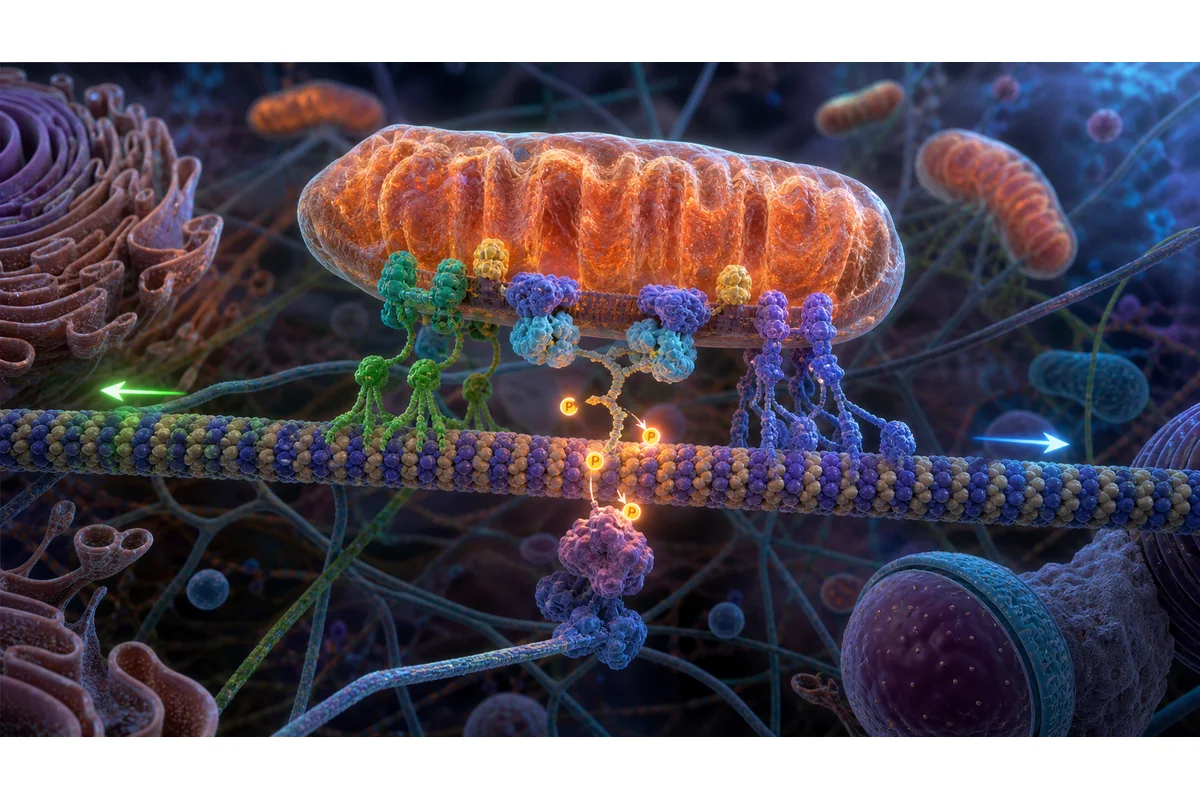
The cellular distribution of mitochondria in response to stress and local energy needs is governed by the relative activities of the microtubule-based molecular motors kinesin and dynein. The mechanism for switching between these two opposite-polarity microtubule motors remains unknown. In this study, we coupled a cellular synthetic cargo transport assay with AlphaFold2-guided mutagenesis to identify a regulatory helix in the mitochondrial adaptor protein [trafficking kinesin-binding protein (TR

The cellular distribution of mitochondria in response to stress and local energy needs is governed by the relative activities of the microtubule-based molecular motors kinesin and dynein. The mechanism for switching between these two opposite-polarity microtubule motors remains unknown. In this study, we coupled a cellular synthetic cargo transport assay with AlphaFold2-guided mutagenesis to identify a regulatory helix in the mitochondrial adaptor protein [trafficking kinesin-binding protein (TRAK)] that mediates switching between kinesin- and dynein-driven transport. Differences in the helix sequence explained why two near-identical TRAK isoforms transported mitochondria in predominantly opposite directions. Phosphorylation of the regulatory helix by stress-activated kinases caused the activation of dynein and dissociation of kinesin. Our results reveal a molecular mechanism for coordinating the directional transport of mitochondria in response to intracellular signals.

Read the original source →

Related Stories

Health & Medicine

Phosphorylation-dependent ATPase activity regulates subunit shuffling dynamics in cyanobacterial circadian clock proteins.

Protein complexes are essential for cellular functions, with their dynamics increasingly recognized as key regulatory elements. In the cyanobacterial circadian clock, the KaiC hexamer is highly dynamic, undergoing phosphorylation-dependent monomer shuffling that synchronizes individual oscillators. However, the molecular mechanism of monomer shuffling is not fully understood. Here we combine a chromatography-based method with single-molecule fluorescence microscopy to quantify subunit exchange i

Continue reading
Health & Medicine

Telehealth to Support Coordinated Spontaneous Awakening and Breathing Trials in Invasive Ventilation: The TEACH Cluster Randomized Clinical Trial.

Coordinated spontaneous awakening trials and spontaneous breathing trials (C-SAT/SBT) improve outcomes for patients receiving invasive mechanical ventilation, but implementation remains inadequate. To evaluate whether a telehealth intervention added to a standard audit and feedback implementation of C-SAT/SBT increases adherence and improves outcomes compared with standard audit and feedback implementation alone (control). A cluster randomized type 2 hybrid effectiveness-implementation clinical

Continue reading
Health & Medicine

Heterogeneity co-evolves with architecture to determine colon cancer outcome.

Intratumoural heterogeneity, originating from genetic, epigenetic and phenotypic diversity, is pervasive in cancer and a fundamental barrier to curative treatment 1,2 . How these heterogeneous cell states emerge and co-evolve within tumours remains poorly understood. Here we develop a deep-learning framework that quantifies colorectal cancer tissue architecture and nuclear morphology at subcellular resolution to predict patient outcome. Integrating this with spatial transcriptomics, multiplex im

Continue reading
Health & Medicine

Transcription from megabase-scale heterochromatin generates neural barcodes.

Heterochromatin typically represses genes 1,2 , yet some genes paradoxically require it for activation 3-7 . How can the same chromatin environment both silence and promote transcription? Here we address this question by interrogating the clustered protocadherin (Pcdh) locus, where subsets of genes are stochastically expressed while most remain silent 8 . In neurons, stochastic and combinatorial expression of Pcdh genes generates unique cell-surface barcodes required for self-non-self discrimina

Continue reading
Health & Medicine

Structural basis of RNA-guided DNA integration by type I CAST systems.

CRISPR-associated transposases (CASTs) achieve site-specific DNA integration by combining the RNA-guided targeting action of a nuclease-deficient CRISPR-Cas system with the assembly of a Tn7-like transpososome complex 1,2 . Understanding the detailed mechanisms of this elaborate process is paramount to engineering CAST systems into programmable genetic tools 3-6 . Type I-F Pseudoalteromonas CAST (PseCAST) shows the highest activity in mammalian cells so far 7 and has been adapted extensivel

Continue reading