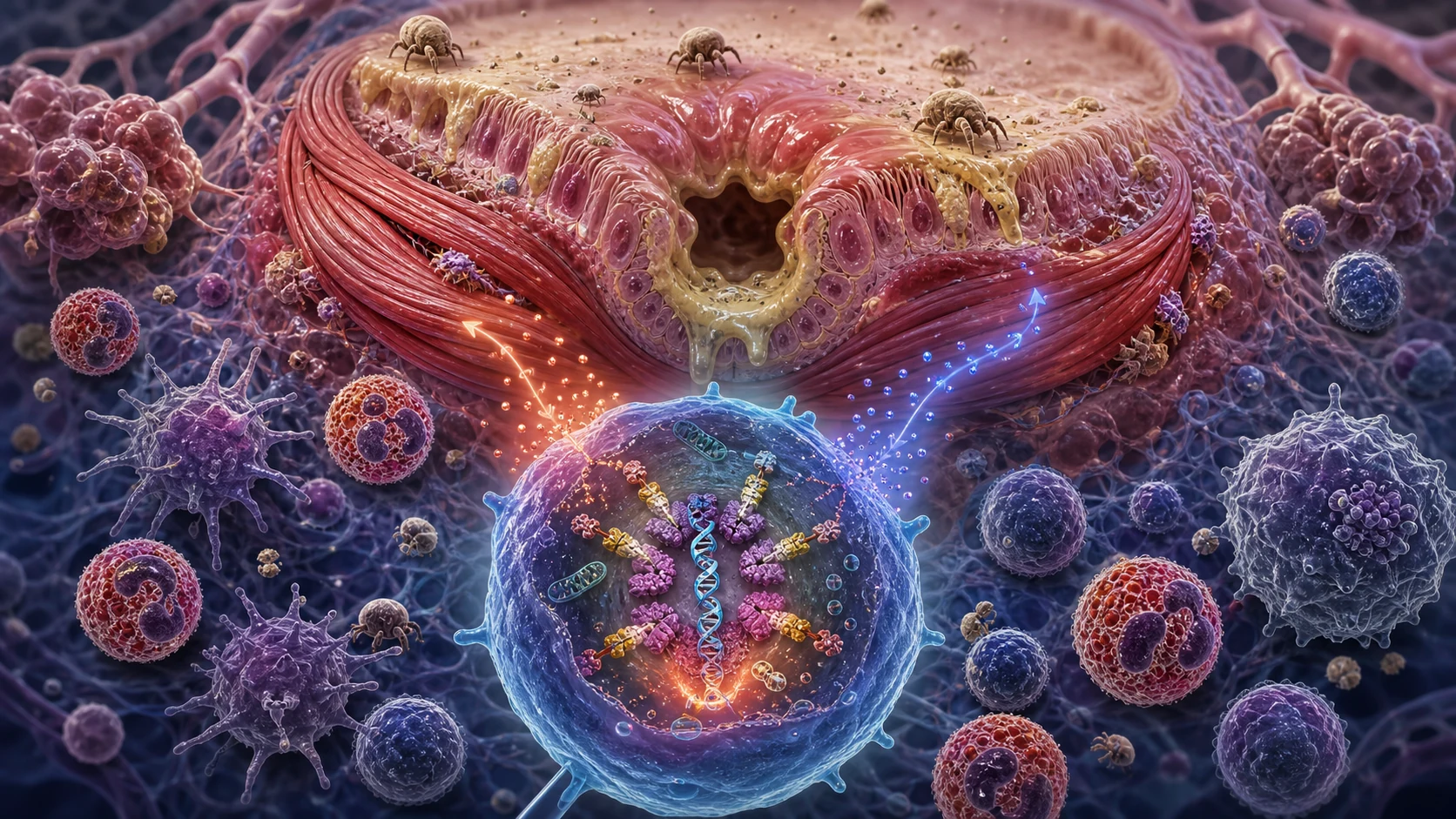
T cell-intrinsic AIM2 exacerbates lung inflammation in OVA-LPS- and HDM-induced asthma models.
Asthma is a heterogeneous inflammatory airway disease characterized by immune dysregulation, airway hyperresponsiveness (AHR), and excessive immune activation. Although NLRP3 (NOD-like receptor family pyrin domain-containing 3) has been extensively studied in asthma, its role remains controversial, and the contribution of DNA sensor AIM2 (Absent in Melanoma 2) is less well defined. To assess AIM2's relevance in asthma, we analyzed public human datasets and found increased AIM2 , but not NLRP3 ,
Asthma is a heterogeneous inflammatory airway disease characterized by immune dysregulation, airway hyperresponsiveness (AHR), and excessive immune activation. Although NLRP3 (NOD-like receptor family pyrin domain-containing 3) has been extensively studied in asthma, its role remains controversial, and the contribution of DNA sensor AIM2 (Absent in Melanoma 2) is less well defined. To assess AIM2's relevance in asthma, we analyzed public human datasets and found increased AIM2 , but not NLRP3 , expression in severe asthma and in neutrophilic compared with paucigranulocytic asthma. In allergic asthma models induced by ovalbumin (OVA)-lipopolysaccharide (LPS) or house dust mite (HDM), AIM2 expression was increased in lung homogenates and bronchoalveolar lavage fluid cells. Analysis of a published single-cell RNA-seq dataset from the HDM model further showed increased Aim2 , but not Nlrp3 , expression in T helper cells, with most Aim2 -expressing cells coexpressing Gata3 . In the OVA-LPS model, whole-body Aim2 deficiency reduced AHR, inflammatory cytokine production, airway smooth muscle actin, and γH2A.X, consistent with decreased airway remodeling and tissue stress. Unexpectedly, CD4-specific, but not Treg- or myeloid-specific, Aim2 deletion significantly attenuated disease, identifying AIM2 in CD4 + T cells as a major driver of pathogenesis. In the HDM model, Aim2 deficiency similarly reduced AHR. Cell-specific deletion showed that AIM2 in CD4 + T cells promotes AHR and cytokine production, whereas AIM2 in myeloid cells modulates IgG1, IL-13-producing CD4 + T cells, and alveolar macrophages. These findings identify AIM2 as a regulator of allergic asthma acting predominantly through T cells, with an additional context-dependent contribution from myeloid cells.