Dysregulation of mechanosensing signaling in monocytes of patients with systemic sclerosis is associated with skin inflammation.
Systemic sclerosis (SSc) is a severe autoimmune connective tissue disease characterized by immune dysregulation and progressive fibrosis of the skin and internal organs, resulting in substantial organ dysfunction and increased mortality. Fibrosis is driven in part by infiltration of immune cells, including monocytes that become activated within fibrotic tissue. However, how the mechanical properties of fibrotic skin regulate their function remains poorly understood. Here, we demonstrate that inc
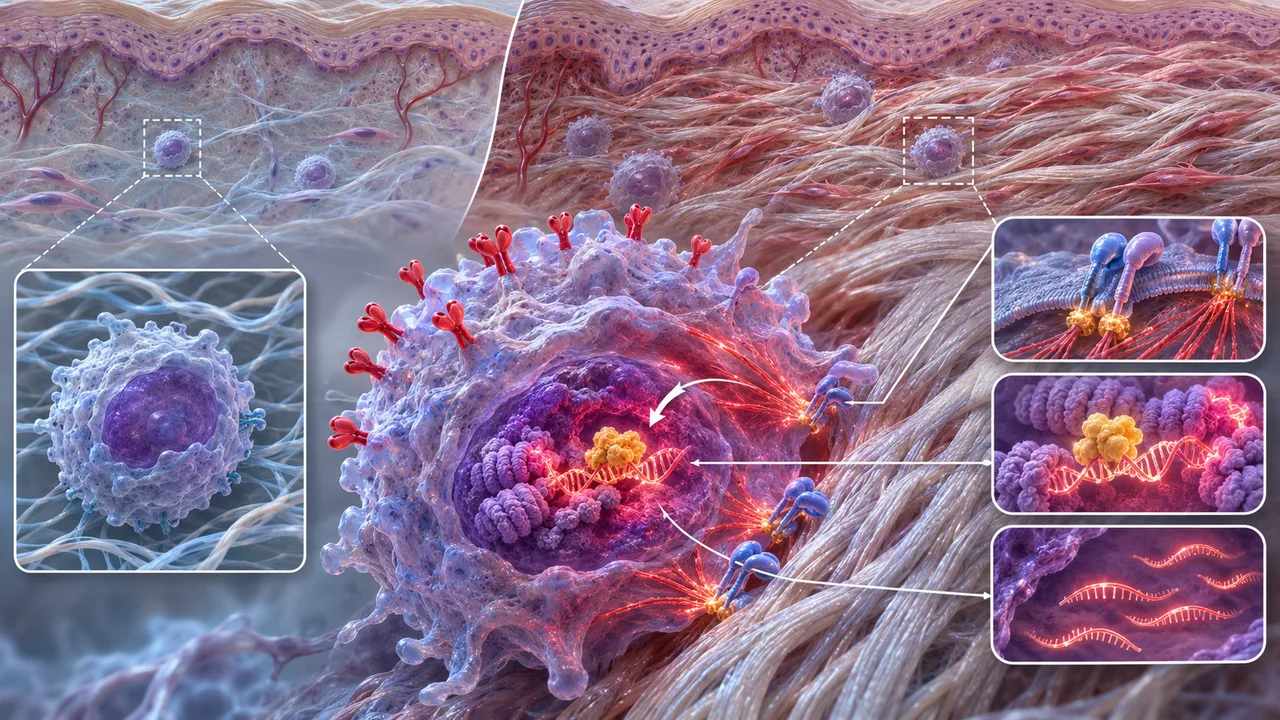
Systemic sclerosis (SSc) is a severe autoimmune connective tissue disease characterized by immune dysregulation and progressive fibrosis of the skin and internal organs, resulting in substantial organ dysfunction and increased mortality. Fibrosis is driven in part by infiltration of immune cells, including monocytes that become activated within fibrotic tissue. However, how the mechanical properties of fibrotic skin regulate their function remains poorly understood. Here, we demonstrate that increased stiffness activates human monocytes through mechanosensing. Reanalysis of single cell RNA sequencing datasets revealed that skin infiltrating monocytes exhibit heightened inflammatory signatures as compared to circulating counterparts, with further amplification in SSc. Using collagen-coated hydrogels modeling physiological and fibrotic stiffness, we show that increased stiffness enhances CD86 expression, and broadly upregulates inflammatory transcriptional programs in human monocytes. Mechanistically, stiffness-driven activation was associated with chromatin remodeling and epigenetic reprogramming, identifying the transcription factor Specificity Protein 1 (SP1) as a central regulator. CRISPR-Cas9-mediated disruption or pharmacologic inhibition of SP1 significantly attenuated stiffness- induced inflammatory gene expression, whereas we found no evidence for involvement of the canonical YAP/TAZ-TEAD axis, and pharmacological modulation of PIEZO1 neither reproduced nor blocked the response. Further, monocytes from patients with SSc displayed altered transcriptional trajectories and an exaggerated inflammatory response to high stiffness, accompanied by reduced expression of wound healing and antifibrotic programs. Together, these findings identify SP1-dependent mechanosensing as a previously unrecognized pathway controlling human monocyte activation in the skin and provide mechanistic insight into how tissue stiffness sustains inflammation in SSc.