Physical/Tech

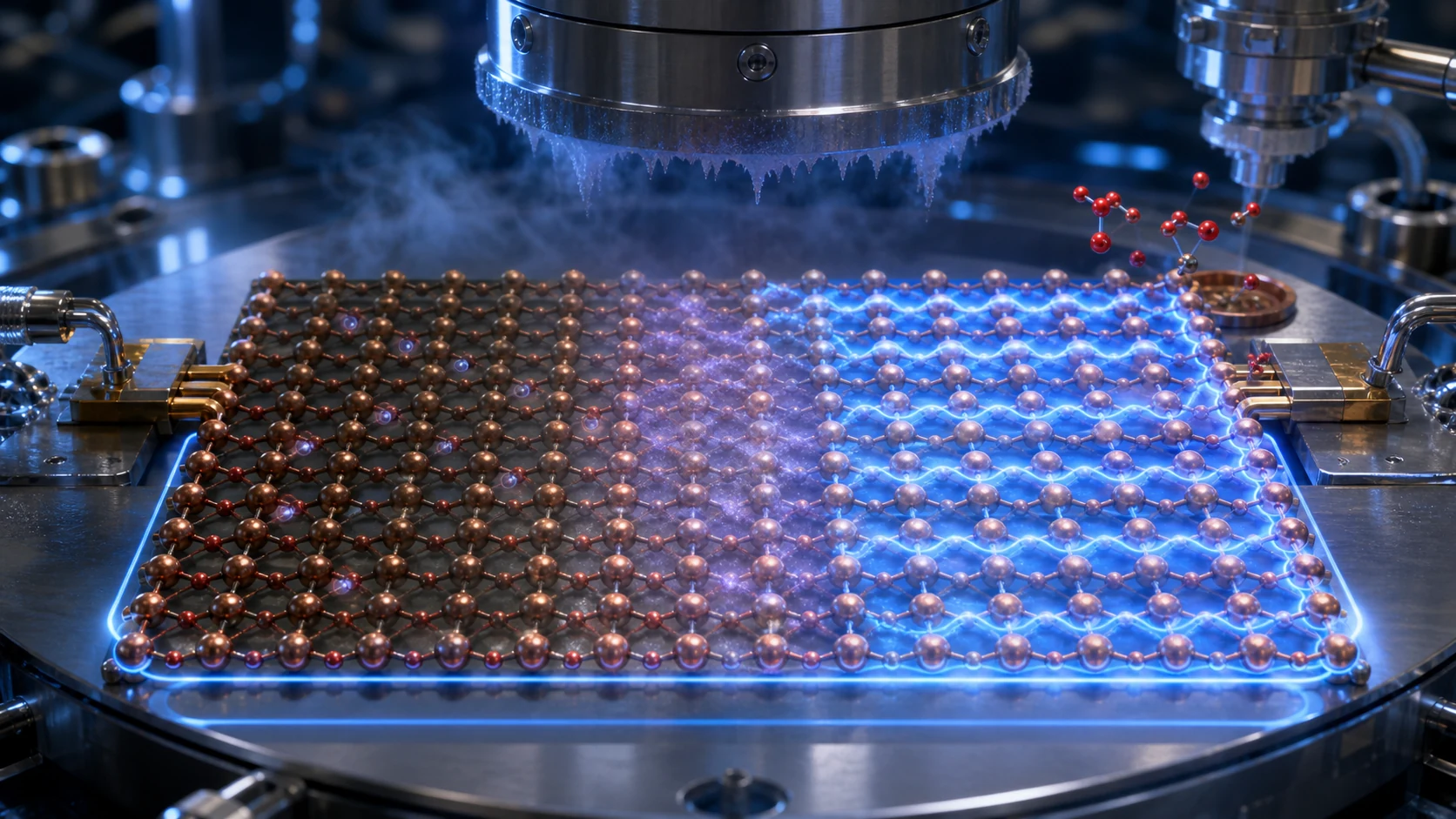
Superconducting 2D cuprate with a single CuO 2 plane.
| Source: Nature

Atomically thin van der Waals crystals epitomize ideal material systems in the two-dimensional (2D) limit. This reduction in dimensionality often leads to important consequences, best exemplified by the emergence of new physics in graphene and other 2D materials that can be readily tuned by gating 1,2 . Vast opportunities arise in extending this top-down approach to other material systems. Recent experiments have demonstrated that the essential physics of high-temperature superconductivity in cu

Atomically thin van der Waals crystals epitomize ideal material systems in the two-dimensional (2D) limit. This reduction in dimensionality often leads to important consequences, best exemplified by the emergence of new physics in graphene and other 2D materials that can be readily tuned by gating 1,2 . Vast opportunities arise in extending this top-down approach to other material systems. Recent experiments have demonstrated that the essential physics of high-temperature superconductivity in cuprates is contained within just two CuO 2 planes 3 . Here we push dimensionality reduction to the extreme by examining a single layer of Bi 2 Sr 2 CuO 6+δ (Bi-2201), which comprises only one CuO 2 plane. In this ultimate 2D limit, we observe a robust dimensionality effect that manifests as an approximately 10% reduction in the optimal superconducting transition temperature. Moreover, this reduction in dimensionality offers unprecedented tunability-we successfully extended the phase diagram of Bi-2201 into uncharted territories via finely controlled oxygenation of single-monolayer specimens. Leveraging this tunability, we discovered that an anomalous metal state emerges between the insulating and superconducting states as the temperature approaches zero. Concurrently, we observe an anomalous scaling behaviour characterized by a divergent critical exponent. These findings illuminate the nature of the superconductor-to-insulator quantum phase transition in cuprates.


Read the original source →

Related Topics

Related Stories

Physical/Tech

Indirect reciprocity with dual private assessment.

People often cooperate out of concern for their reputation. The corresponding theory of indirect reciprocity predicts that such cooperation can only evolve if people's opinions of each other are sufficiently correlated. This correlation, however, can be difficult to achieve when individuals form their opinions independently from one another, as in private assessment models. In that case, errors can generate disagreements that propagate throughout a population. Here, we identify a simple mechanis

Continue reading
Physical/Tech

A genetic program for rapid initiation of axillary meristems at the onset of flowering.

Shoot branching patterns and their diversity arise from variable activities of axillary meristems (AMs). A common feature of flowering plants is delayed AM initiation and growth during the vegetative phase, followed by a sudden and rapid acceleration of apical AM initiation during the reproductive phase. The mechanisms underlying this pronounced developmental shift are poorly understood. During tomato floral transition, the primary shoot meristem (PSM) terminates in a flower after producing two

Continue reading
Physical/Tech

David Botstein: A pioneering geneticist and educator 1942-2026.

David Botstein, who died on February 27, 2026, was a towering figure in the field of modern molecular genetics. His research career was largely focused on the development of methods to better understand biological systems, beginning with his early work on Salmonella phage P22 and yeast, where he exploited the use of conditional lethal mutations as suppressors to identify genes with common functions and to order them in a pathway. He is best remembered for developing restriction fragment length p

Continue reading
Physical/Tech

Ultra-narrowband organic room-temperature phosphorescence achieved by boosting low-frequency vibronic coupling.

We pioneered a strategy based on low-frequency vibronic coupling to design narrowband room-temperature phosphorescent (RTP) materials. Here we select coronene derivative (CoDe) system and report that attaching aroyl group to the coronene core disrupts its intrinsic symmetry and introduces abundant low-frequency vibrational modes, thereby affording efficient room-temperature phosphorescence with a full width at half maximum (FWHM) of approximately 25 nm or narrower. In CoDe systems functionalized

Continue reading
Physical/Tech

Multidomain interaction governs the filamentous assembly of the dominant-negative DNMT3A R882H mutant.

DNA methyltransferase DNMT3A-mediated de novo DNA methylation is important for proper regulation of gene expression and genomic stability in development. The DNMT3A R882H (DNMT3A R882H ) mutation, a hot-spot mutation in acute myeloid leukemia and developmental disorders, exerts a dominant-negative effect in DNMT3A-mediated DNA methylation through promoting high-order protein assembly. However, due to the lack of structural knowledge on DNMT3A homo-oligomers, the mechanism behind wild-type DNMT3A

Continue reading