Submillimetre hot-electron transport in manganese-doped quantum dot solids.
Colloidal quantum dot solids are promising for photoconversion and photochemistry, but their performance is fundamentally limited by rapid hot-carrier cooling, low carrier mobility and short transport ranges 1 . Here we demonstrate a spin-exchange-driven phototransport regime in manganese-doped quantum dot films that enables the generation, long-range transport and regeneration of hot carriers. Ultrafast spin-exchange-mediated Auger upconversion promotes electrons into high-energy, delocalized s
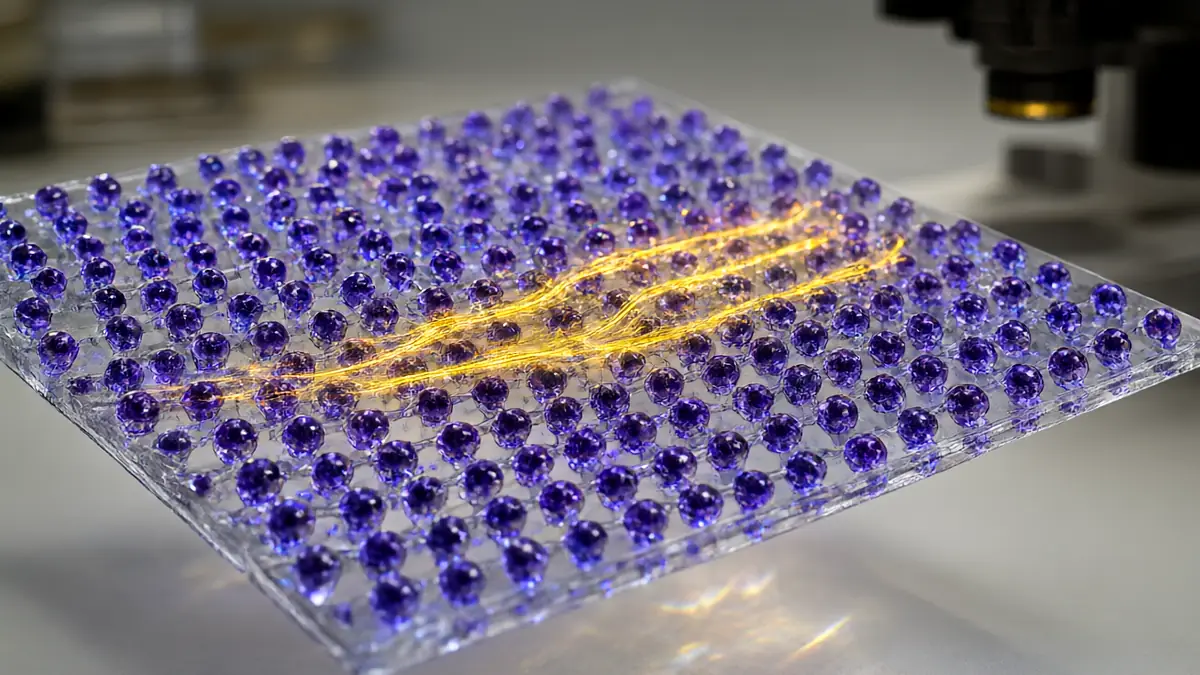
Colloidal quantum dot solids are promising for photoconversion and photochemistry, but their performance is fundamentally limited by rapid hot-carrier cooling, low carrier mobility and short transport ranges 1 . Here we demonstrate a spin-exchange-driven phototransport regime in manganese-doped quantum dot films that enables the generation, long-range transport and regeneration of hot carriers. Ultrafast spin-exchange-mediated Auger upconversion promotes electrons into high-energy, delocalized states before phonon cooling 2,3 , establishing a transient high-mobility conduction channel. Crucially, spin-exchange interactions not only generate hot carriers but also enable their repeated re-excitation, thereby sustaining long-range drift. This mechanism yields room-temperature mobilities of about 150 cm 2  V -1  s -1 and submillimetre drift lengths-far greater than those of conventional quantum dot solids and approaching values characteristic of crystalline semiconductors. Time-of-flight measurements confirm drift-dominated transport, with transit times scaling linearly with distance and inversely with electric field. These results establish a route to long-range energy transport in nanoscale materials and enable the use of hot carriers in photoconversion, photochemistry and transit-time-limited photodetection.