Mussels possess distinct vanadium and iron storage systems for fabricating metal-reinforced adhesive fibers.
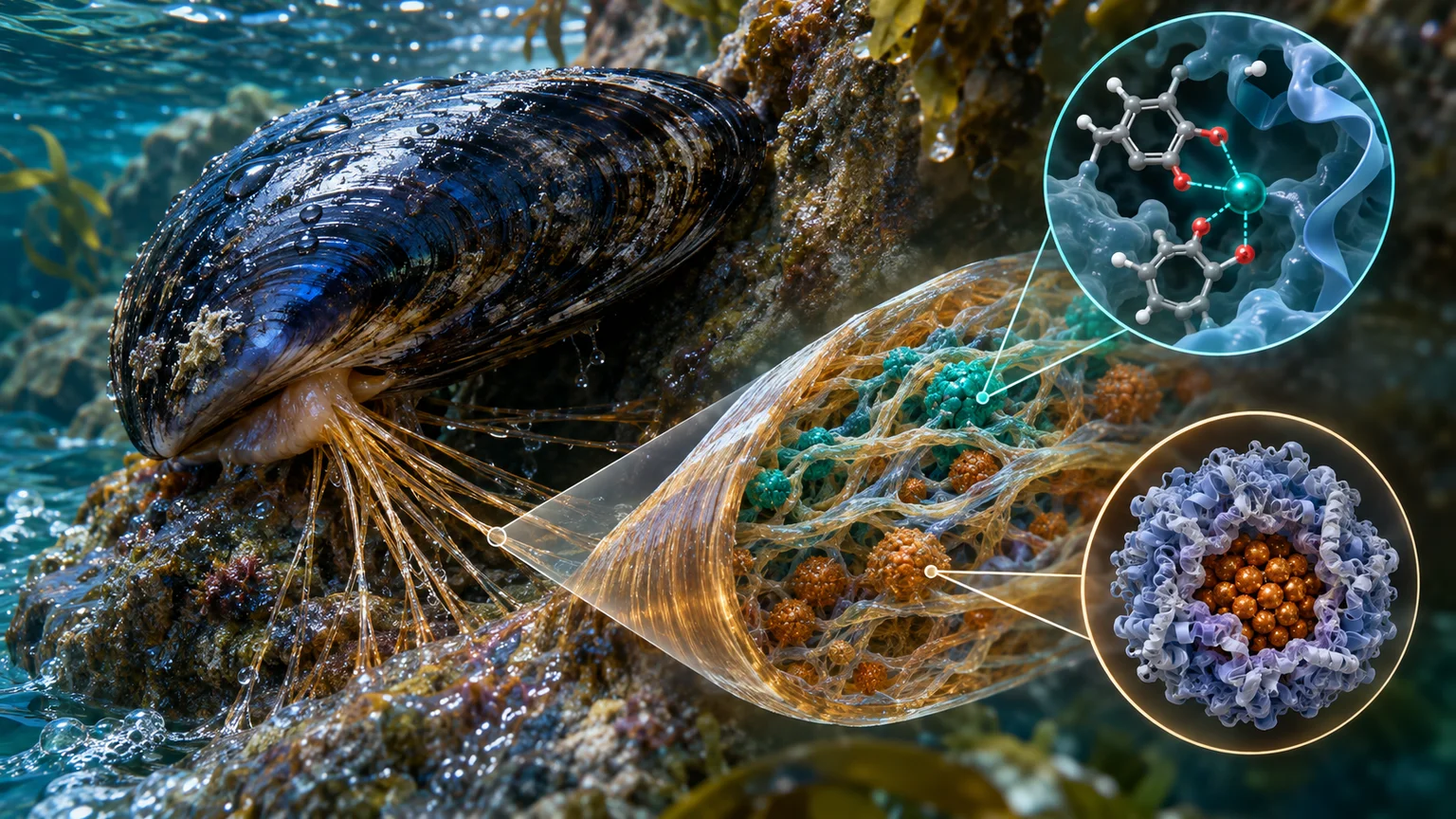
Mussels fashion a protein-based fibrous adhesive holdfast known as a byssus to tether themselves in marine habitats against crashing waves. The capacity of mussels to anchor securely is dependent on load-bearing protein-metal cross-links mediated by 3,4-dihydroxyphenylalanine (DOPA) residues coordinated to metal ions, which significantly enhance byssus mechanical properties (e.g., adhesive strength, abrasion resistance, toughness, self-healing capacity). However, the natural metal incorporation
Mussels fashion a protein-based fibrous adhesive holdfast known as a byssus to tether themselves in marine habitats against crashing waves. The capacity of mussels to anchor securely is dependent on load-bearing protein-metal cross-links mediated by 3,4-dihydroxyphenylalanine (DOPA) residues coordinated to metal ions, which significantly enhance byssus mechanical properties (e.g., adhesive strength, abrasion resistance, toughness, self-healing capacity). However, the natural metal incorporation process during byssus formation remains poorly understood-a knowledge gap that limits the decades-old field of mussel-inspired materials from fulfilling its potential. Here, we investigate the natural byssus biofabrication system, the mussel foot, focusing specifically on iron and vanadium storage using a multilength scale ensemble of spectroscopic methods. Confocal Raman spectroscopy, synchrotron µ-X-ray fluorescence and µ-X-ray absorption spectroscopy, and scanning transmission electron microscopy with energy-dispersive X-ray spectroscopy studies indicate that these two metals occupy separate coordination environments: vanadium storage is DOPA-based, while iron is stored in ferritin-like structures. Lacking precedence, these findings indicate that mussels evolved a catechol-based metal storage system to specifically acquire and store what is typically considered a trace metal ion in biology, which they employ subsequently to mechanically reinforce protein-based glues and coatings produced by the mussel. Beyond the biological implications, these findings have potential to transform the field of mussel-inspired materials.