Structures and inhibition of the Crimean-Congo haemorrhagic fever virus polymerase.
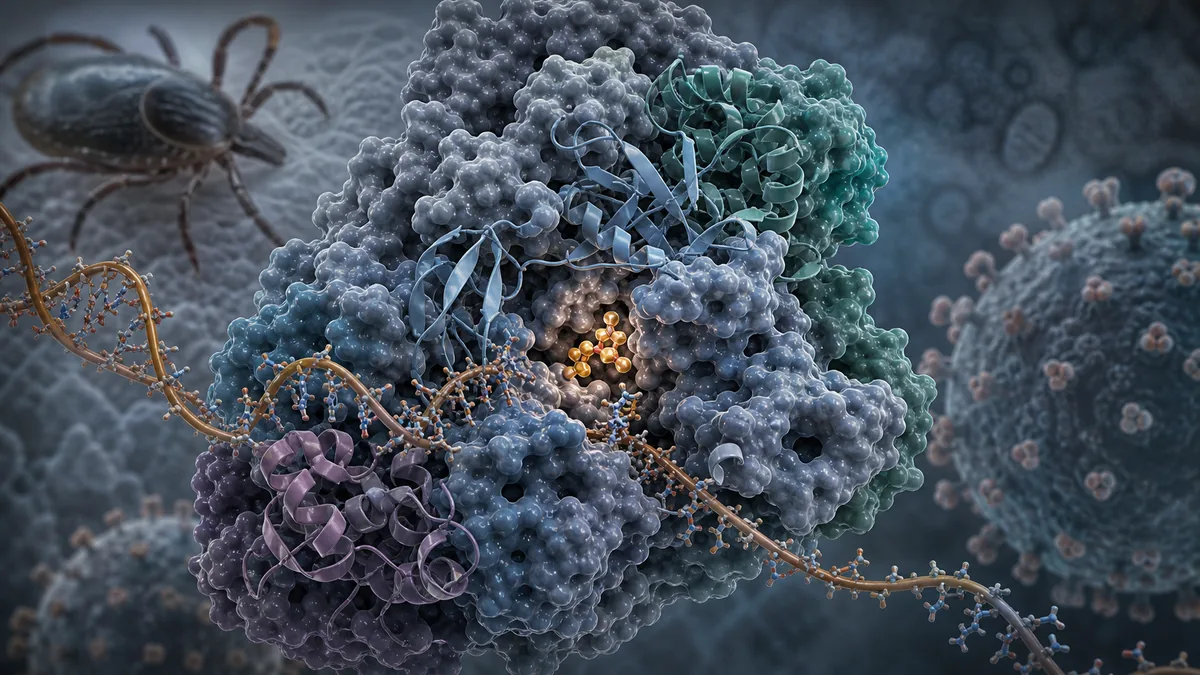
Crimean-Congo haemorrhagic fever virus (CCHFV) is a tick-borne virus and causes severe, often fatal, human infections. Lacking licensed vaccines or drugs, CCHFV is a World Health Organization priority pathogen requiring urgent development of medical countermeasures 1,2 . The CCHFV Large (L) protein functions as the viral RNA-dependent RNA polymerase CCHFV-L, representing a promising antiviral target, and is among the largest viral polymerases in the order Bunyavirales. Here we define the cofacto
Crimean-Congo haemorrhagic fever virus (CCHFV) is a tick-borne virus and causes severe, often fatal, human infections. Lacking licensed vaccines or drugs, CCHFV is a World Health Organization priority pathogen requiring urgent development of medical countermeasures 1,2 . The CCHFV Large (L) protein functions as the viral RNA-dependent RNA polymerase CCHFV-L, representing a promising antiviral target, and is among the largest viral polymerases in the order Bunyavirales. Here we define the cofactors required for CCHFV-L RNA synthesis in vitro, enabling capture and determination of elongating CCHFV-L-RNA complex structures. The structures show a markedly enlarged polymerase architecture, revealing that CCHFV-L RNA synthesis is accompanied by ordering of the polymerase peripheral domains. We also define how the baloxavir-derived experimental drug WXSH0208 (ref. 3 ) and the nucleoside analogue 2'-deoxy-2'-fluorocytidine 4,5 , which has nanomolar cellular potency, inhibit this polymerase through endonuclease inhibition and post-translocation chain termination, respectively. Together, these results should structurally guide rational optimization of inhibitors directed against CCHFV-L.