Retatrutide Once Weekly in Adults with Knee Osteoarthritis Pain and Obesity.
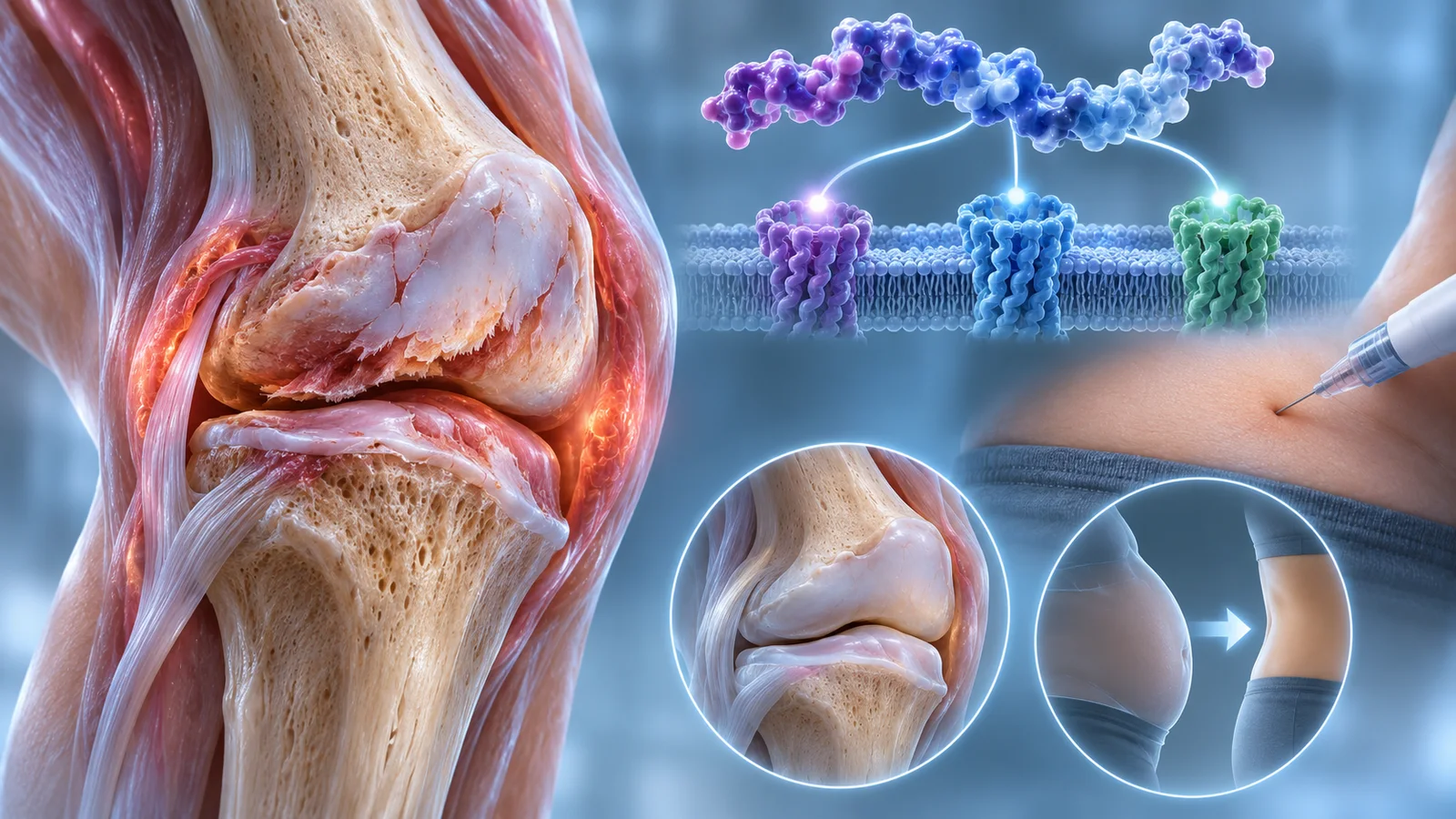
Retatrutide, an investigational triple agonist of GIP, GLP-1, and glucagon receptors, may be useful for the treatment of painful knee osteoarthritis in persons with obesity. In two phase 3 trials, adults without diabetes who had painful knee osteoarthritis and a body-mass index of at least 27 were randomly assigned to receive once-weekly subcutaneous retatrutide (9 or 12 mg in TRIUMPH-4 and 4, 9, or 12 mg in TRIUMPH-1-OA) or placebo. In TRIUMPH-4, the primary end points were the change in the WO
Retatrutide, an investigational triple agonist of GIP, GLP-1, and glucagon receptors, may be useful for the treatment of painful knee osteoarthritis in persons with obesity. In two phase 3 trials, adults without diabetes who had painful knee osteoarthritis and a body-mass index of at least 27 were randomly assigned to receive once-weekly subcutaneous retatrutide (9 or 12 mg in TRIUMPH-4 and 4, 9, or 12 mg in TRIUMPH-1-OA) or placebo. In TRIUMPH-4, the primary end points were the change in the WOMAC pain score (range, 0 to 10, with higher scores indicating worse pain) and the percent change in body weight at week 68. In TRIUMPH-1-OA, the primary end point was the change in the WOMAC pain score at week 80. For non-pain-related end points, intercurrent events were handled with a treatment-policy strategy. For pain-related end points, a hybrid-treatment estimand was applied, with a hypothetical strategy for intercurrent events that suggested treatment failure and a treatment-policy strategy elsewhere. We also report results for an intention-to-treat (ITT) estimand. A total of 445 participants underwent randomization in TRIUMPH-4 and 574 in TRIUMPH-1-OA. At 68 weeks, the mean changes in the WOMAC pain score (hybrid-treatment estimand) with retatrutide in TRIUMPH-4 were -3.96 (9 mg) and -3.74 (12 mg), versus -2.12 with placebo (difference vs. placebo, -1.83 [95% confidence interval {CI}, -2.37 to -1.30] and -1.61 [95% CI, -2.16 to -1.07], respectively). For the ITT estimand, the corresponding differences from placebo were -1.70 (95% CI, -2.19 to -1.22) and -1.38 (95% CI, -1.91 to -0.85) (P<0.001 for all comparisons). The mean percent changes in body weight with retatrutide were -20.0% (9 mg) and -23.7% (12 mg), versus -4.6% with placebo (difference vs. placebo, -15.4 percentage points [95% CI, -18.7 to -12.1] and -19.2 percentage points [95% CI, -22.4 to -15.9]; P<0.001 for both comparisons). At 80 weeks, the mean changes in the WOMAC pain score (hybrid-treatment estimand) with retatrutide in TRIUMPH-1-OA were -3.22 (4 mg), -3.48 (9 mg), and -3.64 (12 mg), versus -1.87 with placebo (difference vs. placebo, -1.35 [95% CI, -1.92 to -0.78], -1.61 [95% CI, -2.20 to -1.02], and -1.77 [95% CI, -2.34 to -1.20], respectively). For the ITT estimand, the corresponding differences from placebo were -0.96 (95% CI, -1.61 to -0.30), -1.41 (95% CI, -2.07 to -0.75), and -1.64 (95% CI, -2.26 to -1.02) (P≤0.005 for all comparisons). In both trials, serious adverse events were more common with retatrutide than with placebo, and the most common adverse events were gastrointestinal. In participants with painful knee osteoarthritis and obesity, treatment with retatrutide resulted in significantly greater reductions in both the WOMAC pain score and body weight than placebo. (Funded by Eli Lilly; TRIUMPH-4 and -1 ClinicalTrials.gov numbers, NCT05931367 and NCT05929066.).