Rare k-mers reveal centromere haplogroups underlying human diversity and cancer translocations.
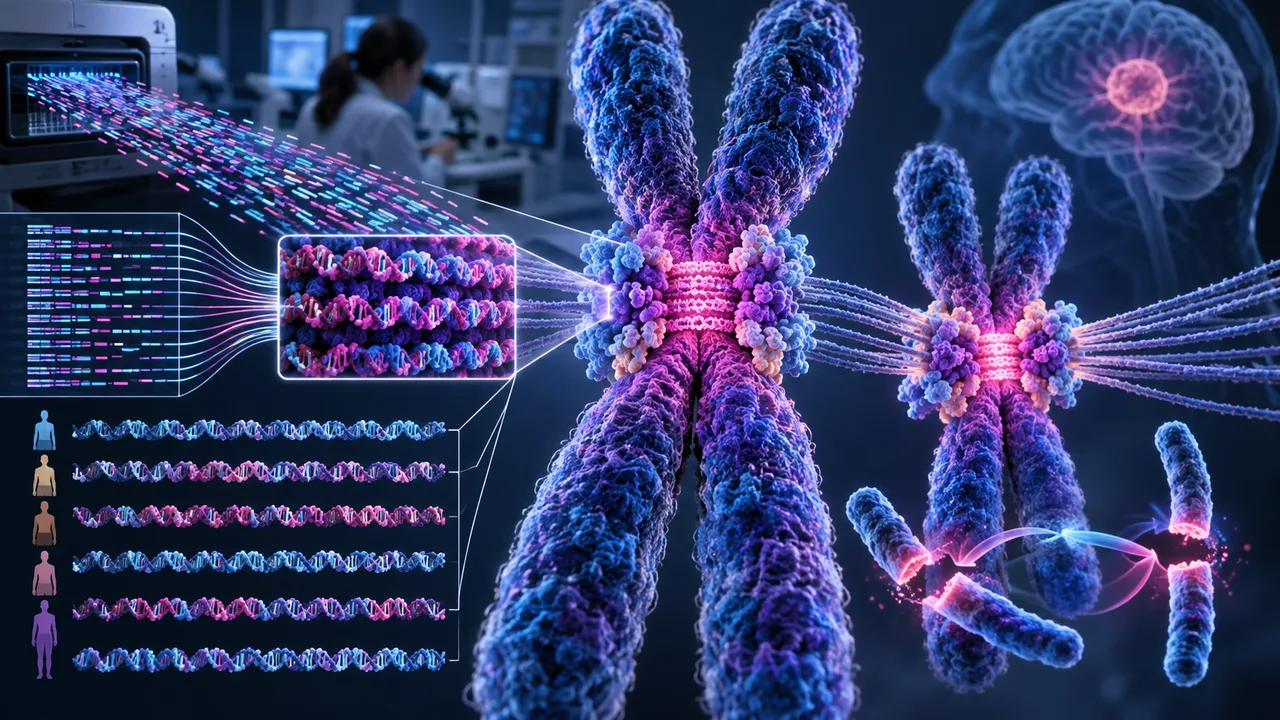
Human centromeres are highly variable but remain among the least characterized regions of the genome because their repetitive structure has hindered conventional analysis of population diversity and disease relevance. Here, we show that rare k-mers in centromeric regions capture lineage-specific variation, defining discrete haplogroups with distinct structural features. We developed ascairn to infer these haplogroups from short-read whole-genome sequencing (WGS) data. Applying this framework to
Human centromeres are highly variable but remain among the least characterized regions of the genome because their repetitive structure has hindered conventional analysis of population diversity and disease relevance. Here, we show that rare k-mers in centromeric regions capture lineage-specific variation, defining discrete haplogroups with distinct structural features. We developed ascairn to infer these haplogroups from short-read whole-genome sequencing (WGS) data. Applying this framework to >3,300 genomes reveals extensive global diversity in centromere haplogroups and signatures of population history. Analyzing short-read WGS data from 142 oligodendroglioma cases with 1p/19q co-deletion, we mapped breakpoints to the centromere regions of chromosomes 1 and 19, revealing a clear positional relationship to kinetochore attachment sites and a link between centromere haplotype structure and rearrangement susceptibility. Rare k-mers thus open centromeres to population-scale analysis, linking centromere structural diversity to human evolutionary history and disease-associated genomic instability.