Health & Medicine

Pulse-Driven Paired Electrosynthesis of Formamide via Redox-Tuned Intermediate Management.
| Source: Journal of the American Chemical Society

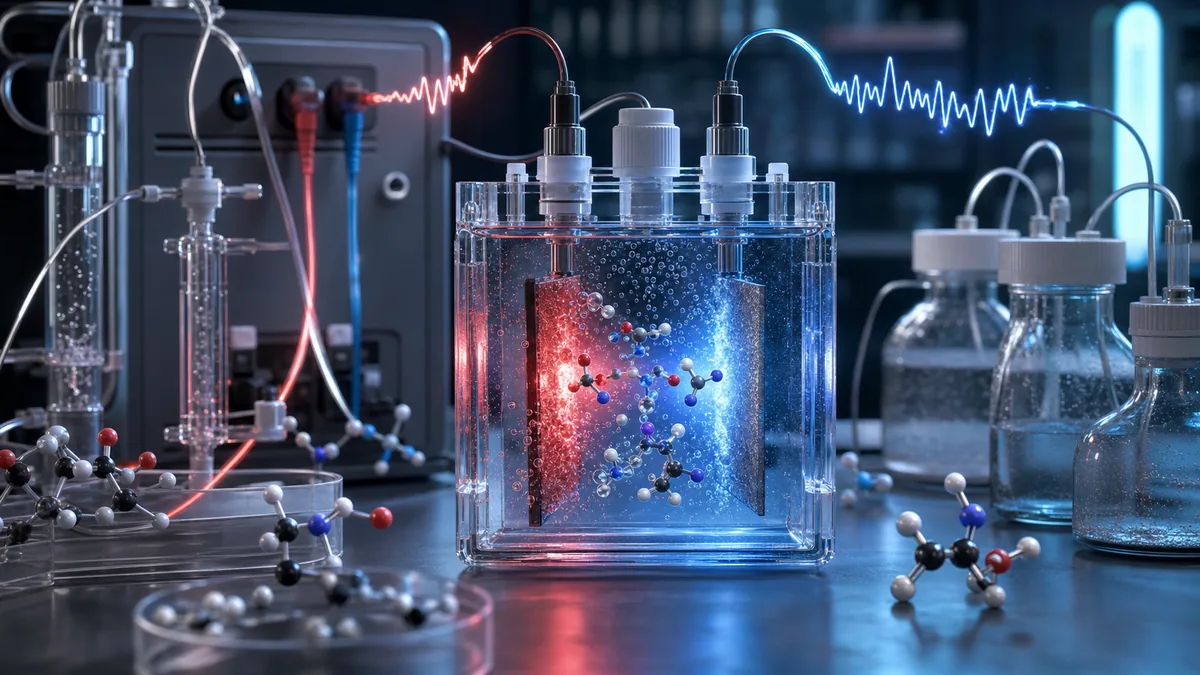
Renewable electricity-driven electrocatalytic systems hold promise for the sustainable formamide (HCONH 2 ) synthesis. However, a major bottleneck remains the low Faradaic efficiency (FE) and overall electron utilization inherent to current unipolar C-N coupling strategies, where substantial electron consumption at the counter electrode severely limits system efficiency. Here, we propose a redox-tuned paradigm ( A red + B oxi → C ) through a pulsed paired electrosynthesis strategy. Using

Renewable electricity-driven electrocatalytic systems hold promise for the sustainable formamide (HCONH 2 ) synthesis. However, a major bottleneck remains the low Faradaic efficiency (FE) and overall electron utilization inherent to current unipolar C-N coupling strategies, where substantial electron consumption at the counter electrode severely limits system efficiency. Here, we propose a redox-tuned paradigm ( A red + B oxi → C ) through a pulsed paired electrosynthesis strategy. Using an atomically ordered CuPd catalyst with CH 3 OH and NO 2 - as feedstocks in an undivided cell, HCONH 2 is simultaneously produced at both electrodes under optimized pulse conditions with alternating change in potential periodically ( E a = 1.3 V, t a = 10 s; E c = -0.7 V, t c = 10 s). This system achieves an FE of 85.6% for HCONH 2 at a current density of 81.5 mA cm -2 , with a yield of 263.3 μmol·h -1 ·cm -2 . The FE is higher than those reported to date. Mechanism studies reveal that pulsed operation creates a periodically switching cathode/anode environment. This enables the ordered CuPd catalyst to function sequentially as a reduction site (converting NO 2 - to *NH 3 ) during cathodic pulses and as a co-oxidation site (converting *NH 3 to *NH 2 along with CH 3 OH to *HCOH) during anodic pulses, thereby driving efficient C-N bond coupling to form HCONH 2 . Techno-economic analysis further confirmed the significant industrial potential of this strategy in the future renewable energy market.
Read the original source →

Related Stories

Health & Medicine

Cryoelectron tomography reveals an age-related decline in mitoribosomes that contributes to T cell dysfunction in older individuals.

Mitochondrial dysfunction drives T cell aging in mice. Yet, due to fundamental differences in T cell aging mechanisms between species, whether human T cells exhibit similar mitochondrial alterations remains unclear, with existing evidence often conflicting. Using cryoelectron tomography, we resolved the structure and spatial organization of mitochondrial ribosomes in primary human CD8 + T cells under physiological conditions. Comparative analysis with human aging models revealed an age-related r

Continue reading
Health & Medicine

RelB NF-κB tunes Notch2 signaling to promote IL-23-secreting solitary isolated lymphoid tissue-resident DCs critical for gut immunity.

While preserving tolerance toward commensals, dendritic cells (DCs) also orchestrate response against pathogens. The noncanonical RelB NF-κB pathway in DCs curbs tolerogenic Tregs in the intestine. Whether RelB-dependent DC regulations also impact intestinal immunity remains less clear. Here, we show that genetic ablation of RelB in DCs compromises IL-23-dependent immune response in the intestine, imparting vulnerability in Relb ΔCD11c mice to infection with Citrobacter rodentium , a

Continue reading
Health & Medicine

X-linked SYTL4 missense variant disrupts RAB27A-dependent vesicle trafficking and synaptic transmission in autism.

Autism spectrum disorder (ASD) is a neurodevelopmental condition characterized by impaired social communication and repetitive behaviors, with genetic studies implicating widespread synaptic dysfunction. However, the contribution of presynaptic vesicle trafficking mechanisms to ASD pathogenesis remains incompletely understood. Here, we identify synaptotagmin-like protein 4 (SYTL4), a RAB27A effector previously characterized in secretory cells, as a regulator of presynaptic function in the mammal

Continue reading
Health & Medicine

Folic acid prevention of neural tube defects requires retinoic acid produced by ALDH1L1.

Folic acid (FA) supplementation during pregnancy is the commonly accepted treatment to prevent neural tube defects. The mechanism by which FA prevents neural tube defects (NTDs) remains unclear. FA also prevents other developmental malformations, including alcohol-induced malformations in Fetal Alcohol Syndrome models. We show that FA acts through a metabolic link to retinoic acid (RA) signaling. Using a pax3 -knockdown Xenopus model of FA-rescuable NTDs, we show that RA or its precursors equall

Continue reading
Health & Medicine

Dynamic principles of concentration buffering through liquid-liquid phase separation.

Living systems must maintain robust biochemical function despite fluctuations that span a wide range of timescales. Biomolecular condensates formed by liquid-liquid phase separation (LLPS) have been shown to buffer concentration fluctuations, but the principles governing their dynamic regulation remain unclear. We address this by probing the response of LLPS to oscillatory perturbations that mimic fluctuations across different timescales, establishing the first systematic frequency-domain analys

Continue reading