Prehospital Fluid Resuscitation for Patients With Suspected Sepsis: The PITSTOP-Fluids Factorial Randomized Clinical Trial.
Early resuscitation with intravenous fluids is recommended for patients with sepsis. To determine the effect of liberal vs more conservative fluid resuscitation strategies in the ambulance on mortality among patients with suspected sepsis. Multicenter, 2 × 2 factorial randomized clinical trial conducted by 4 paramedic services and their destination hospitals in Ontario, Canada. Participants were adults with suspected sepsis, defined as suspected infection, fever (≥38.0 °C), and
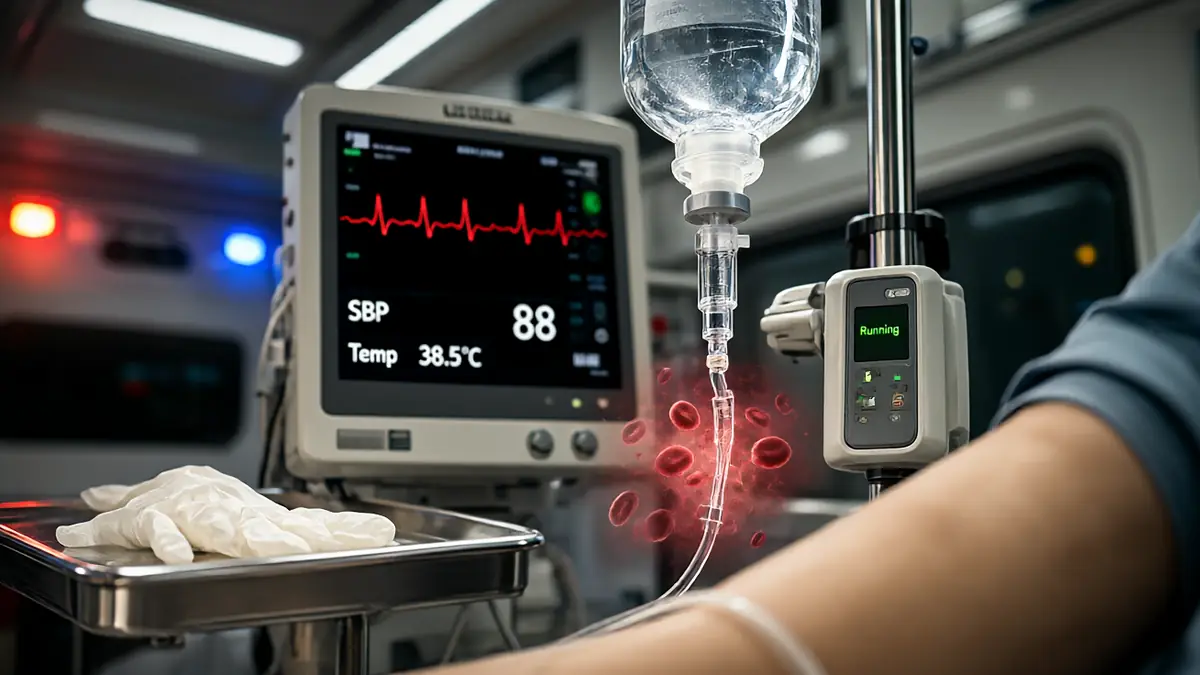
Early resuscitation with intravenous fluids is recommended for patients with sepsis. To determine the effect of liberal vs more conservative fluid resuscitation strategies in the ambulance on mortality among patients with suspected sepsis. Multicenter, 2 × 2 factorial randomized clinical trial conducted by 4 paramedic services and their destination hospitals in Ontario, Canada. Participants were adults with suspected sepsis, defined as suspected infection, fever (≥38.0 °C), and hypotension (systolic blood pressure [SBP] <100 mm Hg), and obtainable intravenous access. Patients were enrolled between March 23, 2020, and August 20, 2025, with last follow-up in December 2025. Patients were randomized to receive liberal fluids (up to 2 L of normal saline regardless of subsequent SBP) or usual care (fluids only when SBP <90 mm Hg and stopped when SBP ≥100 mm Hg) during prehospital care and until transfer of care in the emergency department. (Patients were additionally randomized to receive ceftriaxone vs placebo; analysis of which is reported separately.). The primary outcome was hospital mortality, defined as death prior to hospital discharge up to day 90. There were 17 secondary outcomes, including all-cause mortality at 90 days, hospitalization, intensive care unit admission, mechanical ventilation, vasopressor therapy, dialysis, and total fluids infused within 24 hours of hospital arrival. Among 1686 randomized patients, 1669 were eligible and 1646 were included in the primary outcome analysis (830 in the liberal fluids group and 816 in the usual fluids group). The median age of patients was 76 (IQR, 63-85) years and 938 (57.0%) were male. Most patients in both groups received a fluid bolus (826/848 [97.4%] in the liberal fluids group; 700/821 [85.3%] in the usual fluids group) during transport, but patients in the liberal fluids group received a larger volume (median, 1500 mL [IQR, 1000-2000 mL]) vs 500 mL [IQR, 175-800 mL] in the usual fluids group; difference, 910.1 mL [95% CI, 857.3-962.9 mL]). Hospital mortality was 149/830 (18.0%) in the liberal fluids group and 149/816 (18.3%) in the usual fluids group (risk ratio, 0.98 [95% CI, 0.80-1.20]; unadjusted risk difference, -0.3 [95% CI, -4.0 to 3.4]; P = .82). Among the 17 secondary outcomes, all were similar between groups. Adverse events, including pulmonary edema during transport, were infrequent in both groups. A more liberal fluid resuscitation strategy for the prehospital management of patients with suspected sepsis did not reduce mortality compared with more restrictive usual care. ClinicalTrials.gov Identifier: NCT03068741.