Paleogenomics illuminates mobility and changing lifeways in Chalcolithic Anatolia.
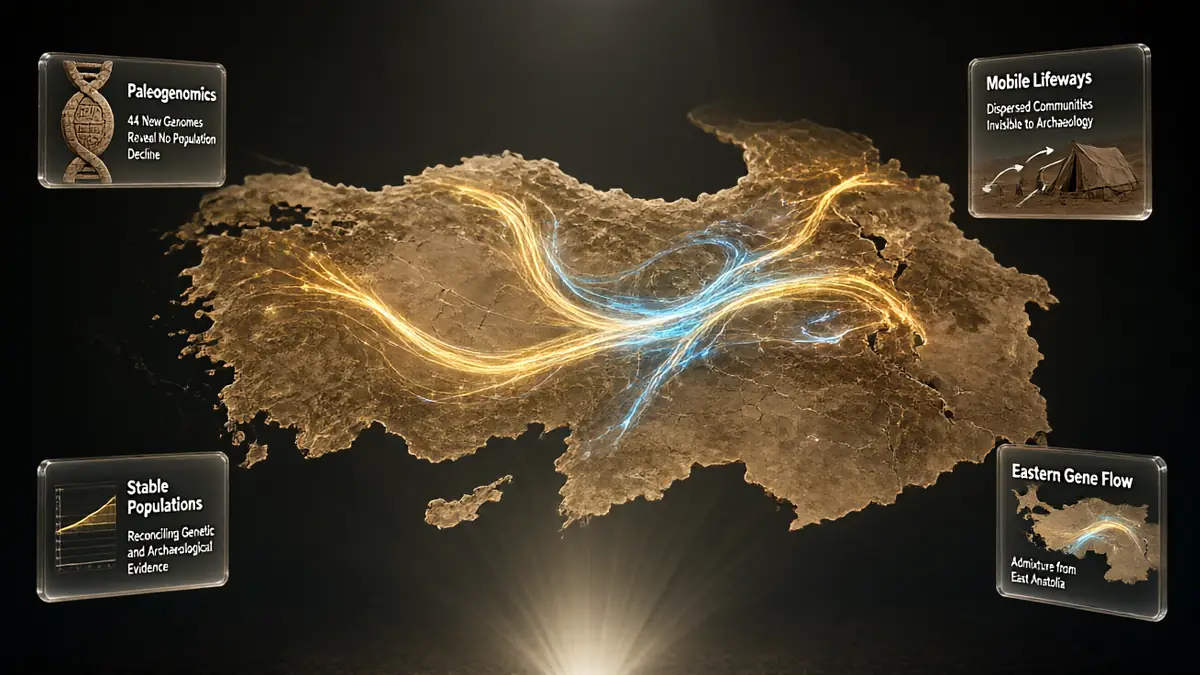
Once labeled the "Dark Ages" of Anatolian prehistory, the Chalcolithic period (c. 6000-3000 BCE) was characterized by drastically reduced settlement densities compared with the preceding Neolithic and the succeeding Bronze Ages, a change interpreted as population decline. Using 44 new genomes combined with published data, we find no evidence for a population reduction. The genetic evidence instead suggests that populations in Chalcolithic Anatolia were increasingly mobile and/or growing in size
Once labeled the "Dark Ages" of Anatolian prehistory, the Chalcolithic period (c. 6000-3000 BCE) was characterized by drastically reduced settlement densities compared with the preceding Neolithic and the succeeding Bronze Ages, a change interpreted as population decline. Using 44 new genomes combined with published data, we find no evidence for a population reduction. The genetic evidence instead suggests that populations in Chalcolithic Anatolia were increasingly mobile and/or growing in size while receiving gene flow from eastern regions (e.g., East Anatolia and the South Caucasus) through a 3,000-year-long admixture process. We propose that genetic and archaeological evidence may be reconciled by hypothesizing the presence of communities with dispersed and mobile lifeways that are mostly invisible to archaeology. These communities also practiced consanguinity at frequencies unobserved in previous periods. Finally, we identify a mid-5th-millennium BCE individual in Central Anatolia carrying ∼10%-30% Pontic-Caspian Steppe-related ancestry, shedding light on mobility between the Eurasian Steppe and Anatolia.