Overcoming the performance ceiling of textured piezoelectric ceramics
Textured piezoelectric ceramics could deliver the ultrahigh piezoelectricity of single crystals while retaining the mechanical robustness and cost-effectiveness of conventional ceramics, but after decades of effort, their piezoelectricity has not approached that of single crystals. We exploited compositional flexibility of textured ceramics, a critical advantage over single-crystal counterparts, using a machine-learning approach. Our samarium (Sm)–doped Pb(In 1/2 Nb 1/2 )O 3 -Pb(Sc 1/2 Nb 1/2 )O
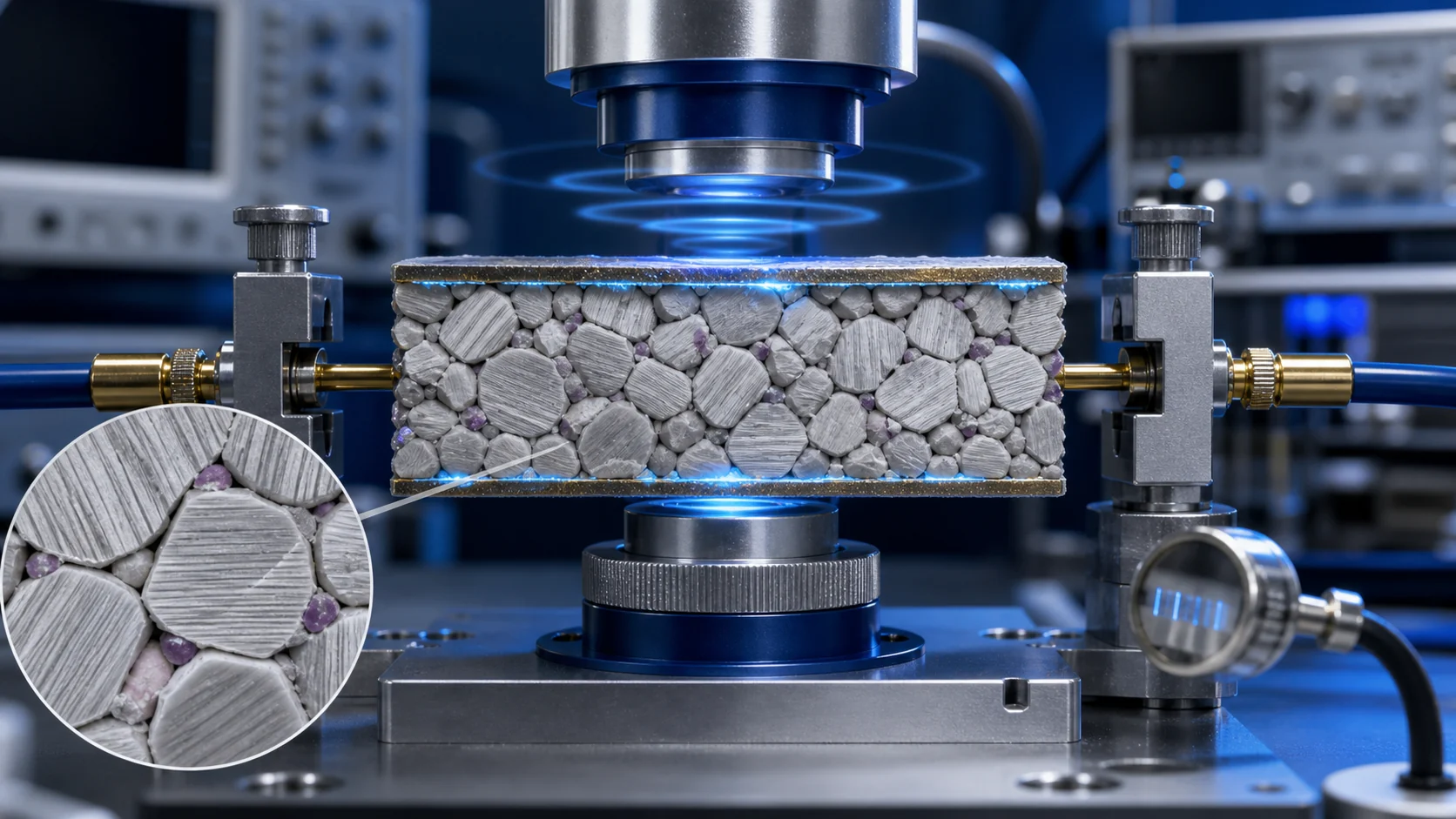
Textured piezoelectric ceramics could deliver the ultrahigh piezoelectricity of single crystals while retaining the mechanical robustness and cost-effectiveness of conventional ceramics, but after decades of effort, their piezoelectricity has not approached that of single crystals. We exploited compositional flexibility of textured ceramics, a critical advantage over single-crystal counterparts, using a machine-learning approach. Our samarium (Sm)–doped Pb(In 1/2 Nb 1/2 )O 3 -Pb(Sc 1/2 Nb 1/2 )O 3 -PbTiO 3 textured ceramics exhibited an ultrahigh piezoelectric coefficient ( d 33 ) of 1720 picocoulombs per newton and a Curie temperature of 250°C. These values are comparable to, or even surpass, those of state-of-the-art single crystals. In situ x-ray diffraction and Rayleigh analysis indicate that their exceptional piezoelectricity is predominantly intrinsic rather than driven by domain switching. Leveraging these textured ceramics, we fabricated a piezoelectric accelerator that exhibits not only higher sensitivity but also substantially better reliability than its single-crystal counterparts.