Neural correlates of facial recognition in a social wasp.
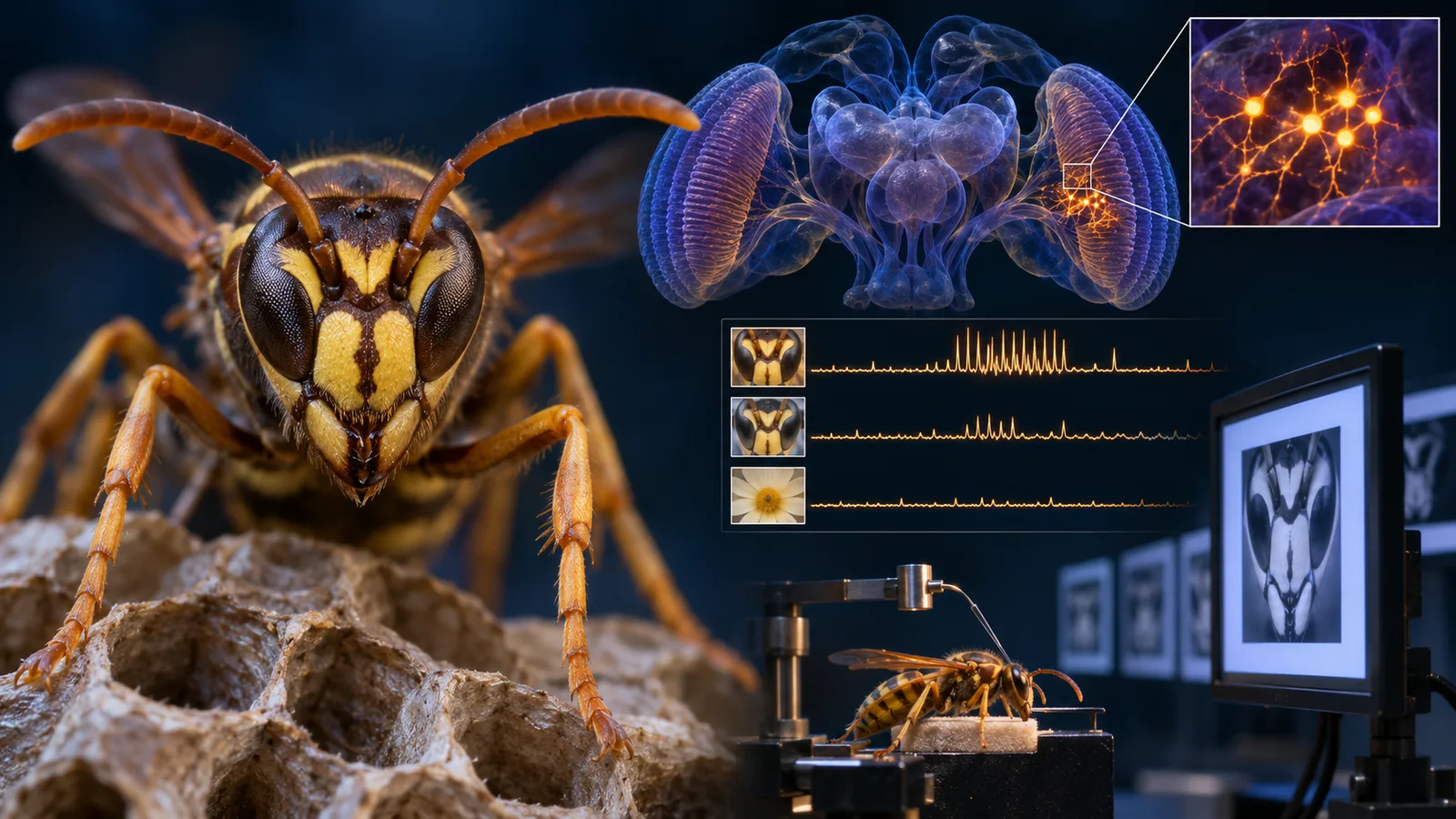
In humans and other primates, faces are special visual objects that are encoded by circuits selective to faces. If specialized circuits are the most efficient way to encode and discriminate among similar-looking objects of high relevance, then we expect that analogous circuits should evolve in other taxa with specialized visual individual recognition abilities. Thus, we surveyed the neural responses to visual objects across the brain of a wasp that has independently evolved specialized facial re
In humans and other primates, faces are special visual objects that are encoded by circuits selective to faces. If specialized circuits are the most efficient way to encode and discriminate among similar-looking objects of high relevance, then we expect that analogous circuits should evolve in other taxa with specialized visual individual recognition abilities. Thus, we surveyed the neural responses to visual objects across the brain of a wasp that has independently evolved specialized facial recognition, Polistes fuscatus. We found a localized population of neurons analogous to face cells, which we term "wasp cells," that selectively fire to front-facing wasp images. Some of these wasp cells encode information about facial patterns, which possibly underlie the unique visual recognition abilities of these wasps. These findings demonstrate high-level feature-selective tuning in an invertebrate and suggest that specialized circuits are an adaptive feature for nervous systems requiring complex visual recognition.