Environment

A conserved flowering-time module underlies double-season cropping.
| Source: Nature

Adapting crops to intensive cultivation systems under climate change requires varieties that combine yield potential with optimized flowering and maturation 1,2 . In central and eastern China, barley has long been cultivated in a double-season cropping system, in which early flowering and maturation are critical for escaping presummer terminal heat stress and enabling flexible rotation with summer crops 3,4 . Here we trace the genomic footprints of 80 years of modern breeding in China usi

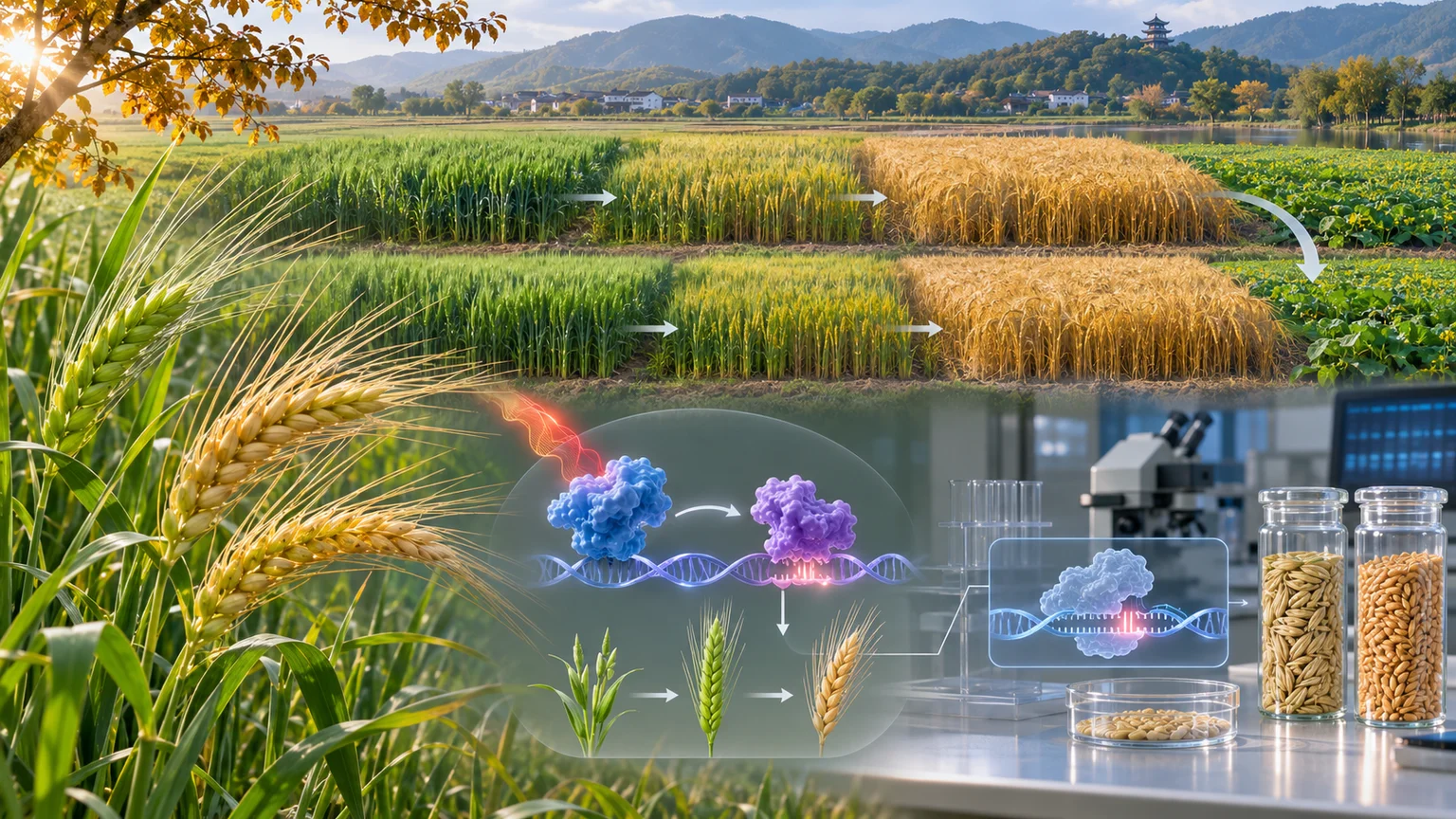
Adapting crops to intensive cultivation systems under climate change requires varieties that combine yield potential with optimized flowering and maturation 1,2 . In central and eastern China, barley has long been cultivated in a double-season cropping system, in which early flowering and maturation are critical for escaping presummer terminal heat stress and enabling flexible rotation with summer crops 3,4 . Here we trace the genomic footprints of 80 years of modern breeding in China using 505 representative cultivars and identify a flowering-time module defined by a single amino acid substitution in PHYTOCHROME C in combination with a winter-type VERNALIZATION 1 haplotype that underpins this adaptation. The derived allele accelerates heading and maturity, and its frequency has risen sharply in modern autumn-sown varieties. Using base editing in barley and wheat, we confirm causality and demonstrate that this flowering-time combination module, PhyC-VRN1, is functionally conserved across Triticeae. Our results identify and experimentally validate a breeding-relevant flowering-time module that has been selected during modern breeding to enable intensive crop rotations, as well as demonstrate how precision genome editing can be used to reconstruct such adaptive modules for climate-resilient crop design.


Read the original source →

Related Topics

Related Stories

Environment

Observation of prethermal dynamical phase transitions and resonant melting.

The dynamics of isolated quantum systems following a sudden quench has a central role in many areas of material science, high-energy physics and quantum chemistry 1-4 . Such far-from-equilibrium quantum dynamics-which features complex phenomena with implications for thermalization, non-equilibrium phase transitions and Floquet phase engineering 5-8 -is challenging to study numerically, in particular, in high-dimensional systems 9,10 . Here we use a programmable neutral-atom quantum simulator 11

Continue reading
Environment

Widespread plasma jets in the Martian magnetosheath revealed by dual-spacecraft observations.

Plasma jets in planetary magnetosheaths are transient, high dynamic pressure structures capable of strongly perturbing downstream magnetospheres and modulating solar wind energy transfer. Although recently identified at Mars, their formation mechanisms and global occurrence remain poorly constrained. Using dual-spacecraft observations from Mars Atmosphere and Volatile EvolutioN and Tianwen-1, we show that magnetosheath jets occur throughout the Martian magnetosheath, in striking contrast to Eart

Continue reading
Environment

Defining and measuring proximity to criticality based on univariate time series.

Diverse social, engineered, and biological systems are made up of multiple interacting dynamical components; to work properly, certain components must be carefully regulated so that their dynamics avoid instability. However, many desirable properties, like optimized computation and control, emerge close to the tipping point between stability and instability, i.e., near criticality. Claims that such dynamical systems operate near criticality have been controversial because it is difficult to asse

Continue reading
Environment

Orexin and pupillary modulation for hunger control.

Fasting-based interventions improve metabolic health and are also explored as adjuncts in other clinical settings, but hunger remains a barrier to adherence. Fasting activates AgRP/NPY neurons (ANs), a hunger-promoting population whose inhibition reduces eating in hungry animals. Here we identify hypocretin/orexin neurons (HONs), classically associated with arousal, as rapid suppressors of AN activity. HON ablation increased AN population activity, whereas HON optostimulation rapidly suppressed

Continue reading
Environment

Environmental RNA improves detection and surveillance of schistosomiasis transmission.

Environmental diagnosis of schistosomiasis, a disease affecting over 250 million people globally, remains challenging, thereby limiting efficient eradication efforts. Current methods, including environmental DNA (eDNA), cannot distinguish between infectious parasite life stages present in the environment. Here, we develop and validate an environmental RNA (eRNA) approach that enables detection and quantification of Schistosoma mansoni miracidia (infective to snails) and cercariae (infective to h

Continue reading