Lean adipocyte oxylipin signaling restrains breast cancer through ferroptosis.
Obesity increases breast cancer risk and tumor aggressiveness, yet the mechanisms underlying this association remain unclear. In this work, we identify a tumor-suppressive lipid signaling pathway in which mammary adipocytes secrete the oxylipin 9S-hydroxyoctadecadienoic acid (9S-HODE). 9S-HODE induces ferroptosis in breast cancer cells by disrupting iron homeostasis. Adipocytes in obese mammary tissue produce less 9S-HODE, and tumors in obese mice exhibit reduced ferroptosis. Accordingly, ferrop
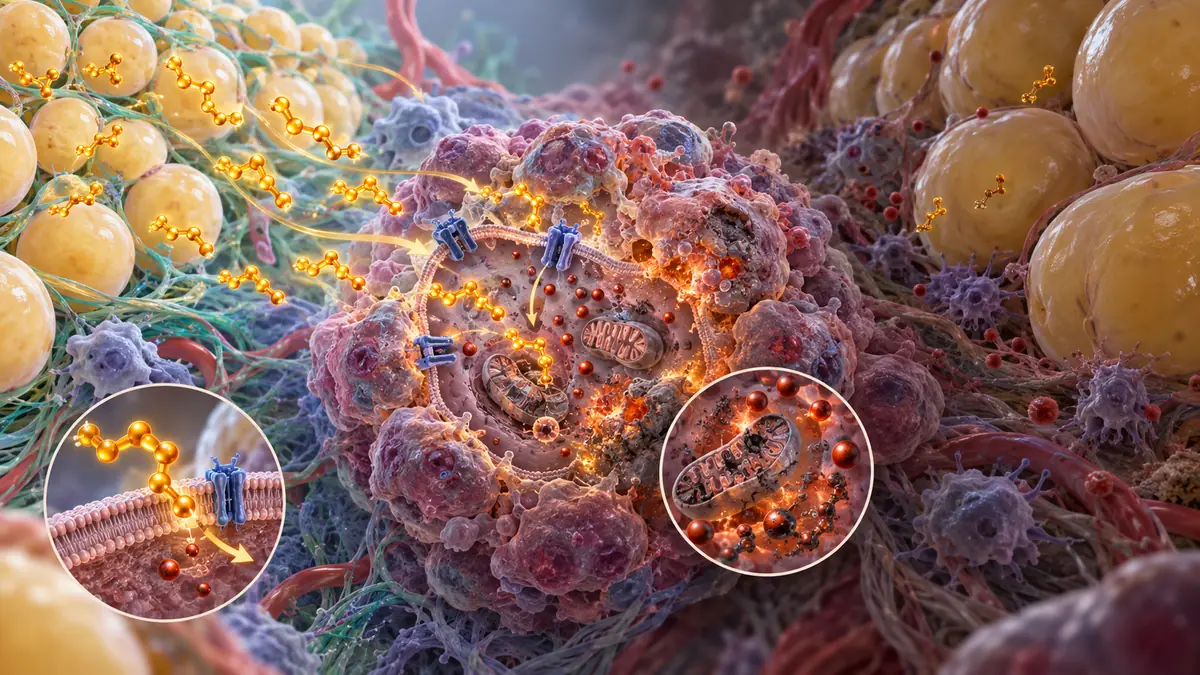
Obesity increases breast cancer risk and tumor aggressiveness, yet the mechanisms underlying this association remain unclear. In this work, we identify a tumor-suppressive lipid signaling pathway in which mammary adipocytes secrete the oxylipin 9S-hydroxyoctadecadienoic acid (9S-HODE). 9S-HODE induces ferroptosis in breast cancer cells by disrupting iron homeostasis. Adipocytes in obese mammary tissue produce less 9S-HODE, and tumors in obese mice exhibit reduced ferroptosis. Accordingly, ferroptosis inhibition accelerates tumor growth in lean mice, and restoring 9S-HODE suppresses tumor growth in obese mice. In humans, mammary 9S-HODE content is inversely correlated with body mass index, and 9S-HODE inhibits patient-derived breast cancer organoid growth. These findings identify the loss of adipocyte-derived 9S-HODE as a mechanism by which obesity promotes breast cancer and suggest that the restoration of ferroptosis-inducing lipid signaling may be a therapeutic strategy.