Efficacy and safety of efinopegdutide in adults with metabolic dysfunction-associated steatohepatitis and stage 2-3 fibrosis: a phase 2b, randomised, placebo-controlled study.
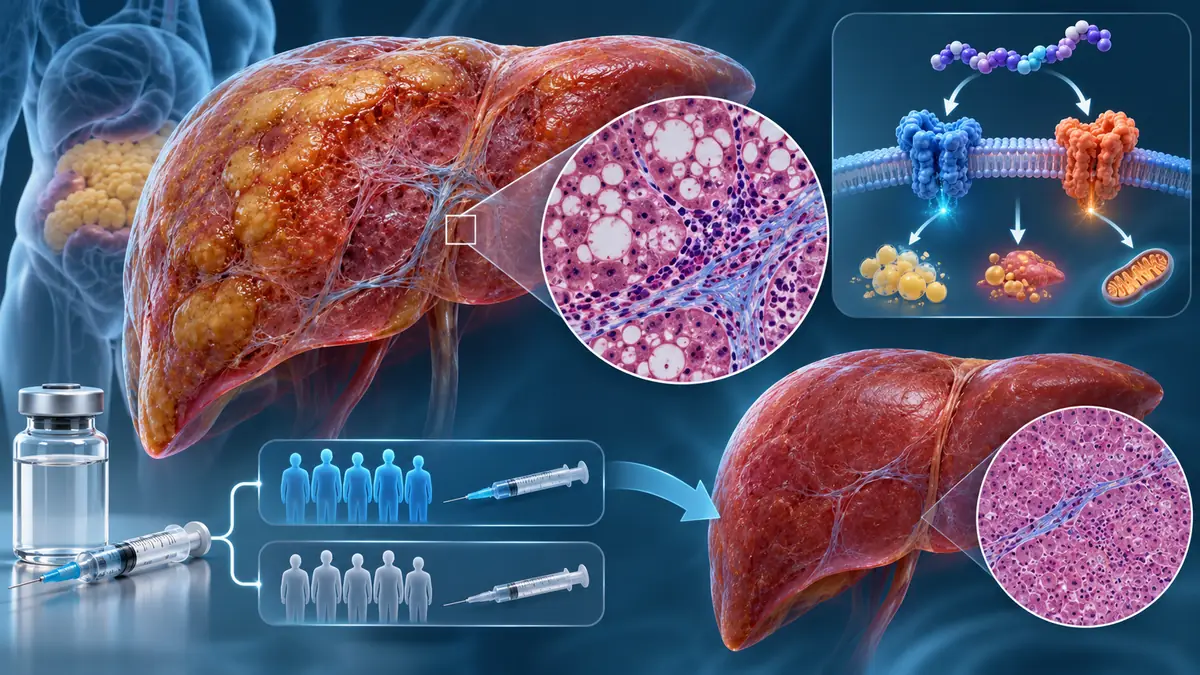
Efinopegdutide is a pharmacologically distinct once-weekly GLP-1-glucagon receptor co-agonist with a relative receptor potency balance of approximately 2:1 under development for metabolic dysfunction-associated steatohepatitis (MASH). We aimed to investigate the efficacy and safety of efinopegdutide in adults with non-cirrhotic MASH. We did a phase 2b, randomised, placebo-controlled, double-blind study conducted at 176 academic and community centres in 26 countries. We included adults (aged 
Efinopegdutide is a pharmacologically distinct once-weekly GLP-1-glucagon receptor co-agonist with a relative receptor potency balance of approximately 2:1 under development for metabolic dysfunction-associated steatohepatitis (MASH). We aimed to investigate the efficacy and safety of efinopegdutide in adults with non-cirrhotic MASH. We did a phase 2b, randomised, placebo-controlled, double-blind study conducted at 176 academic and community centres in 26 countries. We included adults (aged ≥18 years) with biopsy-confirmed MASH and stage 2 or stage 3 fibrosis. Eligible participants were randomly assigned (1:1:1:1:1) to receive either efinopegdutide (4 mg, 7 mg, or 10 mg), placebo, or open-label semaglutide 2·4 mg, all administered subcutaneously once weekly. Randomisation was performed centrally. The primary endpoint was MASH resolution without worsening of fibrosis at week 52. The key secondary histological endpoint was fibrosis improvement of at least one stage without worsening of steatohepatitis. Missing end-of-treatment biopsies were considered as failure for the primary analysis. This study is registered with EU CT, 2022-502647-35-00, and ClinicalTrials.gov, NCT05877547, and is complete. Between June 23, 2023, and Dec 29, 2025, we screened 1704 participants. We randomly assigned 386 (23%) participants, of whom 381 (99%; 194 [51%] women and 187 [49%] men) received at least one dose of study intervention and were included in the analysis. Baseline characteristics were similar across groups; 239 (63%) of 381 participants had F2 fibrosis and 142 (37%) had F3 fibrosis; the mean age of participants was 53 years (SD 13). At week 52, MASH resolution without worsening of fibrosis occurred in 31 (56%) of 55 participants in the 4 mg efinopegdutide group, 31 (63%) of 49 participants in the 7 mg efinopegdutide group, and 35 (61%) of 57 participants in the 10 mg efinopegdutide group versus seven (13%) of 53 participants in the placebo group (difference vs placebo 43·0 percentage points [95% CI 25·7 to 57·8; p<0·0001] for 4 mg, 49·5 percentage points [31·4 to 64·2; p<0·0001] for 7 mg, and 47·8 percentage points [30·7 to 62·0; p<0·0001] for 10 mg); 26 (53%) of 49 participants receiving semaglutide met this endpoint. For the key secondary endpoint, fibrosis improvement of at least one stage without worsening of steatohepatitis occurred in 32 (43%) of 75 participants in the efinopegdutide 4 mg group, 39 (52%) of 75 participants in the 7 mg efinopegdutide group, and 26 (34%) of 77 participants in the efinopegdutide 10 mg group versus 16 (21%) of 77 participants receiving placebo (difference vs placebo 21·7 percentage points [7·1 to 35·7; p=0·0038] in the efinopegdutide 4 mg group, 30·4 percentage points [15·4 to 44·3; p<0·0001] in the efinopegdutide 7 mg group, and 13·0 percentage points [-1·2 to 26·8; p=0·072] in the efinopegdutide 10 mg group); 16 (25%) of 65 participants receiving semaglutide met this endpoint. The most frequently reported adverse events with efinopegdutide were gastrointestinal, with the highest rates among participants receiving efinopegdutide 10 mg. Adverse events leading to discontinuation of study intervention occurred more frequently among participants receiving efinopegdutide 10 mg (nine [11%] of 79 participants) compared with the other doses of efinopegdutide (range 3-4%) or placebo (one [1%]). Treatment with efinopegdutide resulted in a significantly greater proportion of participants with MASH resolution without worsening of fibrosis compared with placebo. The 7 mg dose showed the most favourable benefit-risk profile, improving fibrosis by at least one stage without worsening steatohepatitis in approximately half of participants after 1 year of treatment. These findings support the potential utility of efinopegdutide as a once-weekly GLP-1-glucagon receptor co-agonist in MASH. Merck Sharp & Dohme, a subsidiary of Merck & Co.