Artificial Intelligence

Chemist-aligned retrosynthesis by ensembling diverse inductive bias models.

| Source: Nature

Chemical synthesis remains a critical bottleneck in the discovery and manufacture of functional small molecules 1-3 . While AI-assisted synthesis planning has proliferated in recent years, a detailed understanding of its failure modes has not been achieved, and models still struggle with predicting less frequent, yet strategically critical reactions, as well as hallucinated, incorrect predictions misaligned with chemists' expectations 4-12 . In this work, we analyze the failure modes of current

Chemical synthesis remains a critical bottleneck in the discovery and manufacture of functional small molecules 1-3 . While AI-assisted synthesis planning has proliferated in recent years, a detailed understanding of its failure modes has not been achieved, and models still struggle with predicting less frequent, yet strategically critical reactions, as well as hallucinated, incorrect predictions misaligned with chemists' expectations 4-12 . In this work, we analyze the failure modes of current AI models and propose RetroChimera: a frontier retrosynthesis model, built upon two newly developed components with complementary inductive biases, integrated via a novel, learning-based ensembling strategy. Through experiments across several orders of magnitude in data scale, we show RetroChimera outperforms leading baselines, demonstrating robustness outside the training data, as well as the ability to learn from very small numbers of examples per reaction class. Using both pairwise and pointwise setups, we find that organic chemists prefer predictions from RetroChimera over published reference reactions and over other AI models. Finally, we demonstrate zero-shot transfer and fine-tuning on internal datasets from two major pharmaceutical companies, showing robust generalization under distribution shift. Our work demonstrates the viability of deep learning for accurate synthesis prediction in increasingly challenging regimes.


Read the original source →

Related Stories

Artificial Intelligence

Plant fiber exploitation contributed to the emergence of ground-edged cutting tools in North China.

Ground-edged cutting tools are widely regarded as technological hallmarks of early agriculture in North China, commonly hypothesized to have been developed primarily for cereal harvesting. Yet the functional foundations of this innovation remain insufficiently tested. This study integrates use-wear and microfossil analyses of 140 stone tools from the Peiligang site, with experimental data, to reassess their roles within long-term trajectories of technological change from the Late Paleolithic to

Continue reading
Artificial Intelligence

Neural network-augmented Pfaffian wave-functions for scalable simulations of interacting fermions.

Developing accurate numerical methods for strongly interacting fermions is crucial for improving our understanding of various quantum many-body phenomena, especially unconventional superconductivity. Recently, neural quantum states have emerged as a promising approach for studying correlated fermions, highlighted by the hidden fermion and backflow methods, which use neural networks to model corrections to fermionic quasiparticle orbitals. In this work, we expand these ideas to the space of Pfaff

Continue reading
Artificial Intelligence

Why friends in common reveal network stars.

The Friendship Paradox states that, on average, your friends have more friends than you do. We extend this to common friends-those who appear in multiple people's friend lists. We show that the more people who share a common friend, the more connected that person tends to be, and we derive an expression quantifying this progression. In a regional Facebook network, a common friend to three randomly sampled individuals has on average more friends than 99.9% of the network. In a citation network, a

Continue reading
Artificial Intelligence

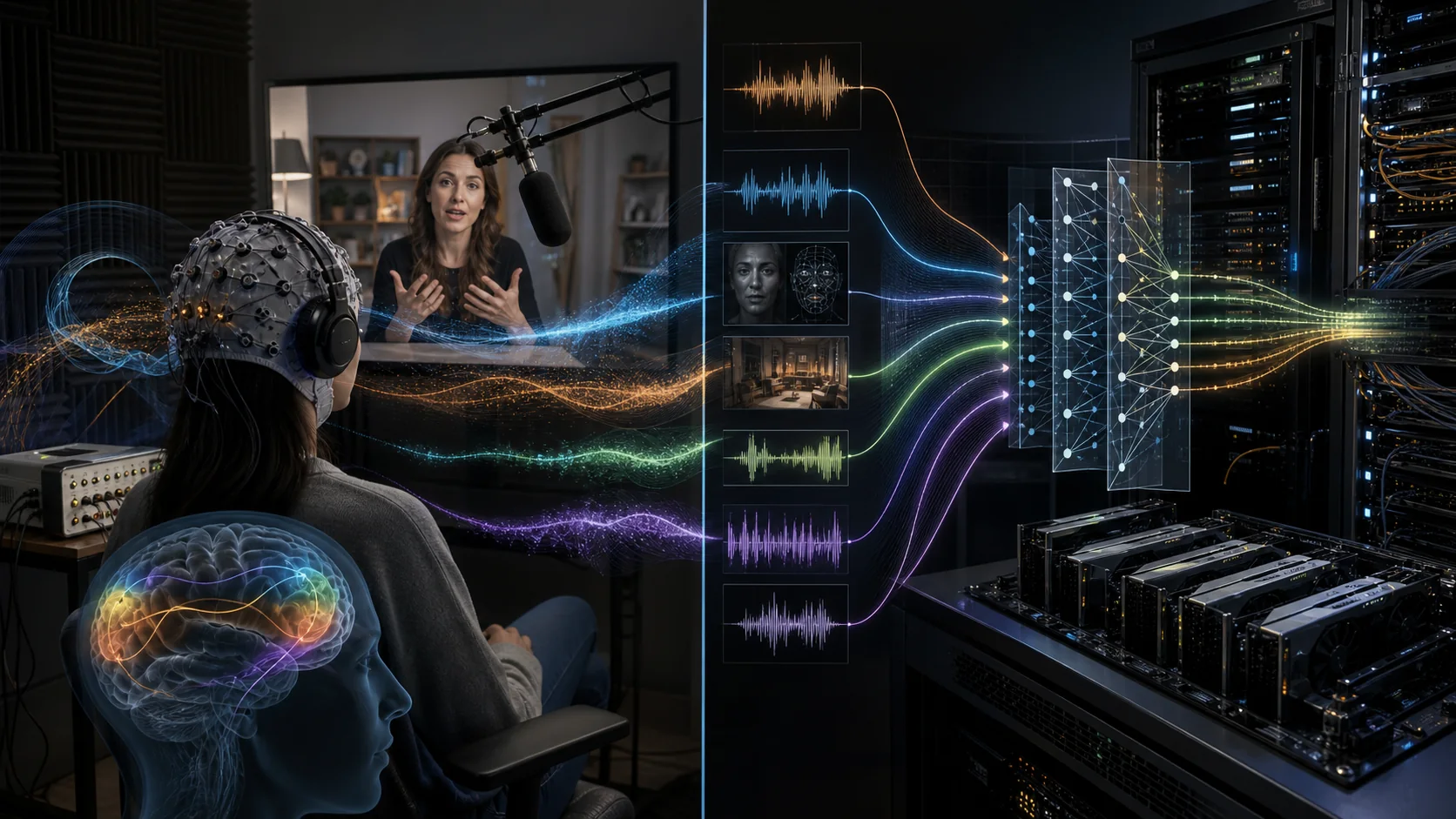
Sensory context improves language prediction in humans and LLMs.

Language is a fundamental human capacity. Large language models (LLMs) have presented the first viable model of language outside of humans, yet how these models learn and use language differs significantly from humans. Here, we compare LLMs and humans predicting language with varying levels of sensory information-from disembodied written text to audiovisual videos of speakers-to demonstrate that, in both humans and LLMs, sensory context is critical for optimal performance. We asked human partici

Continue reading
Artificial Intelligence

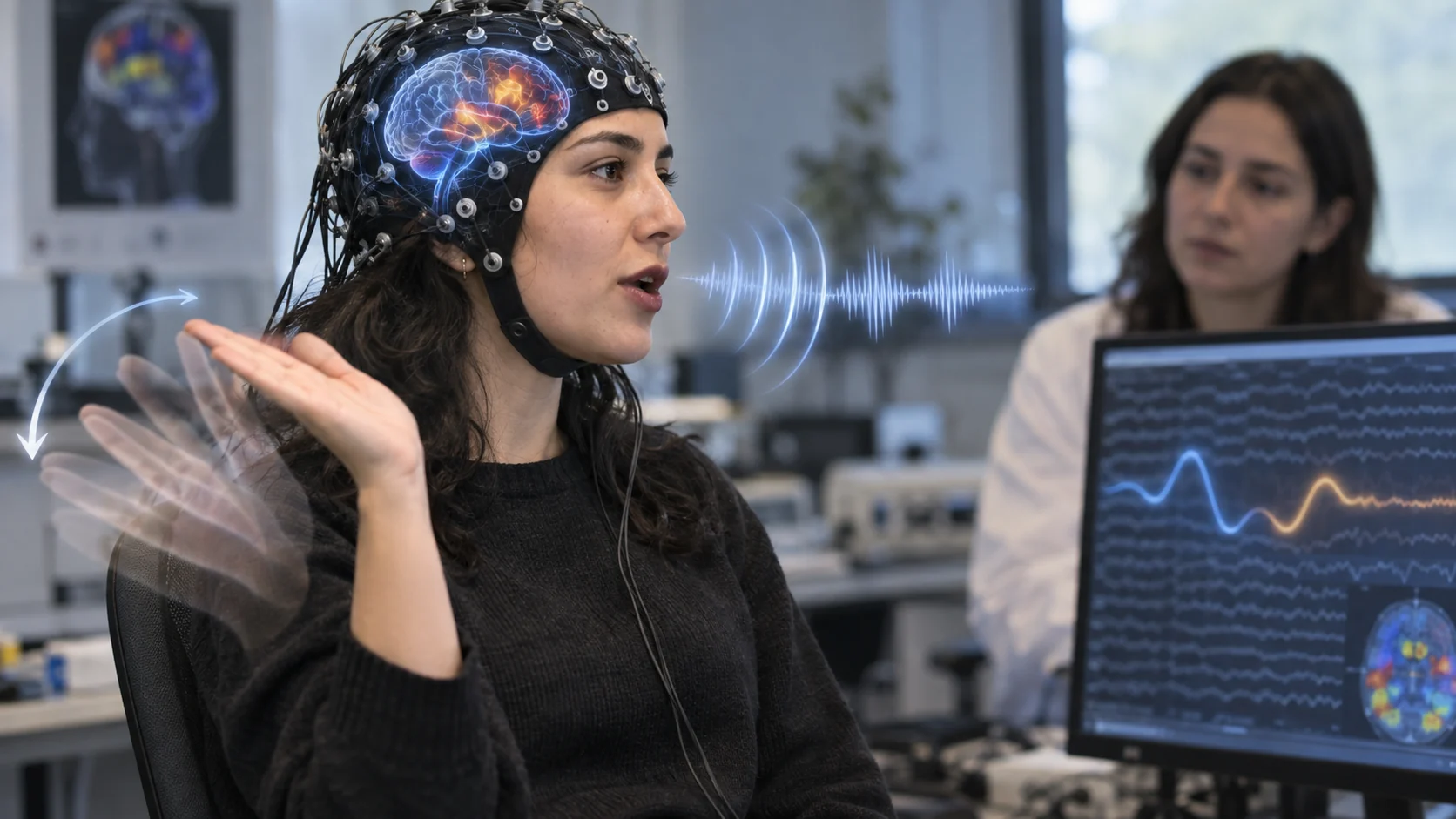
Multimodal integration supports neural processing of grammatical negation.

Negation is a fundamental aspect of human cognition and grammar, expressed across different modalities. Yet, little is known about multimodal processing of negation, especially grammatical negation (e.g., "I did not sleep"), and the contribution of gestures and prosodic markers to its neural processing remains unexplored. This study investigates the neurocognition of multimodal negation in Turkish, a verb-final language where standard verbal negation is expressed morphologically with a postverba

Continue reading