Environment

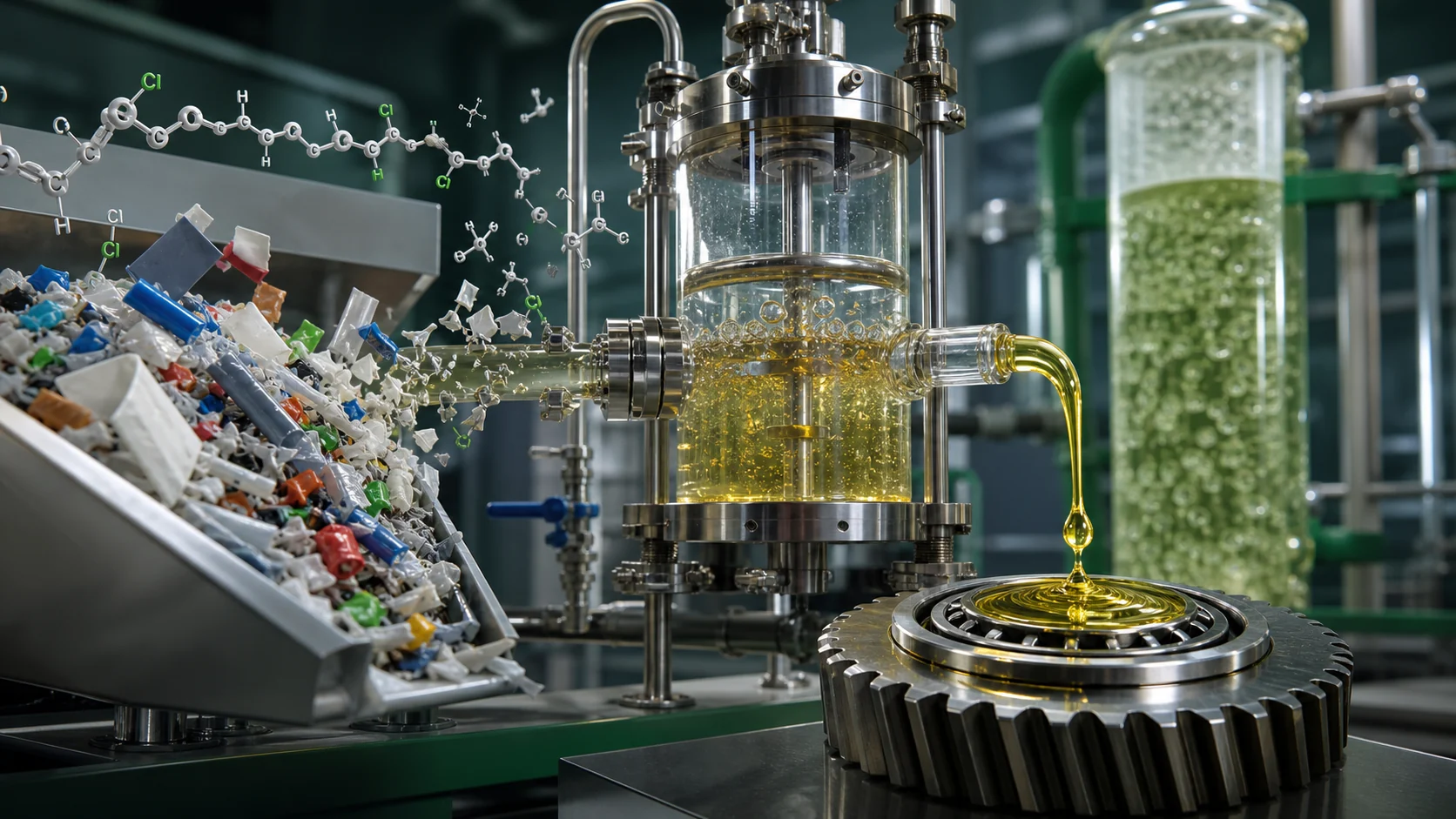
Upcycling of polyvinyl chloride into polyalphaolefin lubricants.
| Source: Nature

Polyvinyl chloride (PVC) is a thermoplastic used ubiquitously in households and industry owing to its light weight, mechanical strength, durability, low cost and ultraviolet and fire resistance 1,2 . With a production volume of about 60 million tonnes annually 2 , post-consumer and post-industrial PVC waste pose marked environmental challenges, such as leaching chlorohydrocarbons and additives, which contaminate groundwater and soil 1-4 . To address the formidable challenge of recycling PVC and

Polyvinyl chloride (PVC) is a thermoplastic used ubiquitously in households and industry owing to its light weight, mechanical strength, durability, low cost and ultraviolet and fire resistance 1,2 . With a production volume of about 60 million tonnes annually 2 , post-consumer and post-industrial PVC waste pose marked environmental challenges, such as leaching chlorohydrocarbons and additives, which contaminate groundwater and soil 1-4 . To address the formidable challenge of recycling PVC and achieving carbon circularity, valorization into high-value products is essential to mitigate the associated costs and offer high financial incentives for reusing plastic waste 5-14 . Here we report a method for upcycling PVC into high-value lubricants with controllable viscosities. Using AlCl 3 at a mild temperature of 70 °C, PVC undergoes dechlorination, alkylation and chain scission, producing vinyl-derived polyalphaolefins (vPAO). PVC serves as an effective template for the alkylation of α-olefins of various chain lengths, producing vPAO with limited short branches in the backbone without the need for metallocene catalysts essential to current PAO technology. The PVC-derived lubricants exhibit tunable molar masses, kinematic viscosities at 100 °C (KV 100  ≈ 14.9-26.3 centistokes), a low coefficient of friction (COF ≈ 0.08-0.15) and a high viscosity index (VI up to 130). This work highlights an economical approach to using PVC as a low-cost feedstock to synthesize high-value lubricants with superior tribological properties, meeting the demand for sustainability in both the plastic and lubricant industries.

Read the original source →

Related Stories

Environment

Highly localized droplet clustering in shallow cumulus clouds.

The size and spatial clustering of water droplets in warm clouds influence cloud evolution and radiation properties and thus are of fundamental importance for the Earth's energy balance and water cycle. Some proposed mechanisms for droplet growth and precipitation initiation in warm clouds require strong droplet clustering. Resolving such clustering on sub-cm scales remains a challenge. The most detailed observations, collected from aircraft, showed weak mm-scale droplet clustering averaged over

Continue reading
Environment

Reversing vegetable biodiversity loss to diversify diets.

Vegetables are a critical component of diets, with inadequate intake of this essential food group leading to poor dietary quality and malnutrition. Food system assessments identify insufficient production, comparatively high prices, and sociocultural barriers as key constraints to vegetable consumption. We argue that vegetable biodiversity, spanning vegetable species and their varieties, as well as their wild relative species, is a central yet underutilized lever for enhancing vegetable consumpt

Continue reading
Environment

Sediment accumulation rate predicts the temporal resolution of marine fossil assemblages.

Time averaging (TA), the mixing of noncontemporaneous organisms in fossil assemblages, governs the resolution of paleontological data and determines which biological and environmental processes are recorded in the geological record. To assess variation in TA and its dependence on external drivers, we used amino acid and radiocarbon methods to individually date 7,593 specimens across 384 samples from late Quaternary marine assemblages of calcifying organisms. Bivalve mollusks dominated the data,

Continue reading
Environment

Early-life sugar restriction causally reduces adult cancer incidence and slows biological aging

Excess sugar consumption is implicated in multiple cancers through insulin resistance, chronic inflammation, and metabolic reprogramming, yet whether early-life sugar exposure causally shapes long-term cancer risk remains an open question. We exploit the abrupt end of United Kingdom sugar rationing in September 1953 as a natural experiment, analyzing 64,761 UK Biobank participants born 1951–1956. Cohorts whose first 1,000 d of life fell under rationing exhibit dose-dependent reductions in adult

Continue reading
Environment

Circumventing thermodynamic limitations in converting carbon dioxide into carbon nanotubes via tandem catalysis

Carbon nanotubes (CNTs) are important materials for electronics and structural composites, but their production still relies on hydrocarbon-based chemical vapor deposition, an energy-intensive and fossil-dependent process, limited by rapid catalyst deactivation. Using CO 2 as a carbon feedstock offers a sustainable route for CNT synthesis, yet direct CO 2 conversion to CNTs is thermodynamically unfavorable and existing CO 2 -to-carbon pathways mainly yield amorphous or weakly graphitized solids.

Continue reading