Mechanism of catalytic regulation by an allosteric hot spot in dihydrofolate reductase.
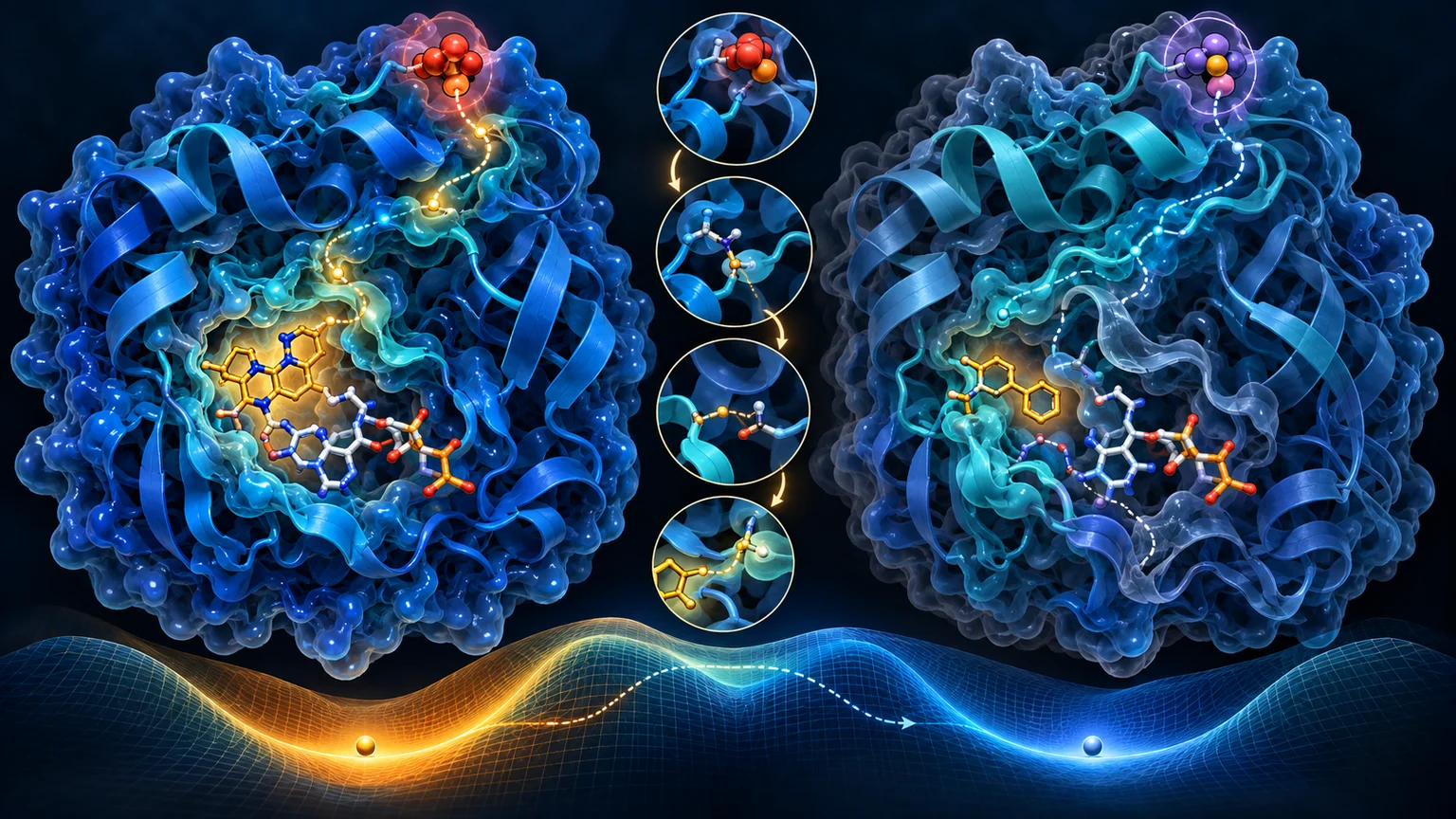
Allostery is central to catalysis and regulation, yet how distal perturbations control enzyme activity remains unresolved. Here we elucidate how a distal allosteric hot spot regulates catalysis in dihydrofolate reductase, a benchmark enzyme exhibiting latent allostery. We combine enhanced conformational sampling, reactive free-energy calculations of the chemical step, and perturbation-induced nonequilibrium molecular dynamics with evolutionary analysis and experimental kinetics to obtain a compr
Allostery is central to catalysis and regulation, yet how distal perturbations control enzyme activity remains unresolved. Here we elucidate how a distal allosteric hot spot regulates catalysis in dihydrofolate reductase, a benchmark enzyme exhibiting latent allostery. We combine enhanced conformational sampling, reactive free-energy calculations of the chemical step, and perturbation-induced nonequilibrium molecular dynamics with evolutionary analysis and experimental kinetics to obtain a comprehensive molecular description of conformational landscapes, catalytic activity, and allosteric communication. We show that a mutational perturbation at the hot spot redistributes the populations of two globally similar conformations with a subtle but critical structural difference that makes one catalytically competent and the other not. Nonequilibrium relaxation simulations further reveal that the transition between these two states in the mutant proceeds through a stepwise sequence of local structural rearrangements rather than a concerted global motion. Guided by this mechanism, we rationally engineer a compensatory second-site mutation that partially restores activity. These results provide a unified thermodynamic and kinetic view of allostery and establish a general, mechanistically guided framework for engineering allosteric regulation in enzymes.