Thermal cycling-induced nitriding increases energy-storage density in titanate ferroelectric films.
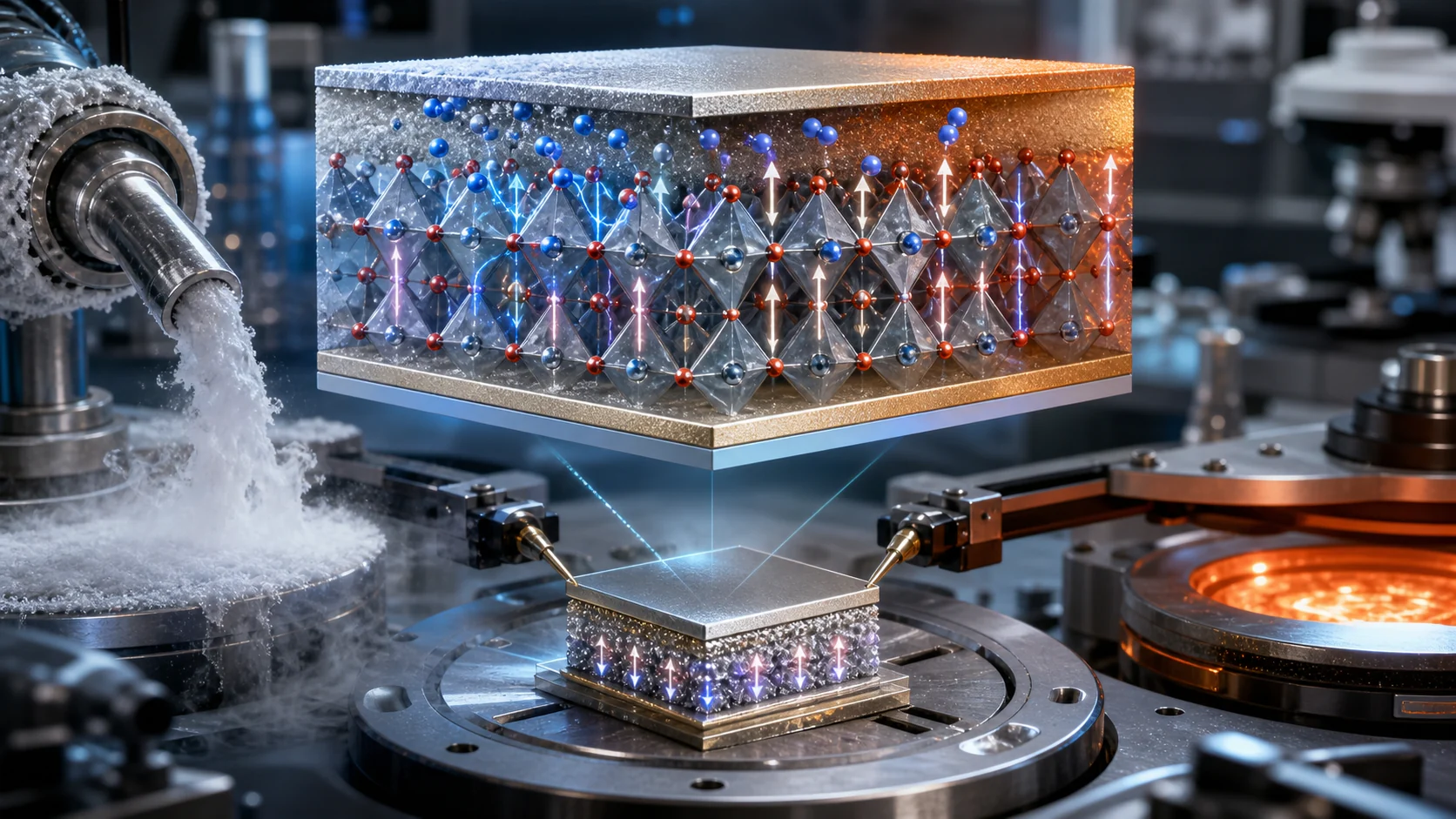
Enhancing dielectric energy-storage density ( U e ) requires maximizing the difference between maximum and remanent polarizations (Δ P ). Improving Δ P remains fundamentally challenging, as existing strategies rarely achieve simultaneous high maximum polarization and low remanent polarization. We introduce a postsynthesis treatment method, cryogenic thermal cycling, in which liquid nitrogen infiltrates the film and then is rapidly cycled to 100°C. This process markedly increases
Enhancing dielectric energy-storage density ( U e ) requires maximizing the difference between maximum and remanent polarizations (Δ P ). Improving Δ P remains fundamentally challenging, as existing strategies rarely achieve simultaneous high maximum polarization and low remanent polarization. We introduce a postsynthesis treatment method, cryogenic thermal cycling, in which liquid nitrogen infiltrates the film and then is rapidly cycled to 100°C. This process markedly increases Δ P to 105 microcoulombs per square centimeter in oxide ferroelectric titanate films through oxygen vacancy-mediated nitrogen hybridization. Using this approach, we increased U e to 261 joules per cubic centimeter with an efficiency approaching 80%. This approach is broadly applicable to diverse film materials with thicknesses spanning the nano- to microscale, offering a facile and cost-effective route to overcoming the critical bottleneck in Δ P and U e .