Structure Sensitivity in CH 4 Oxidation: Switching C 1 to C 2 Selectivity on Mn Single Atoms Versus Nanoparticles.
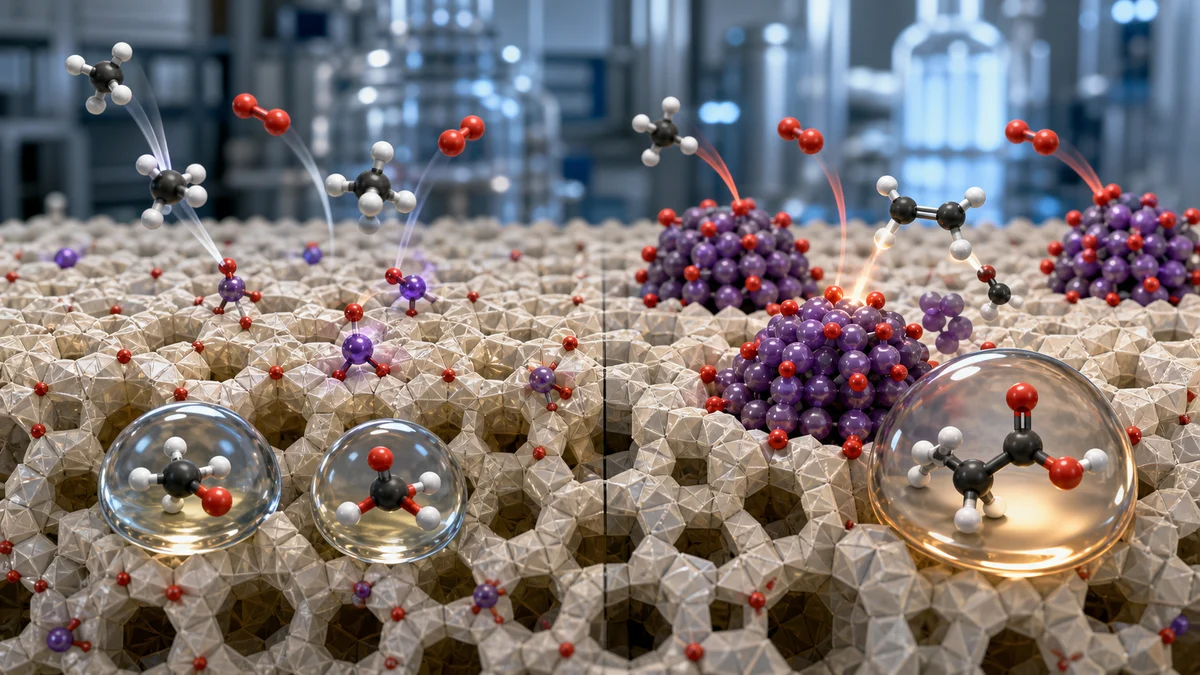
The direct selective oxidation of methane (DSOM) to high value-added liquid oxygenates using only CH 4 and O 2 under mild conditions remains a formidable challenge in catalysis. Herein, we report the use of highly dispersed MnO x /ZSM-5 catalysts, in the form of single atoms and nanoparticles, to steer the DSOM reaction toward C 1 and C 2 oxygenates, respectively. While the Mn single-atom catalysts (SACs) primarily produce C 1 products (HCOOH and CH 3 OH) with a combined selectivity of ∼
The direct selective oxidation of methane (DSOM) to high value-added liquid oxygenates using only CH 4 and O 2 under mild conditions remains a formidable challenge in catalysis. Herein, we report the use of highly dispersed MnO x /ZSM-5 catalysts, in the form of single atoms and nanoparticles, to steer the DSOM reaction toward C 1 and C 2 oxygenates, respectively. While the Mn single-atom catalysts (SACs) primarily produce C 1 products (HCOOH and CH 3 OH) with a combined selectivity of ∼ 78.8%, the Mn nanoparticle (NP) catalysts exclusively produce liquid oxygenates with excellent stability, achieving a remarkable acetic acid selectivity of 81.8%. Various characterizations and density functional theory calculations reveal that the reaction path is governed by distinct methane activation mechanisms at different Mn sites. On SACs, CH 4 is selectively activated to *CH 3 at Mn-O sites, leading to C 1 oxygenates. In contrast, the multiple MnO x sites on NPs promote further dehydrogenation to *CH 2 species, which subsequently couple into a key ethylene intermediate. This intermediate is then oxidized to acetic acid via a nonclassical pathway that circumvents CO carbonylation, thereby effectively suppressing overoxidation. This work provides fundamental insights into structure-sensitive methane activation and offers a practical route for the direct valorization of CH 4 into value-added oxygenates using a noble-metal-free catalytic system.