Society & Culture

Stereoselective Epimerization of 1,3-Diols Using a Chiral Hydrogen Atom Abstraction Catalyst.
| Source: Journal of the American Chemical Society

The 1,3-diol unit is an extremely important functional group motif, and significant effort has gone into development of methods to access it with definition of relative and absolute stereochemistry. Conventionally, stereochemical complexity is built up in a stepwise manner alongside functional group interconversion. It is interesting to consider an unconventional approach whereby the diol may be synthesized nonselectively and the stereoisomers "descrambled" by a chiral catalyst in a subsequent s

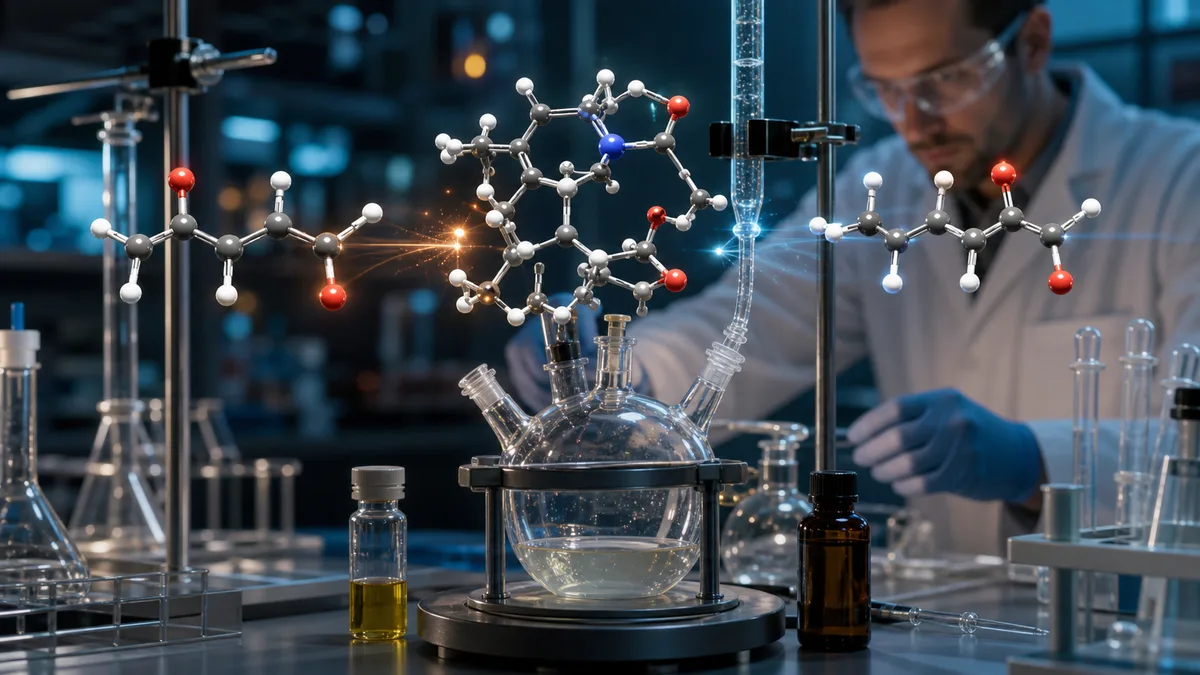
The 1,3-diol unit is an extremely important functional group motif, and significant effort has gone into development of methods to access it with definition of relative and absolute stereochemistry. Conventionally, stereochemical complexity is built up in a stepwise manner alongside functional group interconversion. It is interesting to consider an unconventional approach whereby the diol may be synthesized nonselectively and the stereoisomers "descrambled" by a chiral catalyst in a subsequent step. We report studies toward this goal using a cinchona alkaloid-derived hydrogen atom abstraction catalyst. This catalyst permits selective hydrogen atom abstraction from a given stereoisomer out of, in some cases three or four, depending on diol substitution. The relative rates of abstraction from different stereoisomers determine the ultimate product outcome after hydrogen atom delivery from an achiral thiol. Symmetrical 1,3-diols participate in a kinetic resolution process whereby one enantiomer is converted to the meso diastereomer with extremely high selectivity, a rare example of a kinetic resolution involving conversion of one enantiomer to an achiral diastereomer. Nonsymmetrical 1,3-diols exhibit different outcomes depending on substitution, and their behavior is systematically explored. Notably, sterically differentiated substrates can allow high ee of both syn and anti diastereomers to be achieved from racemic starting material. On the basis of mechanistic studies, a unified rationalization of the behavior of 1,3-diols of various types with our catalyst is presented, and we additionally evaluate the analogous chiral 1,2-diols, uncovering promising outcomes with nonsymmetrical diols.

Read the original source →

Related Stories

Society & Culture

Christopher A. Sims (1942-2026): Paradigm-shifting macroeconomist and econometrician.

Christopher A. Sims, who died on March 14, 2026, left behind an indelible mark on macroeconomics and econometrics. His Nobel Prize winning research reshaped the paradigm for empirical macroeconomics, creating a rigorous and flexible framework for inferring the effects of macroeconomic policies. He also made important contributions to time series forecasting, Bayesian econometrics, factor modeling, approximation theory, and models of monetary and fiscal policy. Few academics have had as direct an

Continue reading
Society & Culture

Social dynamics of AI adoption in parents' educational decisions.

When adopting a performance-enhancing technology offers short-run relative advantages, competitive pressure can drive diffusion even if most adopters would prefer a collective ban. We study this dynamic in the context of unrestricted AI tools for teenagers' education. In preregistered, incentive-compatible experiments with approximately 2,000 parents in the United States, Canada, and the United Kingdom, we elicit willingness to pay for a three-month premium subscription to a leading general-purp

Continue reading
Society & Culture

The social-class gap in negotiation: Lower-class individuals negotiate less and face more backlash.

Economic inequality has widened considerably in the United States and globally, raising pressing questions about the mechanisms that reproduce social stratification. One prominent manifestation of this inequality is the "class ceiling" in organizations: individuals from lower social classes earn less and advance more slowly than their higher-class counterparts, even with comparable credentials. We identify a crucial behavioral pathway contributing to this class ceiling: a social-class gap in the

Continue reading
Society & Culture

Dynamic Coordination-Enabled Metal-Dependent Configurational Switching in a Covalent Organic Framework.

The synthesis of crystalline materials capable of precise and chemically triggered structural transformations remains a significant challenge. Herein, we report a dynamic coordination-mediated strategy for constructing a highly stable bis-acylhydrazone-linked covalent organic framework, COF-LIFM20-Zn, featuring an adjustable U-shaped pentadentate Zn coordination center. The dynamic coordination behavior of Zn 2+ enables reversible interconversions between U- and W-shaped configurations through d

Continue reading
Society & Culture

Anionic Passivation Enables Reconstruction-Free Seawater Electrolysis.

Nonoxide electrocatalysts hold great promise for high-efficiency seawater oxidation, yet their practical application is hindered by the inevitable surface reconstruction and pronounced corrosion under high anodic potentials. Herein, we solve this longstanding challenge by developing a rational anionic ligand passivation strategy that stabilizes phosphide lattices against oxidative degradation while preserving inherent electrocatalytic activity. Leveraging Lewis acid-base interactions, we grow an

Continue reading