Soft matter, hard rules: Emulsions follow the laws of granular suspension rheology.
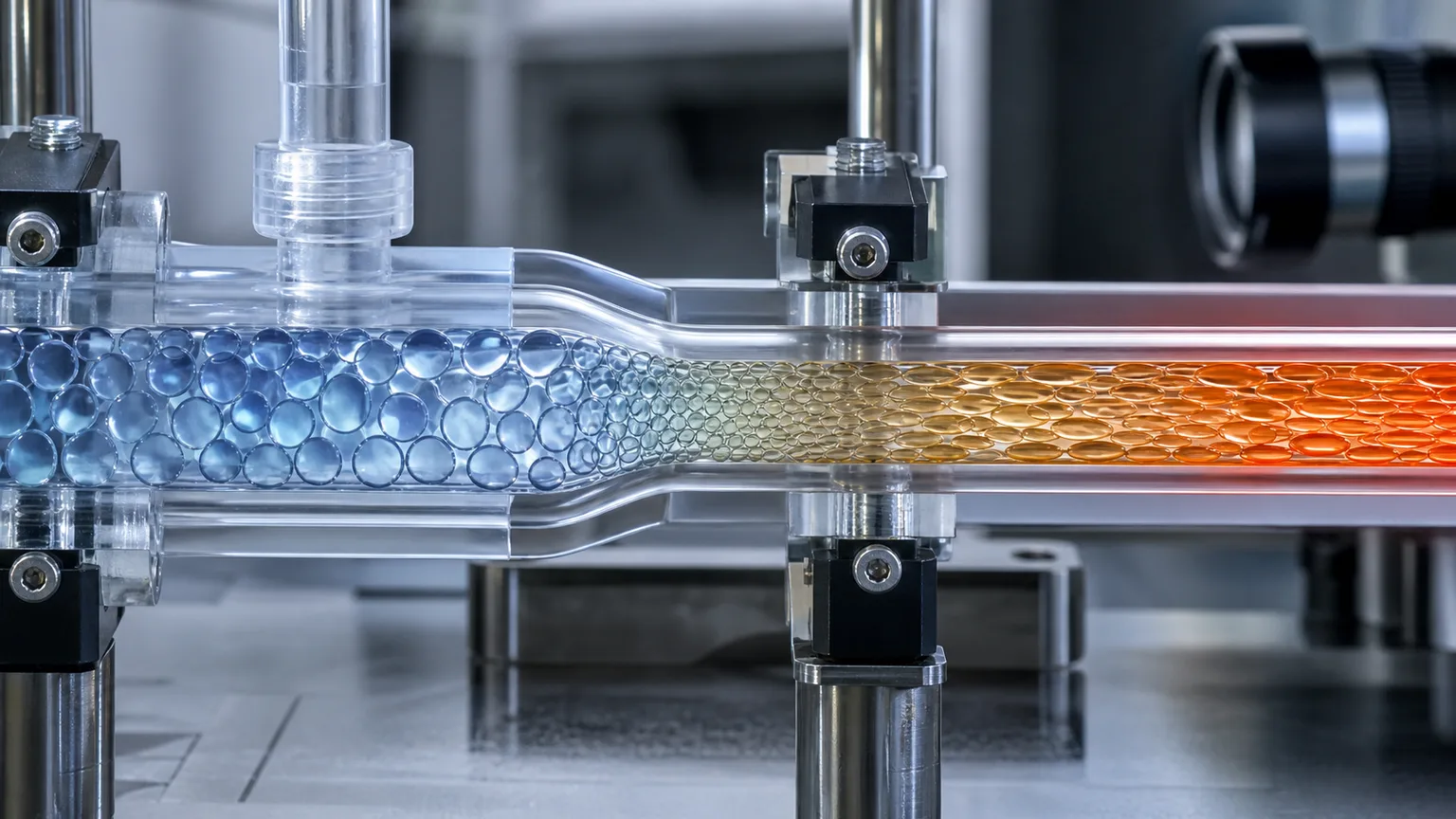
The flow of dense emulsions underlies applications from food and pharmaceutical processing to bioengineering, yet their rheology remains difficult to interpret under conventional volume-imposed conditions. Here, we change the control variable to osmotic-pressure using a recently developed instrument-the Capillarytron. This approach reveals a unified rheological structure where the osmotic pressure [Formula: see text], by controlling droplet deformation, sets a pressure-dependent jamming volume f
The flow of dense emulsions underlies applications from food and pharmaceutical processing to bioengineering, yet their rheology remains difficult to interpret under conventional volume-imposed conditions. Here, we change the control variable to osmotic-pressure using a recently developed instrument-the Capillarytron. This approach reveals a unified rheological structure where the osmotic pressure [Formula: see text], by controlling droplet deformation, sets a pressure-dependent jamming volume fraction. When expressed in terms of the distance to this jamming point, all rheological data-spanning both [Formula: see text]- and [Formula: see text]-imposed measurements-collapse onto a single power-law divergence, akin to granular suspensions. The resulting constitutive relations provide a predictive, parameter-free description of emulsion rheology across Newtonian, yielding, and shear-thinning regimes. Together with recent results on soft spheres, our findings point to a unifying paradigm: Soft amorphous materials-from soft spheres to emulsions and likely foams-obey the same hard rules as granular suspensions, with softness entering through a pressure-dependent jamming point. This framework rationalizes Herschel-Bulkley rheology, assigns its parameters microscopic meaning, and opens perspectives on rigidity transitions in soft, deformable systems, including biological tissues.