Health & Medicine

SIX1 is required for adult cochlear sensory epithelium homeostasis and auditory function
| Source: PNAS

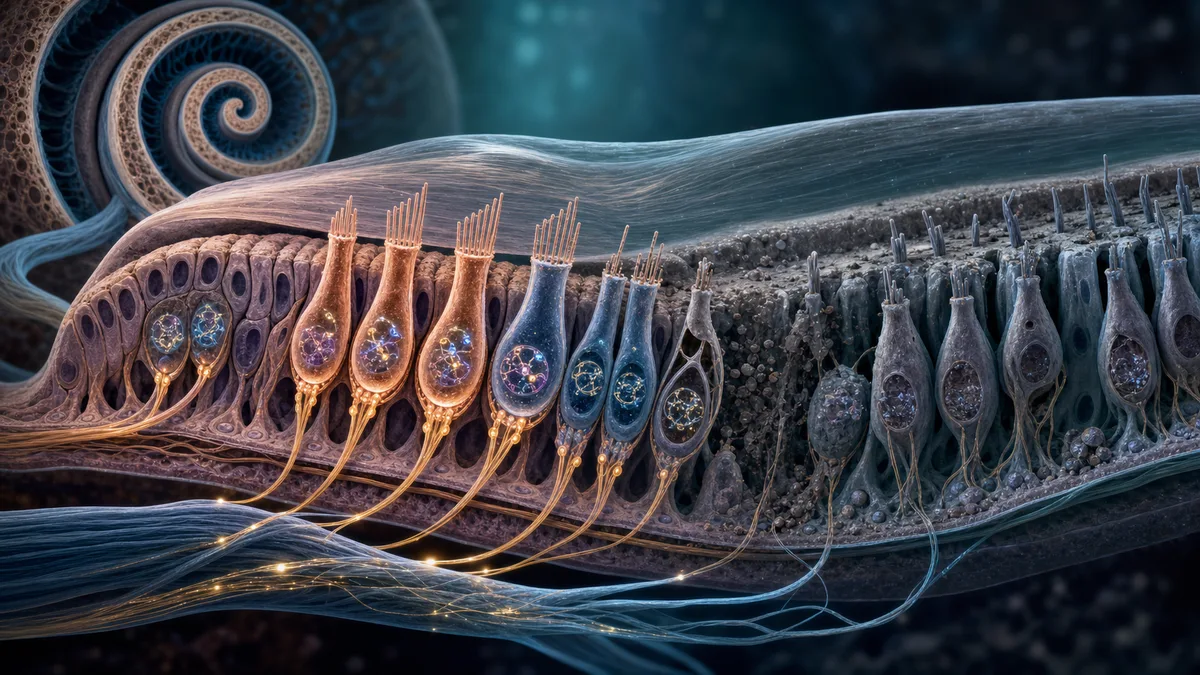
The mammalian auditory sensory epithelium consists of hair cells (HCs), whose stereociliary bundles convert sound-evoked vibrations into electrical signals, and supporting cells (SCs), which provide mechanical stability. The transcription factor SIX1 is essential during otic neurosensory cell specification and HC commitment, but its contribution after birth has remained elusive. Here, we show that SIX1 is required for maintaining the structure and function of the adult cochlear sensory epitheliu

The mammalian auditory sensory epithelium consists of hair cells (HCs), whose stereociliary bundles convert sound-evoked vibrations into electrical signals, and supporting cells (SCs), which provide mechanical stability. The transcription factor SIX1 is essential during otic neurosensory cell specification and HC commitment, but its contribution after birth has remained elusive. Here, we show that SIX1 is required for maintaining the structure and function of the adult cochlear sensory epithelium. Conditional deletion of Six1 in SCs or HCs of young adult mice causes profound deafness. SC-specific deletion disrupts epithelial organization and promotes SC loss with secondary HC degeneration, whereas HC-specific loss results in stereociliary-bundle defects and progressive HC death. To define early molecular defects, we performed single-nucleus RNA-seq before widespread degeneration and found early collapse of mature HC identity and functional gene programs, including mechanotransduction, stereociliary-bundle, and synaptic networks. SIX1 ChIP-seq analysis in the mature cochleamapped SIX1 occupancy at regulatory elements near genes involved in epithelial junctions, actin/cytoskeletal regulation, ion transport, mechanotransduction, and cell survival, and overlapped with a subset of Six1 -dependent transcripts and deafness loci. Together, these results identify SIX1 as a key transcriptional regulator of adult cochlear homeostasis and reveal downstream gene networks that preserve sensory epithelial integrity and hearing throughout life.
Read the original source →

Related Stories

Health & Medicine

Palmitoylation of TK1 exacerbates osteoarthritis by promoting JNK-mediated metabolic reprogramming.

Osteoarthritis (OA) lacks approved disease-modifying therapies. Here, by integrating quantitative proteomics with reanalysis of public single-cell RNA sequencing data from human articular cartilage, we identify thymidine kinase 1 (TK1) as a pathogenic regulator linking inflammatory stress to metabolic rewiring and matrix breakdown. TK1 is markedly upregulated in OA chondrocytes. Mechanistically, IL-1β enhances S-palmitoylation of TK1 at Cys153, which promotes USP9X-dependent deubiquitinati

Continue reading
Health & Medicine

Cryoelectron tomography reveals an age-related decline in mitoribosomes that contributes to T cell dysfunction in older individuals.

Mitochondrial dysfunction drives T cell aging in mice. Yet, due to fundamental differences in T cell aging mechanisms between species, whether human T cells exhibit similar mitochondrial alterations remains unclear, with existing evidence often conflicting. Using cryoelectron tomography, we resolved the structure and spatial organization of mitochondrial ribosomes in primary human CD8 + T cells under physiological conditions. Comparative analysis with human aging models revealed an age-related r

Continue reading
Health & Medicine

RelB NF-κB tunes Notch2 signaling to promote IL-23-secreting solitary isolated lymphoid tissue-resident DCs critical for gut immunity.

While preserving tolerance toward commensals, dendritic cells (DCs) also orchestrate response against pathogens. The noncanonical RelB NF-κB pathway in DCs curbs tolerogenic Tregs in the intestine. Whether RelB-dependent DC regulations also impact intestinal immunity remains less clear. Here, we show that genetic ablation of RelB in DCs compromises IL-23-dependent immune response in the intestine, imparting vulnerability in Relb ΔCD11c mice to infection with Citrobacter rodentium , a

Continue reading
Health & Medicine

X-linked SYTL4 missense variant disrupts RAB27A-dependent vesicle trafficking and synaptic transmission in autism.

Autism spectrum disorder (ASD) is a neurodevelopmental condition characterized by impaired social communication and repetitive behaviors, with genetic studies implicating widespread synaptic dysfunction. However, the contribution of presynaptic vesicle trafficking mechanisms to ASD pathogenesis remains incompletely understood. Here, we identify synaptotagmin-like protein 4 (SYTL4), a RAB27A effector previously characterized in secretory cells, as a regulator of presynaptic function in the mammal

Continue reading
Health & Medicine

Folic acid prevention of neural tube defects requires retinoic acid produced by ALDH1L1.

Folic acid (FA) supplementation during pregnancy is the commonly accepted treatment to prevent neural tube defects. The mechanism by which FA prevents neural tube defects (NTDs) remains unclear. FA also prevents other developmental malformations, including alcohol-induced malformations in Fetal Alcohol Syndrome models. We show that FA acts through a metabolic link to retinoic acid (RA) signaling. Using a pax3 -knockdown Xenopus model of FA-rescuable NTDs, we show that RA or its precursors equall

Continue reading