Photoinduced Copper-Catalyzed Site- and Stereoselective Desymmetrizing β-C(sp 3 )-H Alkynylation of Cycloalkyl Amines.
The one-step construction of multiple contiguous stereogenic centers to access structurally complex, enantioenriched molecules remains a long-standing challenge in organic synthesis and has garnered considerable attention. Catalytic desymmetrization has emerged as a pivotal strategy for forging such arrays in a single operation, proving invaluable in pharmaceutical synthesis and materials development. Herein, we report a photoinduced, copper-catalyzed site- and stereoselective β-C(sp 3 )-H
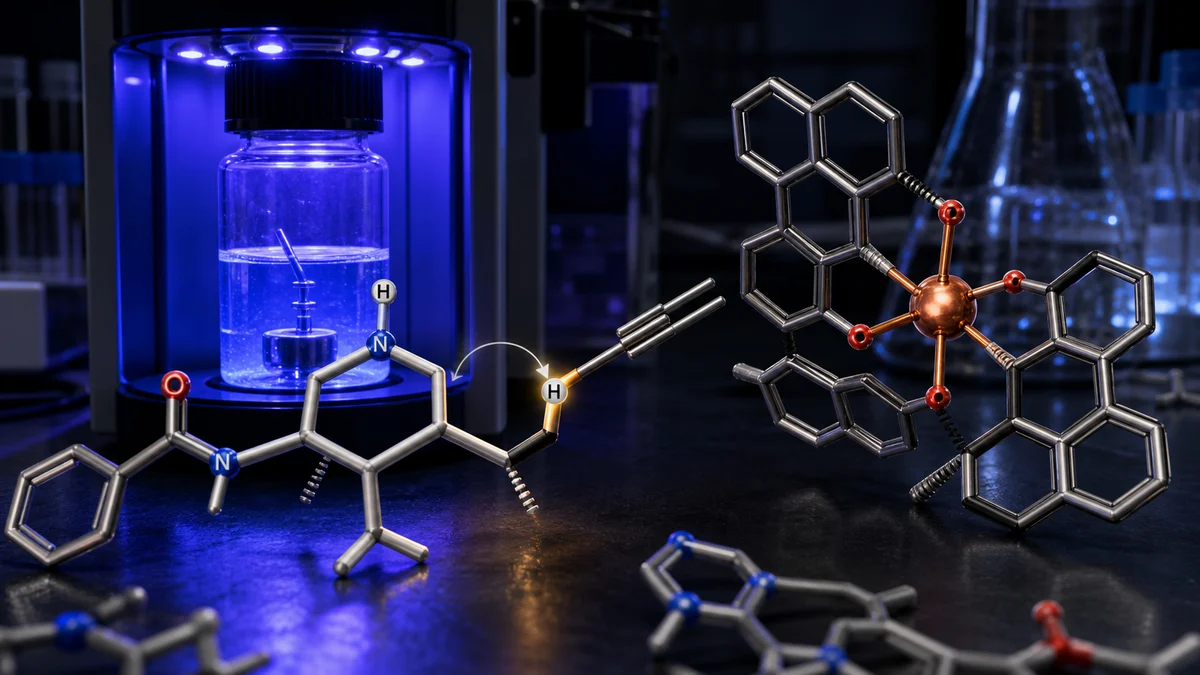
The one-step construction of multiple contiguous stereogenic centers to access structurally complex, enantioenriched molecules remains a long-standing challenge in organic synthesis and has garnered considerable attention. Catalytic desymmetrization has emerged as a pivotal strategy for forging such arrays in a single operation, proving invaluable in pharmaceutical synthesis and materials development. Herein, we report a photoinduced, copper-catalyzed site- and stereoselective β-C(sp 3 )-H alkynylation of cycloalkyl amines via an intramolecular 1,5-hydrogen atom transfer (HAT) strategy, achieving the desymmetrizing radical cross-coupling (DRCC) of enantiotopic C(sp 3 )-H bonds to form C(sp 3 )-C(sp) bonds in the challenging unstrained ring system. A novel combination of binaphthol and a tridentate anionic chiral ligand serves both as the photosensitizer and the chiral catalyst. This practical protocol displays broad functional group tolerance and delivers excellent stereoselectivity via substrate control, installing multiple chiral centers in one step. For a range of acyclic amine substrates, this reaction also exhibits excellent site-selectivity. The method's versatility is further demonstrated by the direct incorporation of alkynyl groups into complex scaffolds, facilitating subsequent synthetic applications and the efficient synthesis of bioactive molecules. DFT calculations indicate that the radical alkynylation is achieved through a concerted coupling pathway. Structural analysis unveils that the robust N-H···π hydrogen bond and the positioning of bulky groups in equatorial orientations are two key factors that stabilize the concerted coupling transition state and guarantee high enantioselectivity.