Open framework–based Brønsted acid–Lewis base interfaces boost proton transfer in the fuel cells
Limited proton conductivity within the catalyst layer induces severe ohmic polarizations and constrains power output at high hydrogen-to-electricity efficiencies in proton exchange membrane fuel cells. We demonstrate that proton transfer can be boosted by constructing Brønsted acid–Lewis base interfaces through integrating organic open frameworks with Nafion. These confined interfaces mediate low-barrier relay pathways, disrupt hydrogen bonding to expedite water network reorganization, facilitat
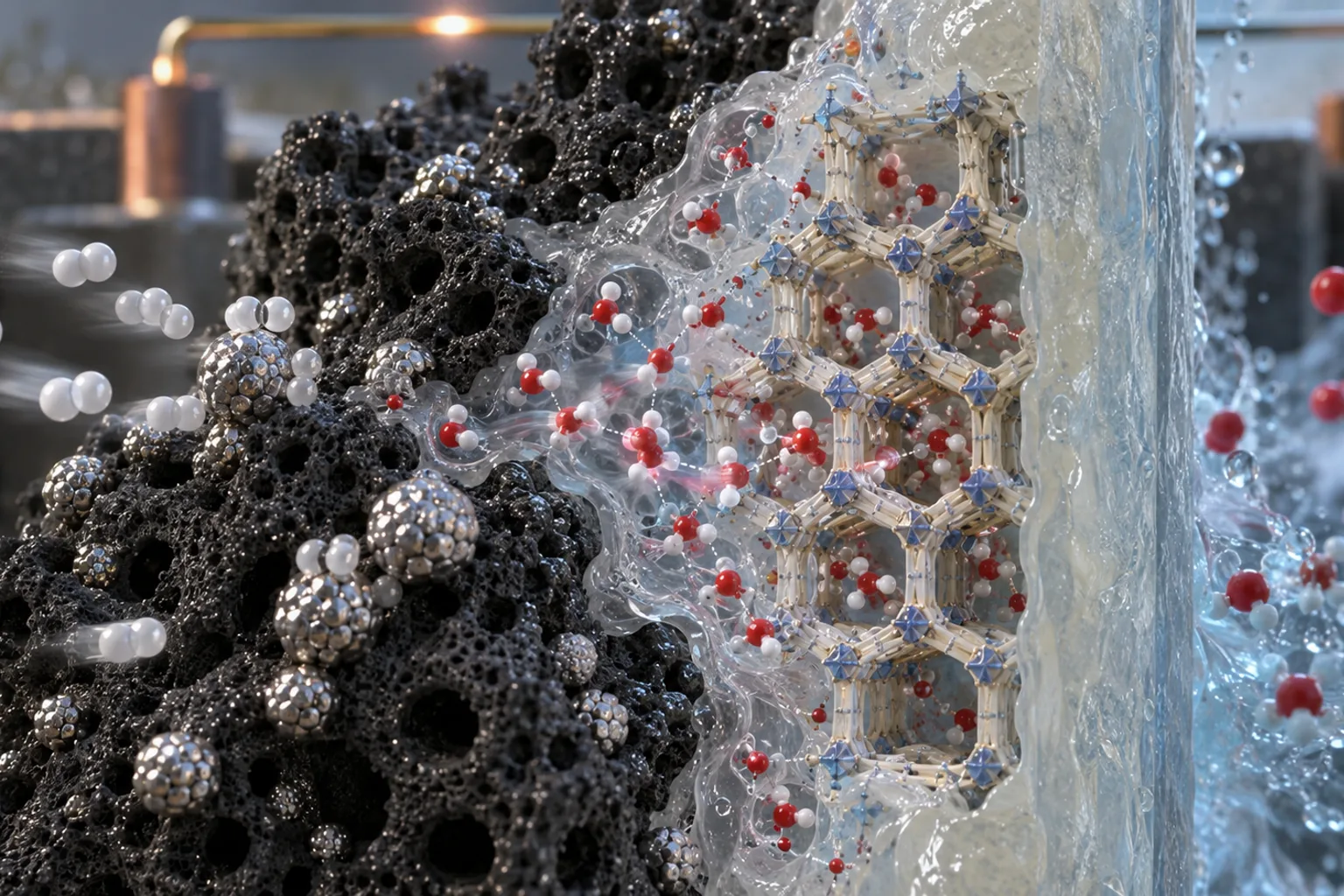
Limited proton conductivity within the catalyst layer induces severe ohmic polarizations and constrains power output at high hydrogen-to-electricity efficiencies in proton exchange membrane fuel cells. We demonstrate that proton transfer can be boosted by constructing Brønsted acid–Lewis base interfaces through integrating organic open frameworks with Nafion. These confined interfaces mediate low-barrier relay pathways, disrupt hydrogen bonding to expedite water network reorganization, facilitate consecutive proton transfer, and enrich protons locally. Compared with Nafion, the complexes exhibit an order-of-magnitude increase in proton self-diffusion coefficient, a 6.5-fold rise in proton conductivity, and a 55% reduction in activation energy. When integrated with commercial platinum on carbon, they deliver a fourfold increase in rated power output relative to the baseline, outperforming representative state-of-the-art membrane electrode assemblies with advanced catalysts under similar conditions.