Observation of tunable superradiant frequency combs.
Cavity quantum electrodynamics 1 with quantum emitters coupled to resonators provides a powerful platform for engineering light-matter interactions 2,3 and exploring many-body phenomena 4,5 . In particular, superradiance 6 -arising from collective quantum interference among emitters-has been explored as a route to ultrastable continuous radiation 7 . However, engineering superradiance in the time domain to realize periodic pulsed sources or frequency combs remains largely unexplored. Here we inv
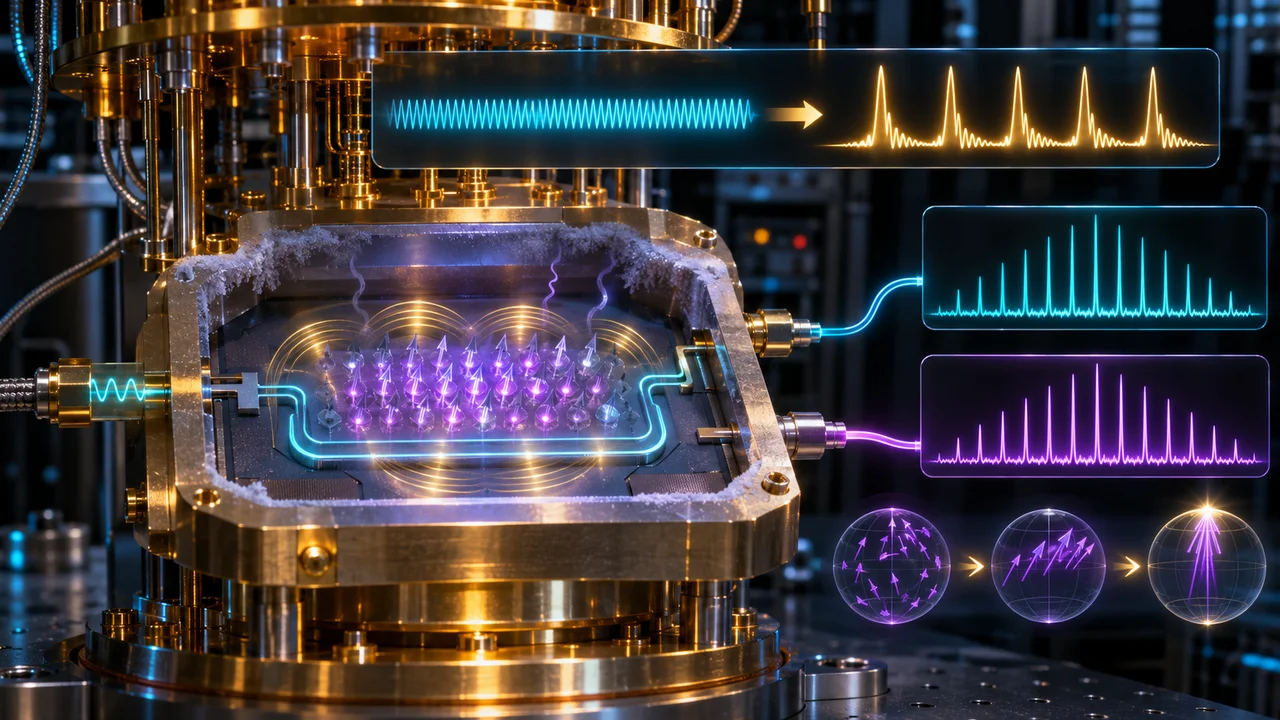
Cavity quantum electrodynamics 1 with quantum emitters coupled to resonators provides a powerful platform for engineering light-matter interactions 2,3 and exploring many-body phenomena 4,5 . In particular, superradiance 6 -arising from collective quantum interference among emitters-has been explored as a route to ultrastable continuous radiation 7 . However, engineering superradiance in the time domain to realize periodic pulsed sources or frequency combs remains largely unexplored. Here we investigate the non-equilibrium many-body dynamics of a driven spin ensemble coupled with an on-chip superconducting resonator and uncover a dynamical phase transition from continuous-wave to periodic pulsed superradiant emission. To quantitatively capture the observed dynamical phases, we introduce a driven-dissipative cavity-quantum electrodynamics model that elucidates how the periodic pulsed superradiant phase emerges from collective, periodically repeating spin dynamics stabilized by the interplay of coherence growth, disorder and dissipation. We also find that rare-earth ion spin systems with both optical and microwave transitions enable phase-synchronized, dual-rail superradiant frequency combs in both the microwave and the optical domains. Our results not only open new opportunities for atom-based frequency-comb sources and programmable superradiant generation, but establish a fundamental connection between periodic pulsed superradiance and the emergence of a continuous time crystal 8-10 as a new non-equilibrium phase in driven open systems.