Physical/Tech

Maternal influences on infant gut microbiome and health.
| Source: Nature

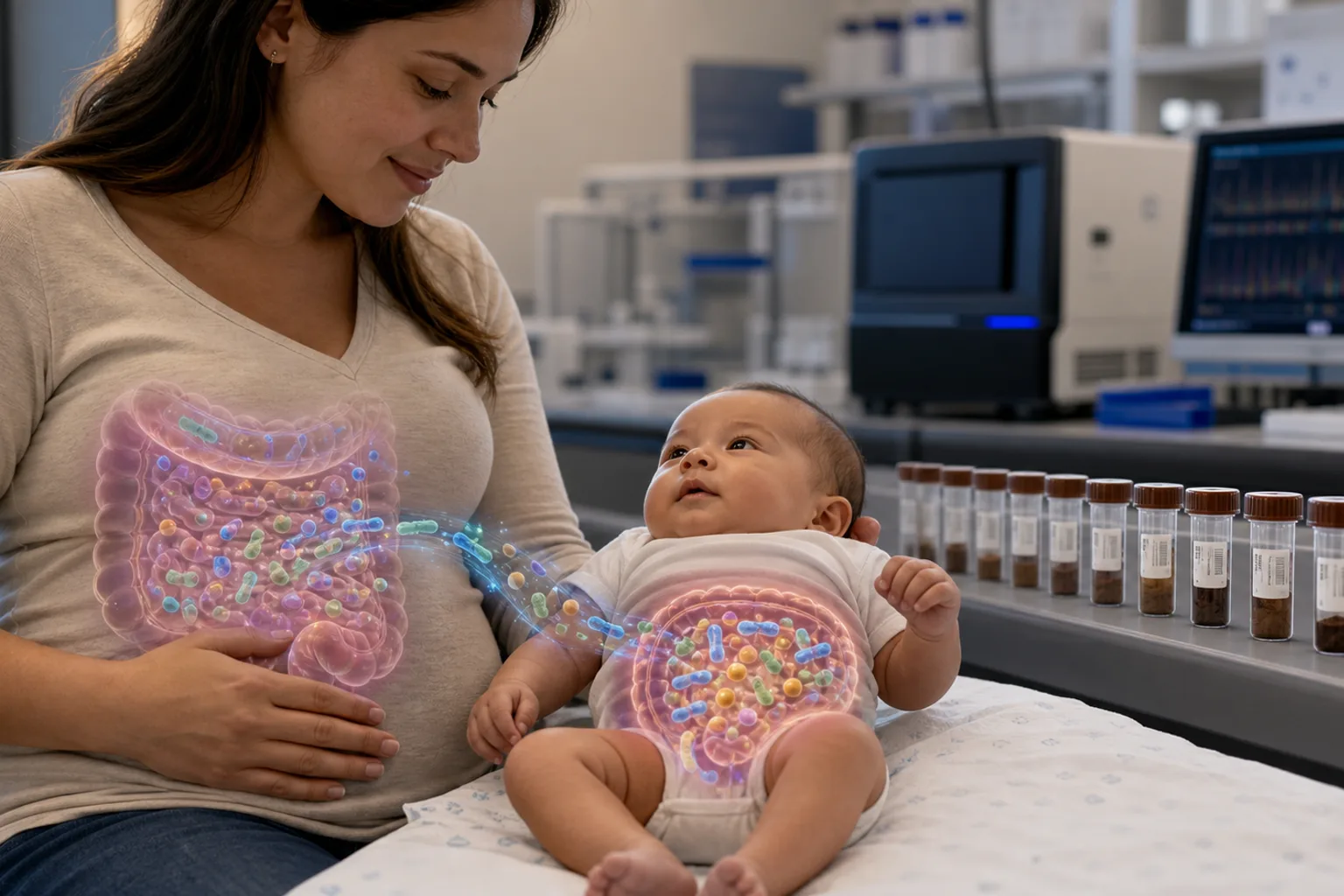
The establishment of the infant gut microbiome is critical for later health 1,2 , yet how it is shaped by maternal and early-life factors remains unclear. Here we metagenomically sequenced 4,526 longitudinal faecal samples from 714 mother-infant pairs in the Dutch birth cohort Lifelines NEXT, spanning 12 weeks of pregnancy to 1 year postpartum. We integrated these data with 474 clinical and exposure variables, and with ultra-deep sequencing of breast milk and vaginal microbiomes. W

The establishment of the infant gut microbiome is critical for later health 1,2 , yet how it is shaped by maternal and early-life factors remains unclear. Here we metagenomically sequenced 4,526 longitudinal faecal samples from 714 mother-infant pairs in the Dutch birth cohort Lifelines NEXT, spanning 12 weeks of pregnancy to 1 year postpartum. We integrated these data with 474 clinical and exposure variables, and with ultra-deep sequencing of breast milk and vaginal microbiomes. We observe that the maternal gut microbiome undergoes only subtle changes during pregnancy and postpartum, influenced by diet, infections and pre-pregnancy smoking. The maternal gut microbiome is a major reservoir for infant gut strains, with only occasional transmission from vaginal and breast milk microbiomes. Mother-infant gut strain sharing is time dependent, and higher maternal gut species abundance increases the likelihood of strain transmission. We find that the maternal gut microbiome is a predictor of infant eczema. Mode of delivery and feeding mode primarily shaped the infant gut microbiome and its functional profiles, with maternal exposures also having a role. Of 585 vaginally delivered infants, 155 were born at home, but home delivery was only moderately associated with infant gut microbiome composition, similar to other birth parameters such as duration of pushing and ruptured membranes. Overall, we highlight the central role of the mother and her microbiome in shaping the infant gut ecosystem and early health outcomes.

Read the original source →

Related Stories

Physical/Tech

Reaction-based cryo-EM resolves the continuous conformational spectrum of CTP synthase catalysis.

Capturing enzymes under native turnover conditions remains a grand challenge in structural biology. Here, we develop a reaction-based cryo-electron microscopy (cryo-EM) strategy that directly samples Drosophila melanogaster cytidine triphosphate synthase (CTPS) from actively catalyzing mixtures containing only natural substrates and allosteric effectors. By integrating reaction-based sampling with three-dimensional variability analysis, we resolve a continuous conformational spectrum of CTPS dur

Continue reading
Physical/Tech

GTP orchestrates CTP synthase via an allosteric effector-cycling mechanism.

Cytidine triphosphate (CTP), a fundamental building block of RNA, plays vital roles in diverse biological processes. CTP synthase (CTPS) is the only known enzyme for de novo synthesis of CTP. Efficient CTPS catalysis requires guanosine triphosphate (GTP) in a dose-dependent, nonconsumptive manner; however, the precise mechanism by which GTP drives CTP formation remains unclear. Here, we integrate a series of cryo-EM structures of Drosophila melanogaster CTPS captured from actively catalyzing sam

Continue reading
Physical/Tech

Convergent innovation of (crypto)vivipary via asymmetric dismantling of seed desiccation and dormancy machinery.

Cryptovivipary and vivipary, referred to as (crypto)vivipary, occur across multiple angiosperm lineages and enable embryos to continue developing before dispersal. Yet, this trait raises a fundamental question: how are seed-specific abscisic acid (ABA) responses modulated to support continuous embryonic growth without compromising ABA-dependent vegetative stress tolerance? Here, integrating phylogenomic analyses of independently evolved (crypto)viviparous lineages with spatiotemporal transcripto

Continue reading
Physical/Tech

The Benjamini-Hochberg procedure can fail to control the FDR for correlated two-sided Gaussian tests.

The Benjamini-Hochberg (BH) procedure is the standard method for controlling the false discovery rate (FDR) in large-scale studies involving testing multiple hypotheses. Whether the BH procedure controls the FDR for every correlation structure among two-sided Gaussian tests has been a long-standing question, and a positive answer has been believed. Here, we settle the question negatively, by providing examples of Gaussian factor models for which the BH method fails to control the FDR at the nomi

Continue reading
Physical/Tech

NA-CDQuant: Quantitative spectral analysis of nucleic acid structure by circular dichroism spectroscopy.

Understanding the structural conformation and dynamics of nucleic acids in solution is critical for the development of nucleic acid therapeutics involving antisense or mRNA therapies, where controlling stability, efficacy, and manufacturability are important. Circular dichroism (CD) spectroscopy allows rapid and nondestructive solution analysis of the spatial arrangements of nucleic acids. While widely used to analyze protein structure, the potential of CD for DNA- and RNA-based pharmaceutical a

Continue reading