Interploidy massively increases meiotic crossovers in pericentromeric recombination deserts
Meiotic recombination reshuffles genetic diversity through reciprocal DNA exchanges between chromosomes known as crossovers. In most eukaryotes, crossovers are highly constrained in both frequency and distribution, leaving large genomic regions with little or no recombination. A notable exception is the Brassica AAC allotriploid hybrid obtained from a cross between allotetraploid Brassica napus (AACC) and diploid Brassica rapa (AA), which exhibits elevated recombination and crossover formation n
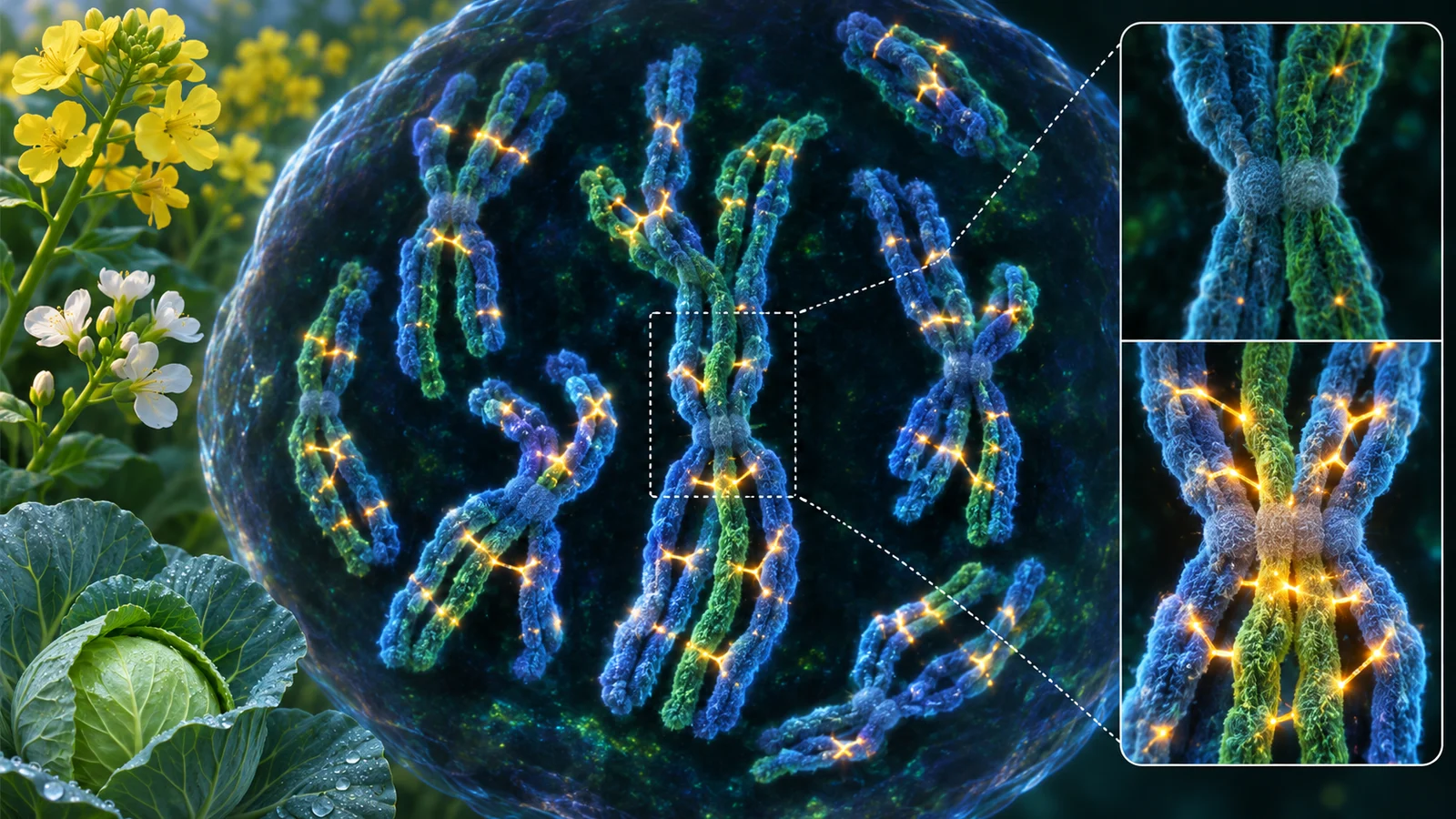
Meiotic recombination reshuffles genetic diversity through reciprocal DNA exchanges between chromosomes known as crossovers. In most eukaryotes, crossovers are highly constrained in both frequency and distribution, leaving large genomic regions with little or no recombination. A notable exception is the Brassica AAC allotriploid hybrid obtained from a cross between allotetraploid Brassica napus (AACC) and diploid Brassica rapa (AA), which exhibits elevated recombination and crossover formation near centromeres. Here, we generated a CCA allotriploid hybrid from a cross between B. napus and Brassica oleracea (CC), and subsequently produced AAC allotriploids by crossing the CCA hybrid with B. rapa . Both CCA and AAC allotriploids exhibit similar meiotic deregulation, demonstrating that this phenomenon is not restricted to AAC hybrids. Both systems displayed a marked increase in crossover frequency within normally low-recombining chromosome regions, reaching 9.4-fold in AAC and 13.4-fold in CCA allotriploids. Alternating CCA and AAC allotriploids efficiently reshuffled both B. napus subgenomes within only two generations. Using genetic mapping and cytogenetics, we further identified homoeologous exchanges. Remarkably, crossovers occurring on chromosomes involved in homoeologous associations exhibited a more pronounced redistribution toward nonrecombining regions than those on homologously paired chromosomes. Moreover, the frequency of homoeologous associations varied with the diploid progenitor genotype, indicating that genetic factors controlling homoeologous recombination already exist in Brassica diploids. Altogether, our results identify allotriploidy as a simple and powerful strategy to unlock recombination deserts, which harbor 21% of total resistance gene analogs, and provide insights into its potential role in allopolyploid evolution, adaptation, and speciation.