Environment

Interfacially Stitched Bilayer Anodes Enforce Surface-Confined Hydroxyl Radical Chemistry in Complex Wastewater.

| Source: Journal of the American Chemical Society

Electro-oxidation technology holds great promise for wastewater treatment, yet its practical application remains hindered by insufficient selectivity in oxidative species generation and limited electrode stability under harsh operating conditions. Here, we devise a layer-by-layer anion-cation engineering strategy to fabricate an Sb-F-stitched SnO2 bilayer anode (SF-SnO2 BA), in which a fluorine-regulated SnO2 catalytic layer is interfacially anchored onto a dense Sb-SnO2 interlayer coated on a T

Electro-oxidation technology holds great promise for wastewater treatment, yet its practical application remains hindered by insufficient selectivity in oxidative species generation and limited electrode stability under harsh operating conditions. Here, we devise a layer-by-layer anion-cation engineering strategy to fabricate an Sb-F-stitched SnO2 bilayer anode (SF-SnO2 BA), in which a fluorine-regulated SnO2 catalytic layer is interfacially anchored onto a dense Sb-SnO2 interlayer coated on a Ti foam scaffold. This hierarchically stitched architecture simultaneously modulates interfacial charge transport and stabilizes the catalytic layer, leading to markedly enhanced electrocatalytic oxidation performance across a broad pH range (1-11). When integrated into a scalable flow-through electro-oxidation system, SF-SnO2 BA enabled highly efficient mineralization (>80%) of four representative industrial wastewaters at low energy consumption. Furthermore, the system also demonstrated remarkable operational durability, sustaining high mineralization efficiency (60-80%) over 14 consecutive days during continuous treatment of real aniline wastewater from a coal chemical plant. In situ spectroscopic investigations coupled with theoretical calculations collectively elucidated that water molecules are initially oxidized on the SF-SnO2 BA surface to form Sn-OH intermediates, which are subsequently transformed into Sn-O species at elevated potentials. Notably, the cooperative F···Sn-O* structural motif directs the generation of surface-confined •OH, which acts as the dominant oxidative species for pollutant degradation. This interfacially stitched bilayer anode offers a viable route toward green and sustainable electrochemical oxidation technologies for practical wastewater treatment.


Read the original source →

Related Stories

Environment

Widespread plasma jets in the Martian magnetosheath revealed by dual-spacecraft observations.

Plasma jets in planetary magnetosheaths are transient, high dynamic pressure structures capable of strongly perturbing downstream magnetospheres and modulating solar wind energy transfer. Although recently identified at Mars, their formation mechanisms and global occurrence remain poorly constrained. Using dual-spacecraft observations from Mars Atmosphere and Volatile EvolutioN and Tianwen-1, we show that magnetosheath jets occur throughout the Martian magnetosheath, in striking contrast to Eart

Continue reading
Environment

Defining and measuring proximity to criticality based on univariate time series.

Diverse social, engineered, and biological systems are made up of multiple interacting dynamical components; to work properly, certain components must be carefully regulated so that their dynamics avoid instability. However, many desirable properties, like optimized computation and control, emerge close to the tipping point between stability and instability, i.e., near criticality. Claims that such dynamical systems operate near criticality have been controversial because it is difficult to asse

Continue reading
Environment

Orexin and pupillary modulation for hunger control.

Fasting-based interventions improve metabolic health and are also explored as adjuncts in other clinical settings, but hunger remains a barrier to adherence. Fasting activates AgRP/NPY neurons (ANs), a hunger-promoting population whose inhibition reduces eating in hungry animals. Here we identify hypocretin/orexin neurons (HONs), classically associated with arousal, as rapid suppressors of AN activity. HON ablation increased AN population activity, whereas HON optostimulation rapidly suppressed

Continue reading
Environment

Environmental RNA improves detection and surveillance of schistosomiasis transmission.

Environmental diagnosis of schistosomiasis, a disease affecting over 250 million people globally, remains challenging, thereby limiting efficient eradication efforts. Current methods, including environmental DNA (eDNA), cannot distinguish between infectious parasite life stages present in the environment. Here, we develop and validate an environmental RNA (eRNA) approach that enables detection and quantification of Schistosoma mansoni miracidia (infective to snails) and cercariae (infective to h

Continue reading
Environment

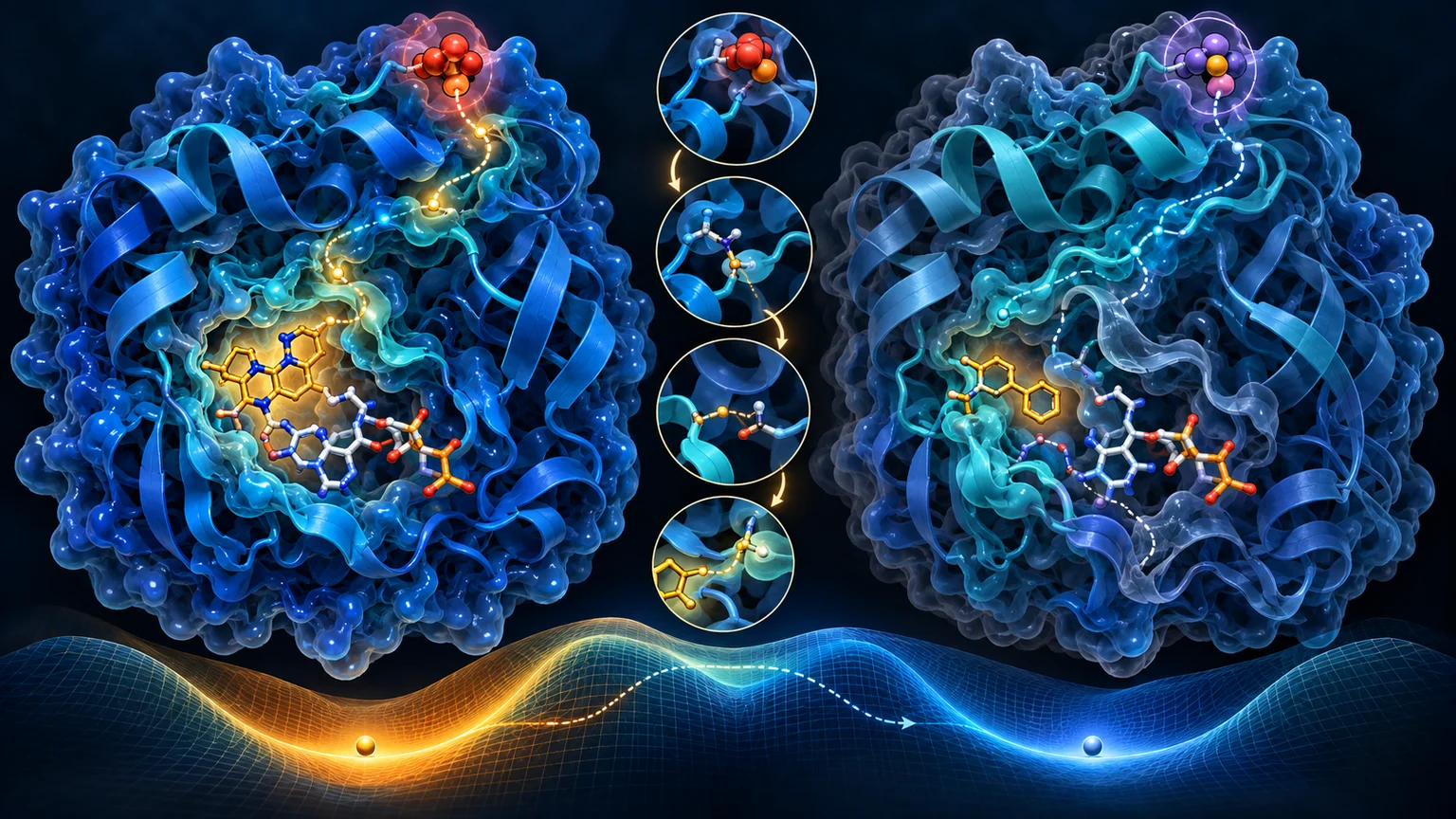
Mechanism of catalytic regulation by an allosteric hot spot in dihydrofolate reductase.

Allostery is central to catalysis and regulation, yet how distal perturbations control enzyme activity remains unresolved. Here we elucidate how a distal allosteric hot spot regulates catalysis in dihydrofolate reductase, a benchmark enzyme exhibiting latent allostery. We combine enhanced conformational sampling, reactive free-energy calculations of the chemical step, and perturbation-induced nonequilibrium molecular dynamics with evolutionary analysis and experimental kinetics to obtain a compr

Continue reading