Imaging the Meissner effect in lanthanum hydride using diamond quantum sensors.
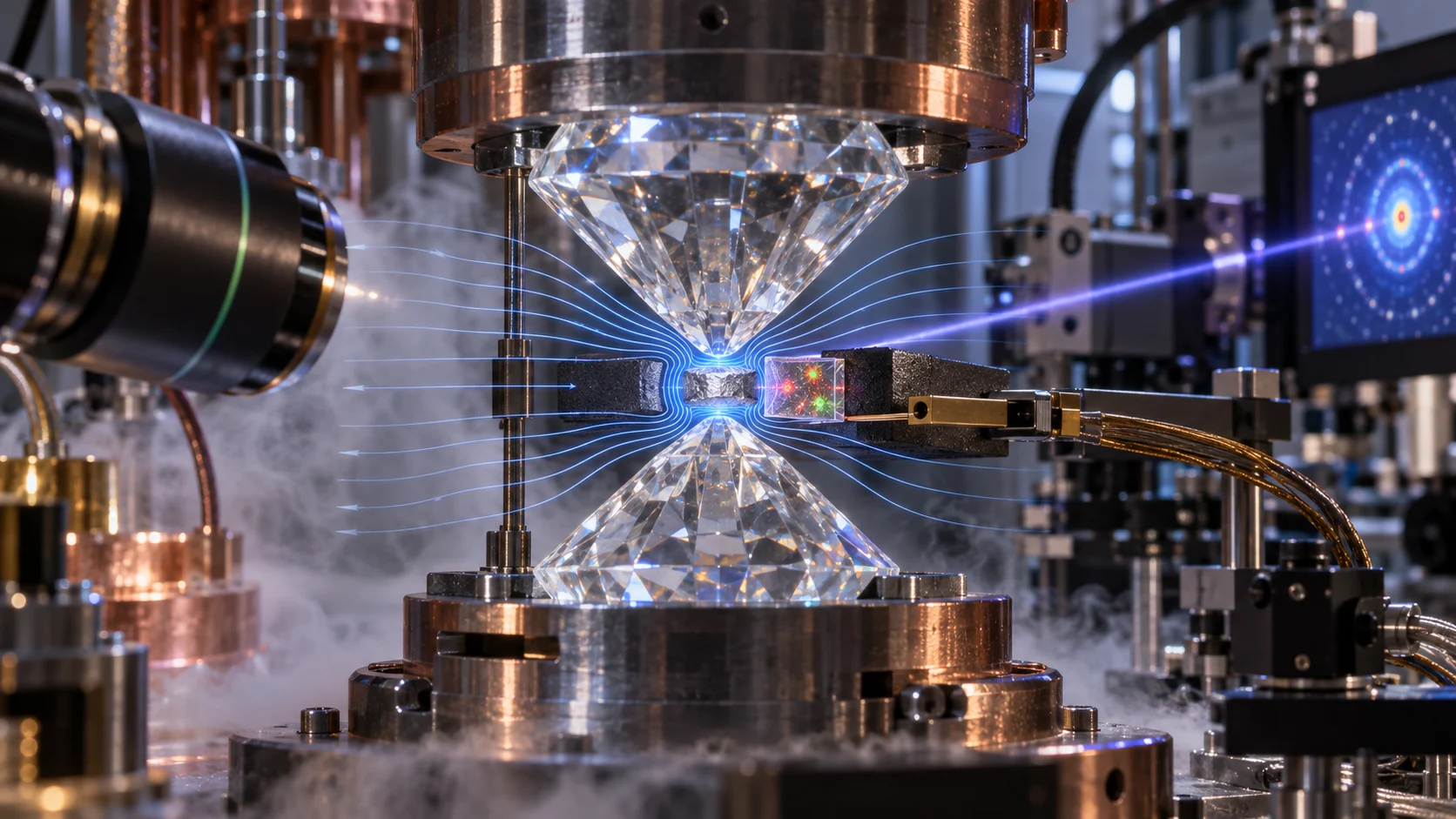
Lanthanum hydride has attracted significant attention in recent years due to its signatures of superconductivity at around 250 K. However, the required megabar pressures present extraordinary challenges in verifying its Meissner effect. Although nitrogen-vacancy (NV) centers in diamond offer a solution, their application has been limited by insufficient working pressures. In this work, using a gaseous pressure-transmitting medium, the working pressure of NV centers is extended to nearly 180 GPa.
Lanthanum hydride has attracted significant attention in recent years due to its signatures of superconductivity at around 250 K. However, the required megabar pressures present extraordinary challenges in verifying its Meissner effect. Although nitrogen-vacancy (NV) centers in diamond offer a solution, their application has been limited by insufficient working pressures. In this work, using a gaseous pressure-transmitting medium, the working pressure of NV centers is extended to nearly 180 GPa. With this quantum probe, magnetic field screening and the Meissner effect of lanthanum hydride are observed at around 240 K and 155 GPa, consistent with the record high transition temperature ([Formula: see text]) of LaH 10 . Additionally, spatially resolved measurements reveal significant inhomogeneities within an insufficiently annealed sample, which has a lower [Formula: see text] of approximately 220 K. Independent X-ray diffraction measurements indicate that this [Formula: see text] could originate from the LaH 9.5± δ [Formula: see text] phase. Our work provides experimental evidence for superconductivity in lanthanum hydride and highlights the importance of spatially resolved techniques in characterizing and optimizing samples under ultrahigh pressure conditions.