Health & Medicine

Human Hsp70 paralogs display selective J-domain interactions tuning proteostasis under stress.
| Source: Proceedings of the National Academy of Sciences of the United States of America

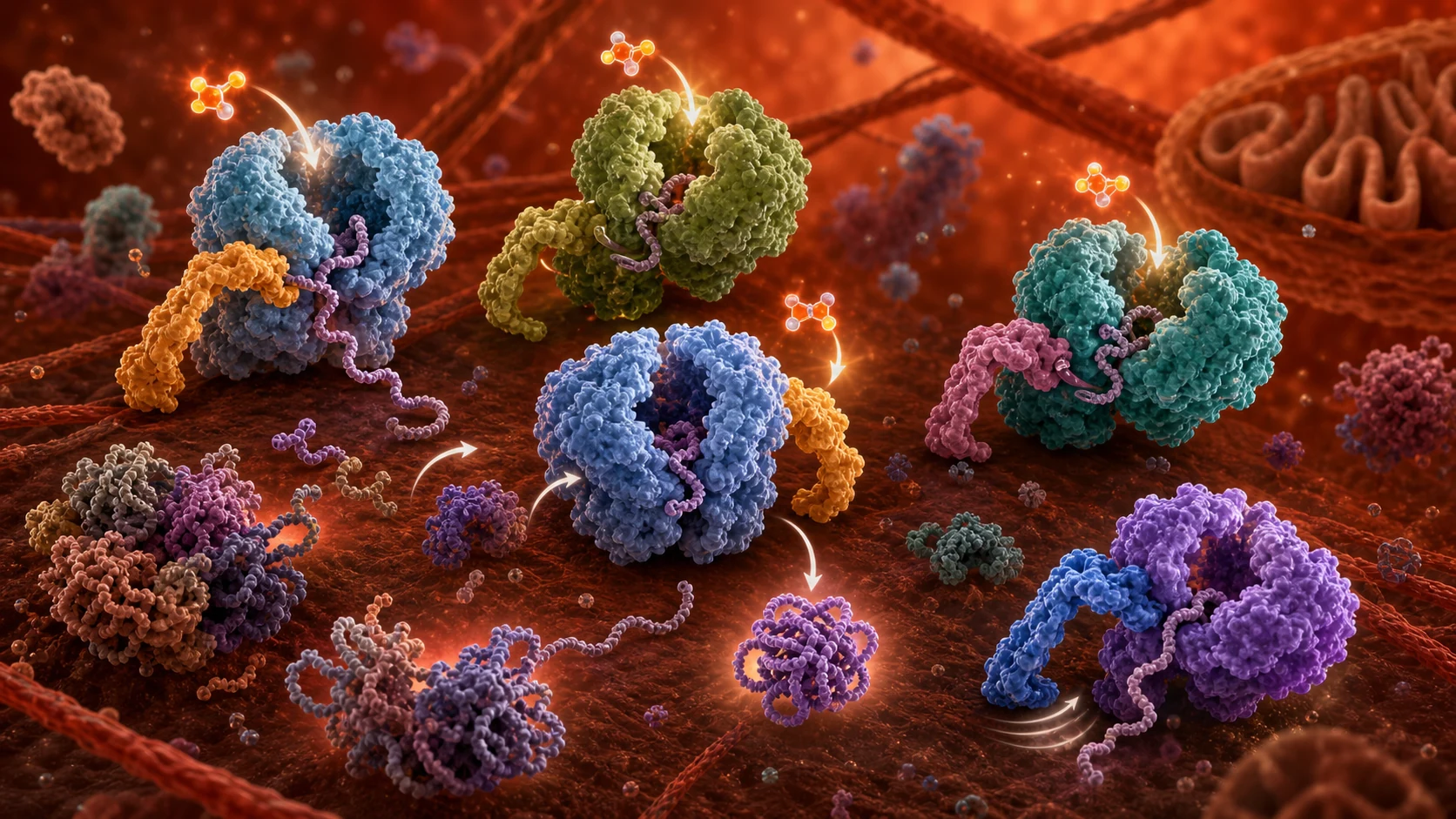
Hsp70 chaperones are central regulators of proteostasis, mediating folding, refolding, degradation, and aggregation-prevention. Their activity is tuned by the diverse J-domain proteins (JDPs), which both recruit client proteins and stimulate Hsp70 ATP hydrolysis via interaction with a conserved J-domain. The cytosol contains four Hsp70 paralogs-the stress-inducible HSPA1A/B and HSPA6, and the constitutively expressed HSPA8. Whether these act redundantly or carry distinct cellular functions has r

Hsp70 chaperones are central regulators of proteostasis, mediating folding, refolding, degradation, and aggregation-prevention. Their activity is tuned by the diverse J-domain proteins (JDPs), which both recruit client proteins and stimulate Hsp70 ATP hydrolysis via interaction with a conserved J-domain. The cytosol contains four Hsp70 paralogs-the stress-inducible HSPA1A/B and HSPA6, and the constitutively expressed HSPA8. Whether these act redundantly or carry distinct cellular functions has remained unresolved. Here, we systematically map the interactions of cytosolic Hsp70s with broad-specificity JDPs to elucidate how paralog identity shapes cellular function. We found that despite the high conservation of the JDP-Hsp70 interaction sites, the affinities of these interactions and their functionality varied greatly. HSPA8 behaves as a generalist, engaging all JDP classes with comparable affinity, consistent with its housekeeping role. By contrast, HSPA1 preferentially binds canonical Class A and B JDPs, while showing only weak binding to Class B'. Therefore, under stress, HSPA1 pairs only with Class A/B JDPs to support robust protein refolding, while freeing Class B' to suppress protein aggregation in an Hsp70-independent manner. Most unexpectedly, HSPA6, the most stress-inducible paralog, binds selectivity to Class B JDPs, losing interactions with both Class A and B'. Thus, under severe stress, HSPA6 works exclusively with Class B JDPs to ensure ATP-dependent protein repair, while freeing Class A and B' JDPs to act independently of Hsp70 to protect damaged/misfolded proteins. Our findings reveal an evolved hierarchy of paralog-specific JDP couplings that dynamically rewires the Hsp70 network from active repair to protection during stress.
Read the original source →

Related Topics

Related Stories

Health & Medicine

PLASTID ENVELOPE ION CHANNELS (PEC1/2) link Ca 2+ and jasmonic acid signaling in plant cells.

Plants constantly encounter adverse environmental interactions. One organelle is particularly specialized in stress signaling and phytohormone synthesis: the plastid. Calcium (Ca 2+ ), a key second messenger, is known to intersect with cellular phytohormone signaling networks. While cytosolic Ca 2+ dynamics have been studied extensively, the physiological relevance of stromal Ca 2+ transients and the identity of channels mediating rapid Ca 2+ flux into plastids remain largely unexplored. In this

Continue reading
Health & Medicine

Detection of "hidden" mitotic crossovers by long-read DNA sequencing.

Mitotic crossovers in diploid organisms are usually detected by looking for loss of heterozygosity (LOH) for a marker. Assuming the crossover occurs between two duplicated chromatids, a single reciprocal crossover will result in two recombinant chromatids and two nonrecombinant chromatids. LOH will only be observed when a recombinant chromatid cosegregates with a nonrecombinant chromatid. Cells containing both recombinant chromosomes will not result in LOH. Below, we use long-range DNA sequencin

Continue reading
Health & Medicine

Amino acid homeostasis by CORVET/HOPS: A metabolic and stress resilience checkpoint for T cells.

Amino acid sufficiency is critical for T cell metabolic reprogramming, yet how T cells maintain amino acid homeostasis remains poorly defined. Here, we identify the CORVET and HOPS (CORVET/HOPS) tethering complexes as essential upstream regulators. In activated T cells, they sustain intracellular amino acid levels by promoting macropinocytosis to acquire extracellular nutrients. This function enables dual signaling outcomes: suppression of the integrated stress response (ISR) and activation of m

Continue reading
Health & Medicine

Bright monomeric fluorescent protein elite-niRFP704 for two-channel near-infrared STED nanoscopy.

The near-infrared (NIR) spectral region is attractive for live-cell imaging, due to low autofluorescence and reduced phototoxicity. Some phytochrome-derived fluorescent proteins absorb and emit fluorescence in the NIR, but have short fluorescence lifetimes and relatively low quantum yields, requiring higher laser powers thus limiting their usefulness for live-cell superresolution microscopy. Using the bacterial phytochrome miRFP703 as a template, we screened for variants with longer fluorescence

Continue reading
Health & Medicine

Quantitative nanoscale imaging shows peptide-MHC I complexes are monomeric and spatially regulated in human dendritic cells.

Major histocompatibility complex class I (MHC I) molecules present antigenic peptides to cytotoxic T cells, a process central to immune surveillance. However, the nanoscale spatial organization of peptide-MHC I (pMHC I) on human dendritic cells (DCs), key initiators of cytotoxic T cell responses, remains largely unexplored. Here, we combine high-affinity soluble T cell receptors with DNA-based point accumulation for imaging in nanoscale topography (DNA-PAINT) to quantitatively map and count defi

Continue reading