Health & Medicine

HLA class I escape drives the evolution of SARS-CoV-2 in human populations
| Source: PNAS

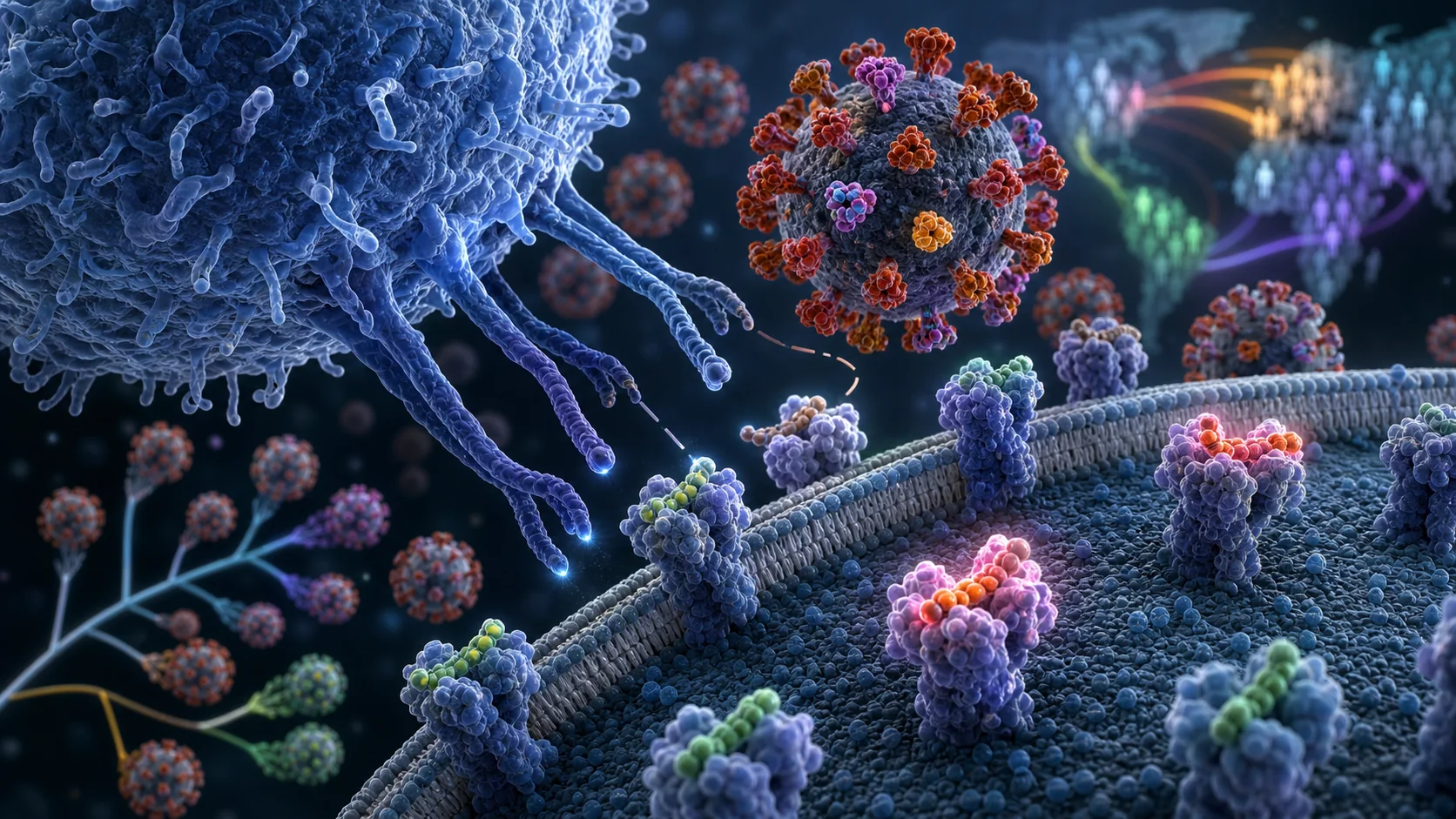
The role of escape from the cytotoxic T cell (CTL) response in Severe acute respiratory syndrome-related coronavirus 2 (SARS-CoV-2) evolution remains controversial. Here, we study the origin and spread of SARS-CoV-2 variants whose mutations reduce presentation by the human leukocyte antigen (HLA) class I alleles common in human populations. We find that 35% of mutations that are characteristic of the variants of concern, and 39% of all subsequent viral mutations, facilitate escape of viral epito

The role of escape from the cytotoxic T cell (CTL) response in Severe acute respiratory syndrome-related coronavirus 2 (SARS-CoV-2) evolution remains controversial. Here, we study the origin and spread of SARS-CoV-2 variants whose mutations reduce presentation by the human leukocyte antigen (HLA) class I alleles common in human populations. We find that 35% of mutations that are characteristic of the variants of concern, and 39% of all subsequent viral mutations, facilitate escape of viral epitopes from presentation. Mutations allowing escape from more common HLA alleles reach higher frequencies, particularly in those countries where these HLA alleles are more frequent, indicating that escape is selected by the local genetic composition of the human host population. We also show that viral mutations that accumulated in general-population transmission chains matched population HLA class I allele frequencies as well as, or better than, mutations acquired during persistent infections, suggesting that selection in favor of escape mutations is not limited to immunocompromised individuals. Together, these data reveal CTL escape as a facet of selection, a driver of evolution, and an epidemiological concern for SARS-CoV-2.
Read the original source →

Related Stories

Health & Medicine

Design of ionic self-assembled monolayers suppressing proton release to mitigate proton-based degradation of perovskite solar cells.

Self-assembled monolayers (SAMs) serve as effective hole-transport layers (HTLs) in perovskite solar cells (PSCs), facilitating energy-level alignment and defect passivation at perovskite interfaces. However, their integration is limited by weak anchoring to transparent conducting oxides (TCOs), resulting in desorption during deposition and the release of acidic protons, which react with components of the perovskite leading to degradation [T. Li et al., Nature 648, 84-90 (2025) and C. Fei et al.

Continue reading
Health & Medicine

Phosphorylation-dependent ATPase activity regulates subunit shuffling dynamics in cyanobacterial circadian clock proteins.

Protein complexes are essential for cellular functions, with their dynamics increasingly recognized as key regulatory elements. In the cyanobacterial circadian clock, the KaiC hexamer is highly dynamic, undergoing phosphorylation-dependent monomer shuffling that synchronizes individual oscillators. However, the molecular mechanism of monomer shuffling is not fully understood. Here we combine a chromatography-based method with single-molecule fluorescence microscopy to quantify subunit exchange i

Continue reading
Health & Medicine

Identifying which patients with metastatic hormone-sensitive prostate cancer benefit most from androgen receptor pathway inhibitors (STOPCAP): a systematic review and meta-analysis of individual parti

Adding novel androgen receptor pathway inhibitors (ARPIs) to standard of care improves outcomes for patients with metastatic hormone-sensitive prostate cancer (mHSPC), but whether benefits are consistent across patient subgroups remains uncertain. We aimed to assess whether ARPI effects vary according to participant or tumour characteristics, or by docetaxel use. In this systematic review and meta-analysis (STOPCAP), we sought individual participant data for completed trials adding ARPIs to stan

Continue reading
Health & Medicine

Envudeucitinib in moderate-to-severe plaque psoriasis (ONWARD1 and ONWARD2): results from two replicate, multicentre, double-blinded, placebo-controlled and active comparator-controlled, phase 3 rando

Safe and highly effective oral treatment options for patients with moderate-to-severe psoriasis are scarce. Here, we aimed to assess the efficacy and safety of envudeucitinib (ESK-001), an investigational next-generation, highly selective, oral, allosteric tyrosine kinase 2 inhibitor, in patients with moderate-to-severe plaque psoriasis. ONWARD1 (NCT06586112) and ONWARD2 (NCT06588738) are completed, replicate, multicentre, randomised, double-blinded, placebo-controlled and active comparator-cont

Continue reading
Health & Medicine

Performance of intracortical microelectrode arrays in people with implanted brain-computer interfaces over a 20-year period.

The silicon microelectrode 'Utah' array has enabled people with paralysis to control computer cursors, operate prosthetic limbs and communicate using high-performance brain-computer interfaces. However, reports so far have typically been limited to one or two individuals, with no systematic assessment of array longevity, decoding accuracy and day-to-day stability. Here we present a comprehensive 20-year evaluation of neural data from the BrainGate clinical trials, spanning 2,289 recording sessio

Continue reading