Economics

HAR1 receptor kinase links nodule autoregulation with repression of auxin signaling and lateral root development.
| Source: Proceedings of the National Academy of Sciences of the United States of America

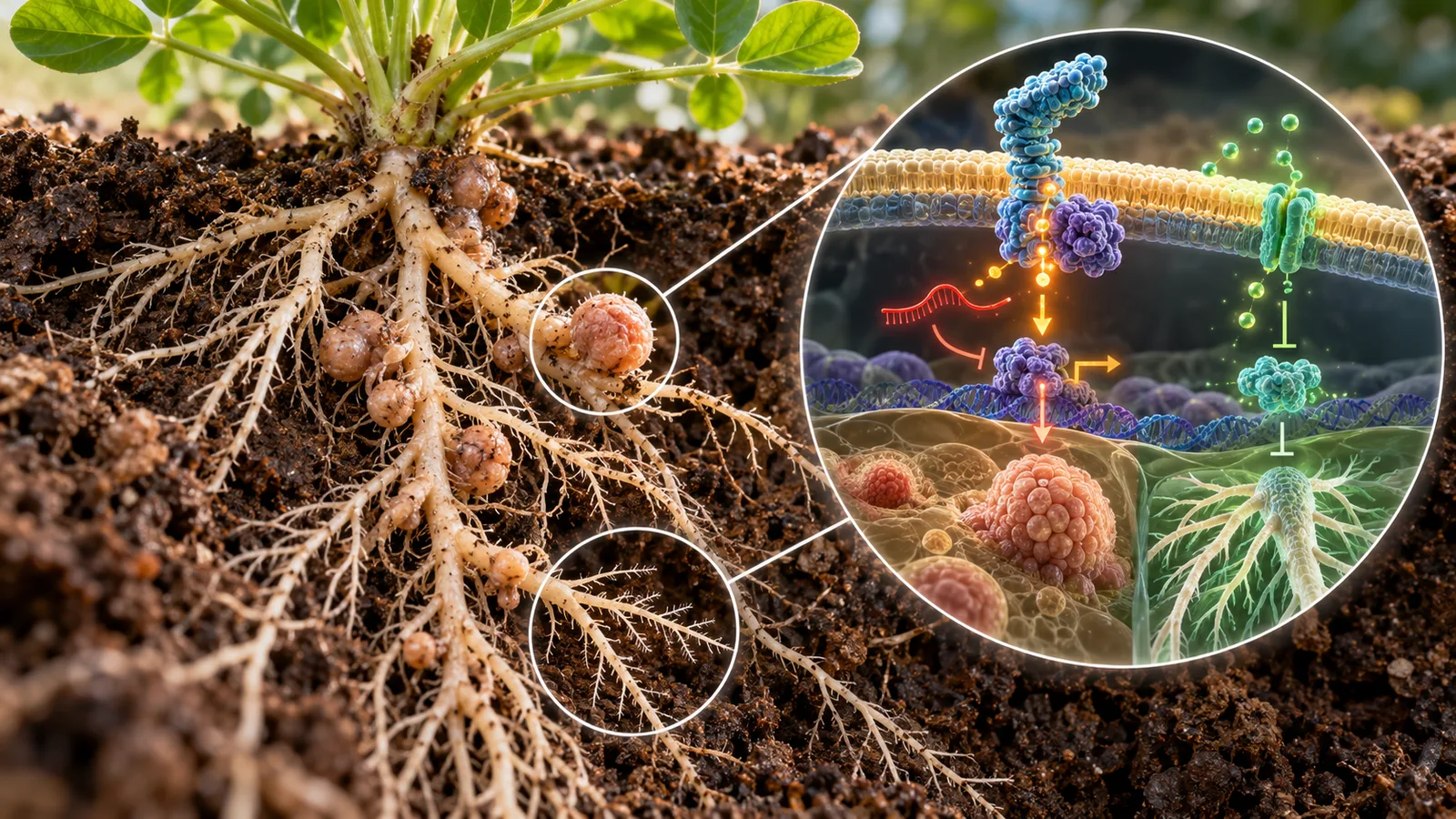
Nitrogen-fixing root nodules develop as lateral organs on legume roots and their formation is restricted by autoregulation of nodulation (AON), a systemic mechanism with unclear evolutionary origins. We identify Lotus japonicus NUCLEAR FACTOR Y subunit A4 ( NF-YA4 ) gene as a central target of the leucine-rich repeat receptor kinase HAR1, which controls both AON and root system architecture. Under nonsymbiotic conditions, HAR1 suppresses expression of NF-YA4 and its close paralog NF-YA1 , at lea

Nitrogen-fixing root nodules develop as lateral organs on legume roots and their formation is restricted by autoregulation of nodulation (AON), a systemic mechanism with unclear evolutionary origins. We identify Lotus japonicus NUCLEAR FACTOR Y subunit A4 ( NF-YA4 ) gene as a central target of the leucine-rich repeat receptor kinase HAR1, which controls both AON and root system architecture. Under nonsymbiotic conditions, HAR1 suppresses expression of NF-YA4 and its close paralog NF-YA1 , at least in part through a miR169-dependent mechanism, mirroring the Arabidopsis CLAVATA1/2-miR169- NF-YA module. Loss of HAR1 leads to NF-YA4 overexpression, broad transcriptional reprogramming, and induction of LATERAL ORGAN BOUNDARIES DOMAIN , STYLISH , and YUCCA auxin biosynthesis genes, enhancing auxin signaling and lateral root development. Grafting experiments show that HAR1 constrains NF-YA4 -mediated branching both locally in roots and systemically from shoots. Because NF-YA4 functions partly redundantly with NF-YA1 to mediate nodule emergence, our results suggest a model in which duplication and neofunctionalization of an ancestral NF-YA-dependent pathway controlling lateral root development facilitated its recruitment to the nodulation program. They also raise the possibility that AON could have evolved, at least in part, through the co-option of a LRR-RK/miR169/ NF-YA regulatory module that limited lateral root development.

Read the original source →

Related Stories

Economics

A glycan superbinder reveals polysialylated-CD56 as a precision biomarker for pancreatic cancer.

Pancreatic cancer remains one of the most lethal malignancies, largely due to the lack of reliable biomarkers for early detection. Aberrant glycosylation presents a promising source of diagnostic signatures, yet polysialic acid (polySia), a distinctive glycan, has remained underexplored, primarily owing to limitations in detection methods and recognition tools. Here, we report the development of a polySia "superbinder," a nanoscale molecularly imprinted polymer (nanoMIP) that exhibits superior s

Continue reading
Economics

Structural basis of glycoprotein recognition by the human folding sensor UDP-glucose:glycoprotein glucosyltransferase.

UDP-glucose:glycoprotein glucosyltransferase 1 (UGGT1) plays a central role in quality control of glycoprotein folding within the early secretory pathway, yet the molecular basis of UGGT1 substrate recognition remains poorly understood. Here, we report cryo-EM structures of human full-length multidomain UGGT1. Monomeric UGGT1 structures reveal two conformational states corresponding to "open" and "closed" architectures. Three-dimensional variability and molecular dynamics simulations suggest the

Continue reading
Economics

Evolution of the arbuscular mycorrhizal regulatory network through differential GRAS gene retention and protein interaction in land plants.

Plants rely on an ancient genetic "toolkit" to establish arbuscular mycorrhizal symbiosis (AMS) with fungal partners. However, the symbiotic outcomes vary among AMS hosts, indicating divergence in downstream transcriptional reprogramming after the perception of symbiotic signals. To uncover the cross-species variation of the AMS regulatory network, we traced the evolutionary trajectory of the GRAS gene family, which encodes the major group of transcription factors in AMS regulation. Phylogenetic

Continue reading
Economics

Meta-analysis of 990 EBV genomes identifies EBER2 SNP7048 and its interaction with HLA-A*11:01 driving nasopharyngeal carcinoma risk.

Nasopharyngeal carcinoma (NPC) is a major health burden in East and Southeast Asia (SEA). While EBV infection is a primary driver, the specific viral strains responsible for NPC development and their interaction with host genetics across geographically diverse endemic regions remain poorly understood. We performed a whole-genome sequencing of 388 EBV isolates and matched host whole-exome sequencing in a Singaporean cohort. To define the global significance of these findings, we conducted a meta-

Continue reading
Economics

Ancient DNA challenges to admixture narratives: Insights from Notre-Dame Cemetery (1683-1796) in Colonial Montreal, Canada.

Historical narratives of early colonization in Quebec frequently portray French-Indigenous relations as cooperative and characterized by admixture; which are often mobilized in modern debates on false-indigeneity. These narratives have been studied through genealogical, genetic, and bioarchaeological analyses, yet individuals of African descent remain mostly absent from them, while Indigenous peoples are framed largely in relation to colonists. Notre-Dame Cemetery (1683-1796) in Tiohtià:ke-

Continue reading