Genomics and social practices at Mogou and other Gansu sites during prehistoric trans-Eurasian exchange.
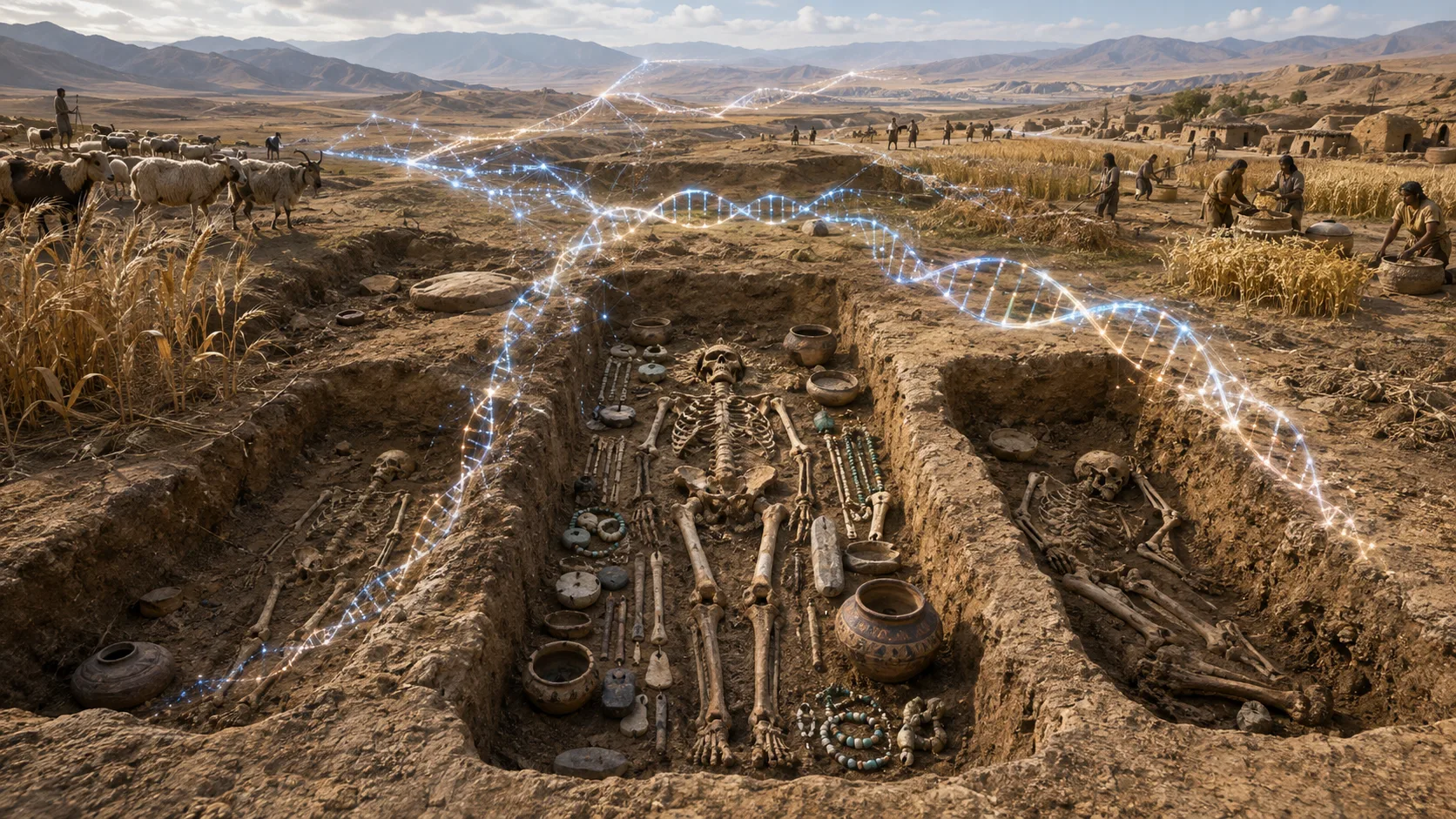
Beginning approximately 4,000 years ago, southwest-Asian-originating domesticated crops and livestock began appearing in Gansu, a key crossroads in northwestern China, yet the population dynamics and social practices underlying these historically transformative events in the region have not been fully explored. Despite the adoption of western domesticates, genome sequences of 149 individuals from the large Mogou cemetery and ten other sites in Gansu, dating between 4,700 and 3,000 years ago, rev
Beginning approximately 4,000 years ago, southwest-Asian-originating domesticated crops and livestock began appearing in Gansu, a key crossroads in northwestern China, yet the population dynamics and social practices underlying these historically transformative events in the region have not been fully explored. Despite the adoption of western domesticates, genome sequences of 149 individuals from the large Mogou cemetery and ten other sites in Gansu, dating between 4,700 and 3,000 years ago, revealed migrations within East Asian regions but no detectable evidence of genetic influence from western or central Eurasia, suggesting that early agricultural dispersals may have followed a model distinct from that documented in Europe and Central Asia. The Mogou cemetery represents a continuous community that interacted with surrounding regions but does not exhibit clear matrilocal or patrilocal residential patterns. We found no strong evidence that co-buried individuals represented biological relatives. Non-local ancestry appears to be linked to lower-status burial practices.