Facial palsy reveals the sensorimotor contribution to facial-emotion recognition.
Although recognizing emotions from facial expressions appears effortless, the field is divided between vision-based accounts, which posit matching to learned visual templates, and embodied accounts, which posit recruitment of facial motor circuits. We propose an ambiguity-gated, developmentally calibrated architecture in which the recognition system draws on sensorimotor information primarily when visual evidence is insufficient, with early motor experience proposed to shape the threshold and ga
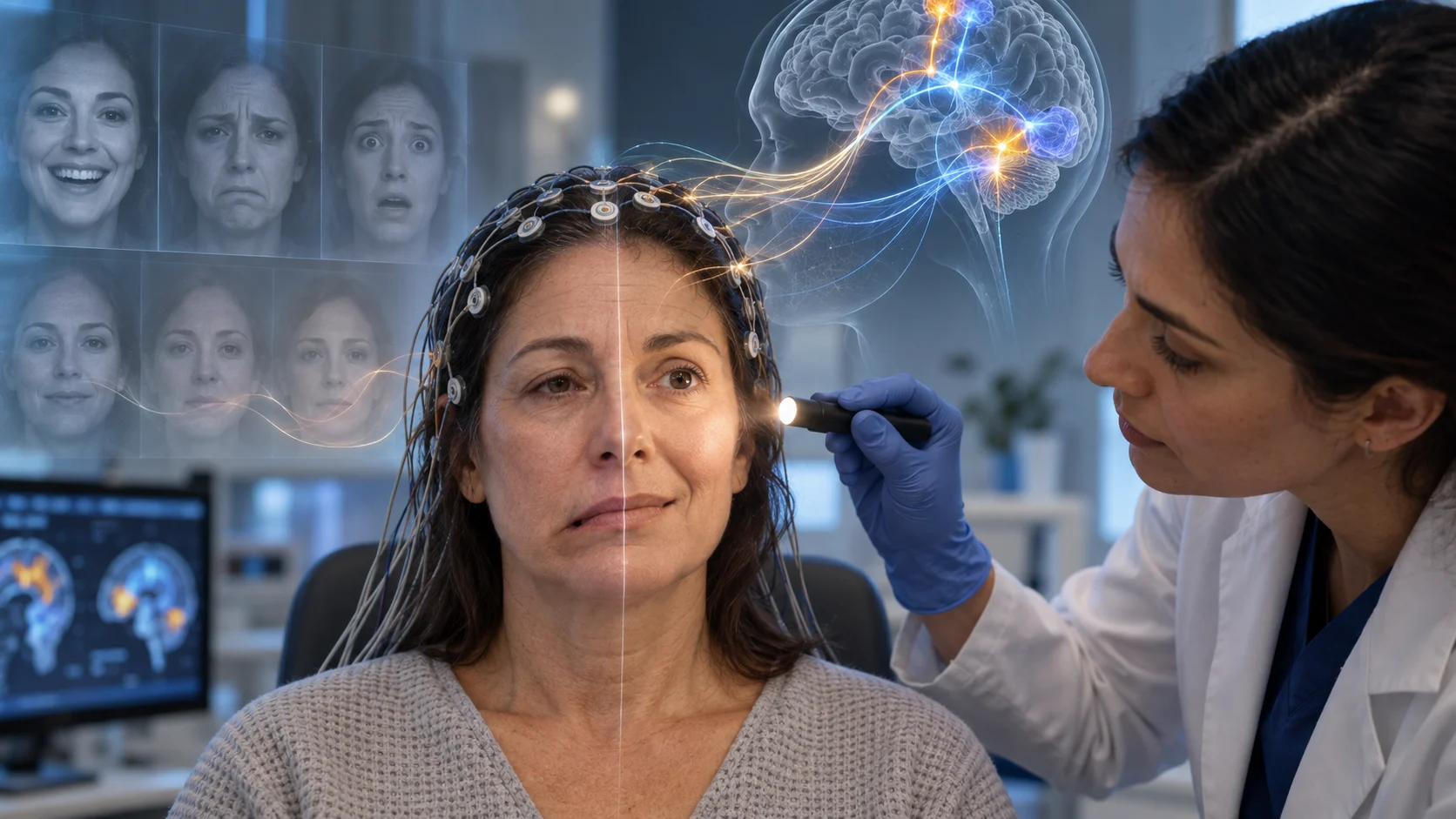
Although recognizing emotions from facial expressions appears effortless, the field is divided between vision-based accounts, which posit matching to learned visual templates, and embodied accounts, which posit recruitment of facial motor circuits. We propose an ambiguity-gated, developmentally calibrated architecture in which the recognition system draws on sensorimotor information primarily when visual evidence is insufficient, with early motor experience proposed to shape the threshold and gain of this contribution. We tested this model across three studies (N = 185) integrating dynamic prototypical and nonprototypical expressions, congenital (Moebius syndrome) and acquired facial palsy, and standardized severity grading (Sunnybrook Facial Grading System; SFGS). Neurotypical adults (N = 117) confirmed a robust prototypicality-dependent cost on recognition. Both congenital (N = 15) and acquired (N = 19) cohorts showed severity-performance coupling for nonprototypical expressions, consistent with shared reliance on sensorimotor information when visual evidence is insufficient; only the Moebius cohort showed this coupling also for prototypical expressions, consistent with undercalibrated visual templates following lifelong atypical facial motor experience. Exploratory electroencephalography (EEG) revealed reduced sensorimotor-face-network functional connectivity in Moebius, consistent with altered cross-route integration. Reanalysis of an independent dataset of ultra-ambiguous static morphs replicated severity-performance coupling and revealed Moebius-control mean differences only under high perceptual demand. Together, the findings provide strong behavioral support for an ambiguity-gated, developmentally calibrated architecture and motivate direct tests of how developmental motor experience shapes when-and how strongly-the recognition system draws on sensorimotor information.