Discovery of an intrinsic non-Hermitian phase transition in a bulk condensed-matter system
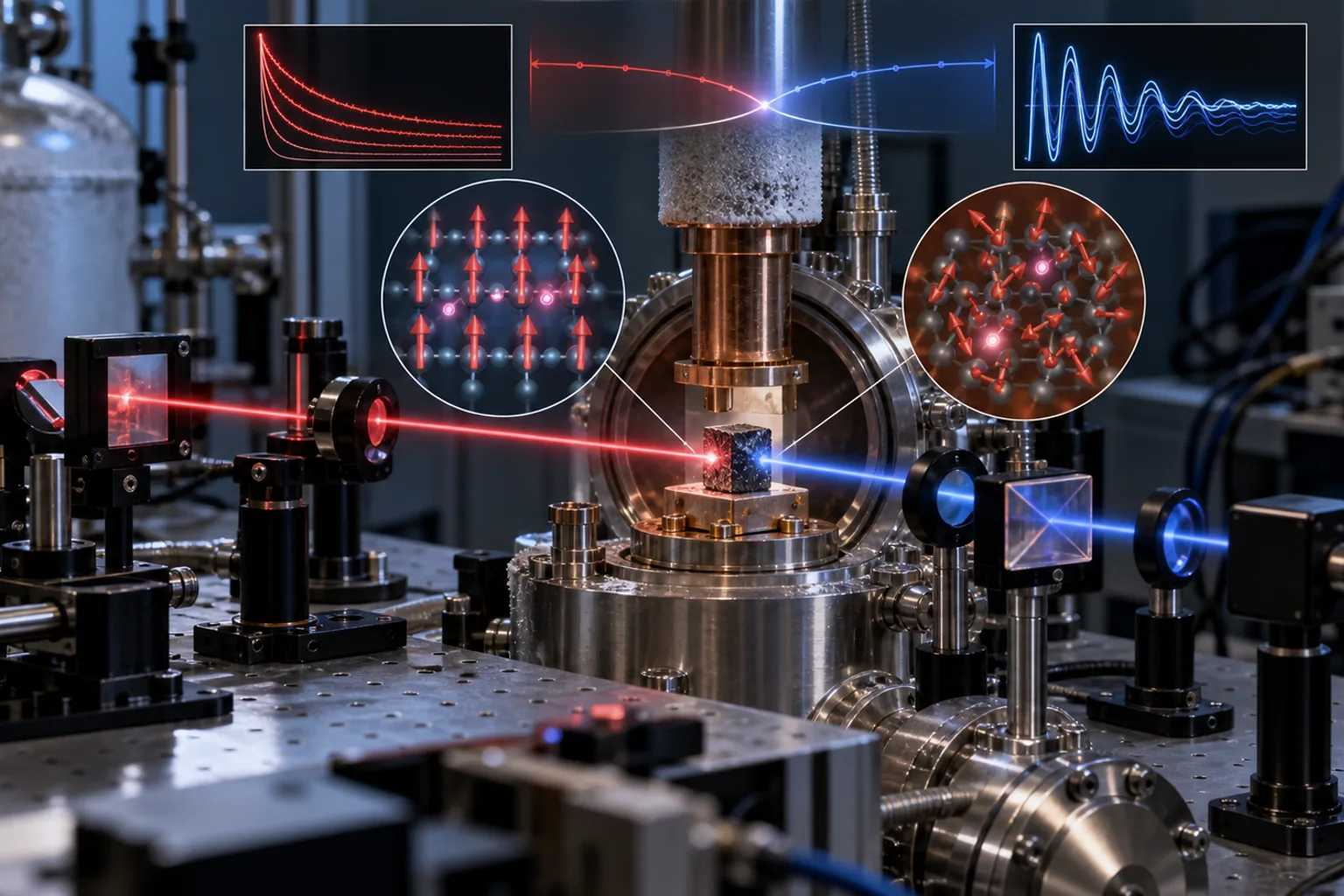
Across regular phase transitions, systems remain in thermal equilibrium. However, when a system is driven far from equilibrium, non-Hermitian phase transitions may arise where the dynamical behavior—rather than steady properties—undergoes a qualitative change at a critical, so-called exceptional point. We experimentally realize a non-Hermitian phase transition in a bulk condensed-matter system. Optical excitation creates charge carriers in ferromagnetic europium monoxide. In a temperature-depend
Across regular phase transitions, systems remain in thermal equilibrium. However, when a system is driven far from equilibrium, non-Hermitian phase transitions may arise where the dynamical behavior—rather than steady properties—undergoes a qualitative change at a critical, so-called exceptional point. We experimentally realize a non-Hermitian phase transition in a bulk condensed-matter system. Optical excitation creates charge carriers in ferromagnetic europium monoxide. In a temperature-dependent interplay with the Hermitian transition to ferromagnetic order, a non-Hermitian change of the relaxation dynamics occurs, manifesting in our time-resolved reflection data as the transition from biexponential real to single-exponential complex decay. Our theory models this behavior and suggests that non-Hermitian phase transitions may generically emerge in bulk condensed matter.