Direct dating of 3.5 Ga biogenic carbon in a microbial mat remnant, Singhbhum Craton, India.
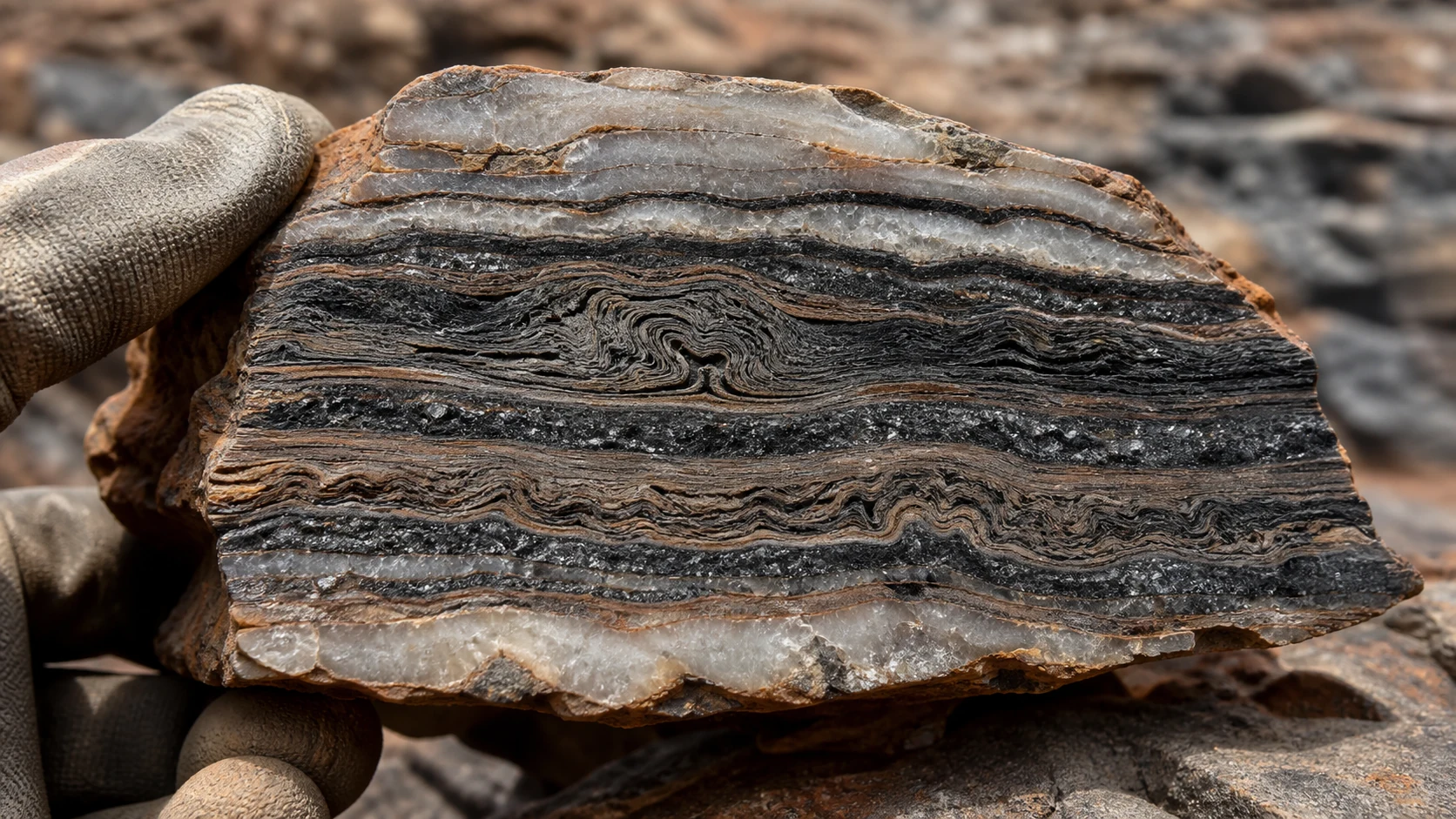
Zircons interpreted to be of syn-volcanic origin recovered from the lower greenschist "black and white banded" Bhitardari chert, Eastern Iron Ore greenstone belt, Singhbhum craton, India, yield a 207 Pb/ 206 Pb zircon age of 3497 ± 5 Ma ( n = 4; MSWD = 1.2). This chert contains abundant carbonaceous matter (CM) that occurs in two textural modes: 1) ultrafine laminae distributed within the matrix and 2) graphite flakes in late quartz veins. Bulk δ 13 C CM of both modes in the Bhitardar
Zircons interpreted to be of syn-volcanic origin recovered from the lower greenschist "black and white banded" Bhitardari chert, Eastern Iron Ore greenstone belt, Singhbhum craton, India, yield a 207 Pb/ 206 Pb zircon age of 3497 ± 5 Ma ( n = 4; MSWD = 1.2). This chert contains abundant carbonaceous matter (CM) that occurs in two textural modes: 1) ultrafine laminae distributed within the matrix and 2) graphite flakes in late quartz veins. Bulk δ 13 C CM of both modes in the Bhitardari chert yield a value of -30.9‰, which we interpret as reflecting a biogenic origin. This represents the documentation of a directly dated, CM-bearing, Paleoarchean rock with δ 13 C CM diagnostic of biologic activity. The observed isotopic compositions are consistent with the rise of relatively sophisticated metabolic mechanisms (e.g., Calvin cycle) by 3.5 Ga.