Decoupling Local Chemistry and Electrostatics for Scalable and Accurate Prediction of Core-Level Binding Energies.
Accurate interpretation of X-ray photoelectron spectroscopy (XPS) in complex environments remains a longstanding challenge, as core-level binding energies (BEs) reflect a convolution of local chemical bonding and long-range electrostatic effects. In heterogeneous systems such as electrochemical interfaces and solvated phases, this interplay obscures chemical assignment and limits the quantitative power of XPS. Here, using representative surface, molecular, and solvated systems, we demonstrate th
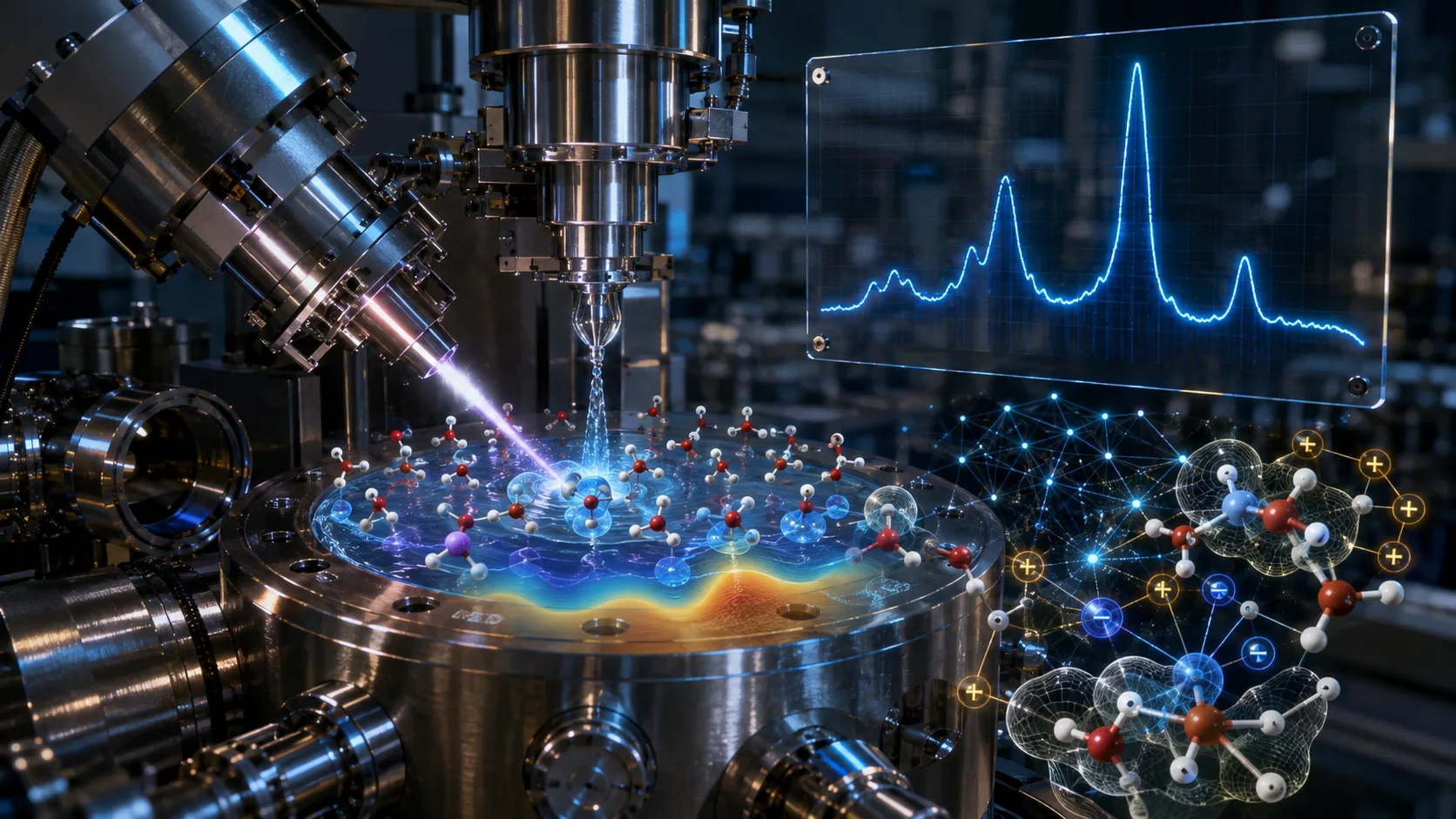
Accurate interpretation of X-ray photoelectron spectroscopy (XPS) in complex environments remains a longstanding challenge, as core-level binding energies (BEs) reflect a convolution of local chemical bonding and long-range electrostatic effects. In heterogeneous systems such as electrochemical interfaces and solvated phases, this interplay obscures chemical assignment and limits the quantitative power of XPS. Here, using representative surface, molecular, and solvated systems, we demonstrate that core-level BEs are intrinsically multiscale observables and cannot, in general, be described as purely local quantities. Building on this insight, we introduce a physics-informed, multistage machine learning framework that explicitly decouples electrostatic and local contributions. By treating the electrostatic potential via learned atomic charges and modeling the residual term with local descriptors, the approach restores both accuracy and transferability across diverse chemical environments. The framework further enables scalable prediction of final-state BEs, bypassing the prohibitive cost of ΔSCF calculations. Application to depth-resolved XPS simulations of liquid water demonstrates agreement with experiment and reveals the microscopic origin of spectral shifts. This work establishes a computational framework for disentangling chemical and electrostatic effects in XPS and provides a scalable route for interpreting spectroscopy in heterogeneous systems.