Cryogenic silicification enables nongenetic functional continuity across mammalian cell generations.
Mammalian cells are intrinsically soft, with Young's moduli typically ranging from 0.1 to 10.0 kPa depending on the organization of the F-actin cytoskeleton, rendering them highly susceptible to mechanical and environmental stresses. This inherent fragility severely constrains their manipulation and functional deployment under nonphysiological conditions. Here, we report a cryogenic dormancy-enabled silicification strategy that achieves deep integration of inorganic silica reinforcement within l
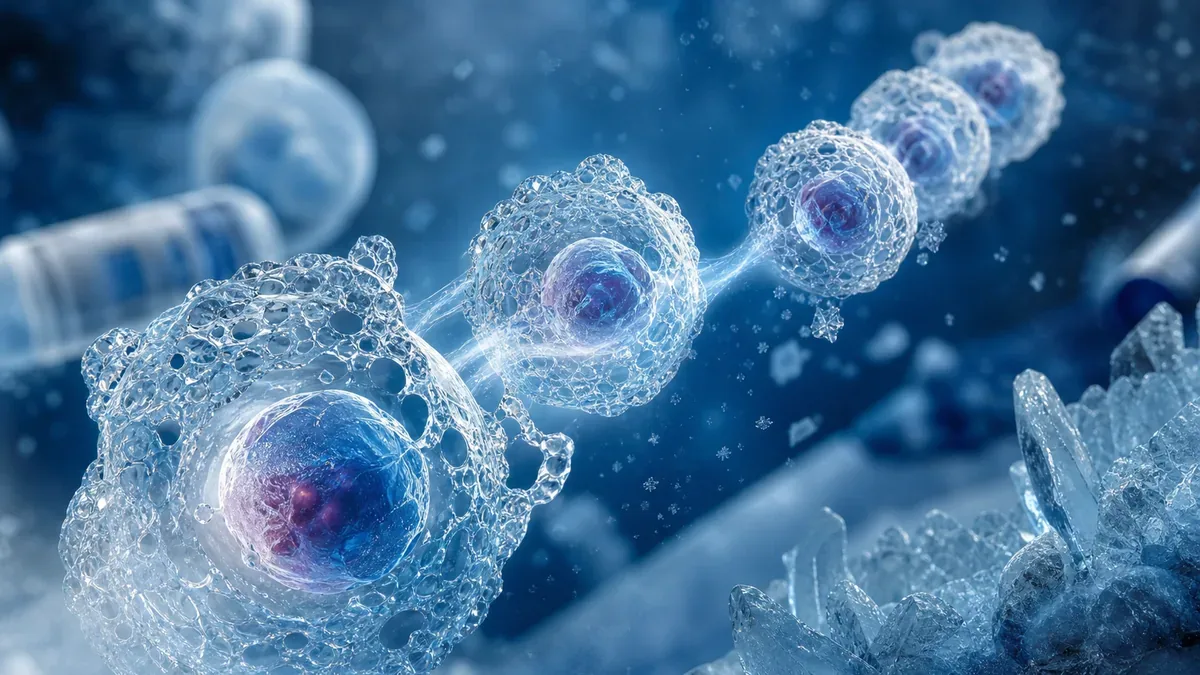
Mammalian cells are intrinsically soft, with Young's moduli typically ranging from 0.1 to 10.0 kPa depending on the organization of the F-actin cytoskeleton, rendering them highly susceptible to mechanical and environmental stresses. This inherent fragility severely constrains their manipulation and functional deployment under nonphysiological conditions. Here, we report a cryogenic dormancy-enabled silicification strategy that achieves deep integration of inorganic silica reinforcement within living mammalian cells while preserving cell viability and proliferative capacity. Transient membrane permeability during cryogenic dormancy allows intracellular accumulation of silicic acid, which subsequently undergoes protein-mediated condensation to form a conformal amorphous silica network spanning both extracellular and intracellular compartments. The resulting silica-cell hybrids, termed Silicacytes , exhibit substantially enhanced mechanical robustness and resistance to a broad range of environmental stresses. Notably, this materials-mediated reinforcement is neither permanent nor genetic in nature: silica structures are progressively partitioned during cell division, conferring a pseudoheritable enhancement that persists for two to three generations before gradually dissipating. By enabling a reversible and temporally bounded extension of cellular robustness without altering genetic identity, cryosilicification establishes a nongenetic mode of functional continuity across cell generations. This work expands the conceptual framework of material-cell interactions and provides a general strategy for transient cellular reinforcement, with implications for cell engineering, immune cell manipulation, and the development of adaptive biohybrid systems.