Coordinated RNA- and protein-templated synthesis of double-stranded DNA by a dual reverse transcriptase immune system.
Defense-associated reverse transcriptase (DRT) systems mediate antiviral immunity through distinct modes of cDNA synthesis: class 1 DRTs catalyze untemplated synthesis, whereas class 2 DRTs polymerize non-coding RNA-templated products. However, how these distinct modes drive defense remains unclear. Here, we report that DRT3 immunity arises when class 1 and class 2 RT activities cooperate to produce self-complementary double-stranded DNA (dsDNA). DRT3a uses a 5'-ACACAC-3' RNA template to synthes
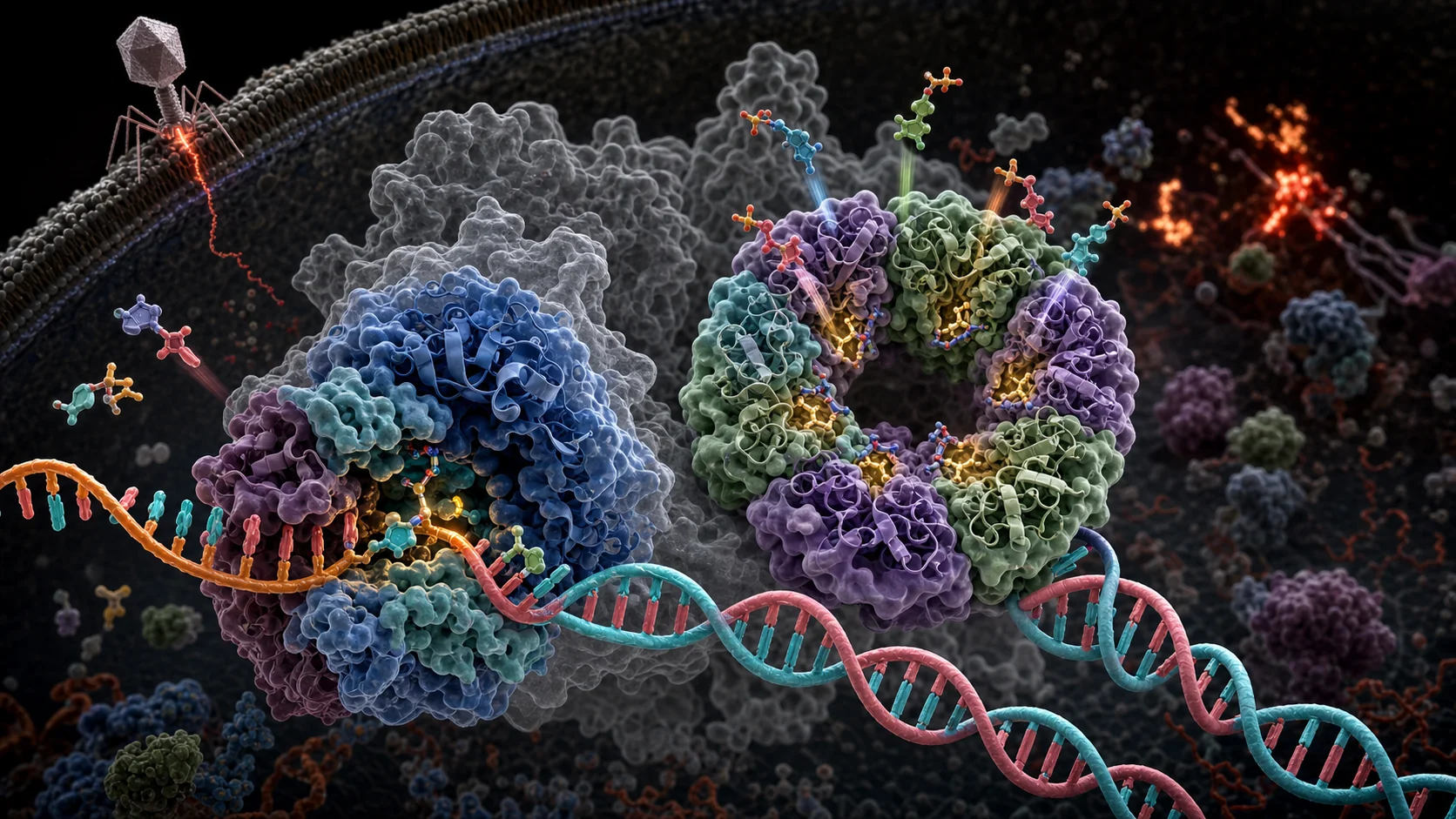
Defense-associated reverse transcriptase (DRT) systems mediate antiviral immunity through distinct modes of cDNA synthesis: class 1 DRTs catalyze untemplated synthesis, whereas class 2 DRTs polymerize non-coding RNA-templated products. However, how these distinct modes drive defense remains unclear. Here, we report that DRT3 immunity arises when class 1 and class 2 RT activities cooperate to produce self-complementary double-stranded DNA (dsDNA). DRT3a uses a 5'-ACACAC-3' RNA template to synthesize poly-(dTdG) repeats, whereas DRT3b synthesizes poly-(dCdA) repeats without any nucleic acid template. Cryo-electron microscopy reveals that DRT3b forms a hexamer and uses active-site-adjacent residues as deoxyadenosine and deoxycytidine gates to enforce alternating nucleotide addition, representing a unique example of amino-acid-templated DNA polymerization. DRT3 is toxic in cells lacking RecBCD, implicating host recombination machinery in limiting dsDNA accumulation, and the phage-encoded RecBCD inhibitor Gam triggers DRT3-mediated abortive infection. These findings reveal how two polymerases with distinct templating strategies generate complementary DNA for antiviral defense.