Chromatin end-anchored chromosome-sized domains and promoter loops organize a transcriptionally active genome in Tetrahymena .
Three-dimensional (3D) genome architecture shapes gene regulation, yet the folding principles of compact unicellular genomes remain unclear. Among unicellular eukaryotes, the ciliate Tetrahymena thermophila provides a distinctive model, harboring a transcriptionally active somatic macronucleus (MAC) with a genome fragmented into gene-dense minichromosomes and a silent, intact germline micronucleus. To delineate macronuclear chromatin organization, we integrated nucleosome-resolution Micro-C, ATA
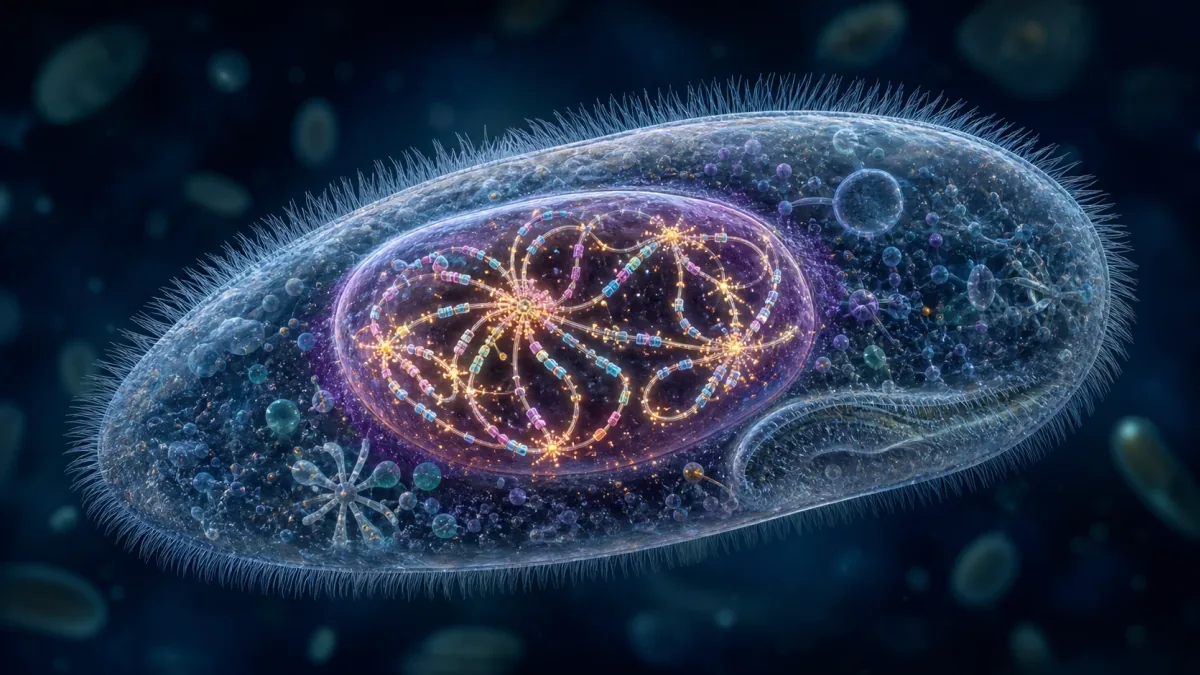
Three-dimensional (3D) genome architecture shapes gene regulation, yet the folding principles of compact unicellular genomes remain unclear. Among unicellular eukaryotes, the ciliate Tetrahymena thermophila provides a distinctive model, harboring a transcriptionally active somatic macronucleus (MAC) with a genome fragmented into gene-dense minichromosomes and a silent, intact germline micronucleus. To delineate macronuclear chromatin organization, we integrated nucleosome-resolution Micro-C, ATAC-seq, and RNA-seq across the Tetrahymena life cycle. We find that macronuclear chromosomes form chromosome-sized interaction domains rather than canonical A/B compartments or internal TAD-like hierarchical structures. Each macronuclear chromosome behaves as a telomere-bounded structural unit organized by two major features: Highly accessible telomere-capped ends form stable end-end interaction hubs, and promoter-proximal open chromatin sites anchor long-range internal promoter-centered loops whose strength correlates with transcriptional activity. During conjugation, the sexual life cycle of Tetrahymena , long-range internal loops, and promoter-promoter contacts are transiently diminished and subsequently restored in later conjugation stages, whereas chromosome end-end contacts remain relatively stable. A similar architecture is observed in the related ciliate Tetrahymena pyriformis , indicating conservation within the genus. Together, our results define a compact, end-anchored, and promoter-centric genome-folding strategy that organizes a fragmented, gene-dense, transcriptionally active genome without the canonical compartment/TAD hierarchy seen in metazoan genomes. These findings expand the known repertoire of eukaryotic 3D genome architectures and suggest that promoter-associated transcription hubs can evolve independently in divergent eukaryotic lineages.