Calculated residue protonation states find functional, conserved E-channel proton-loading sites in Complex I from bacteria to mammals
Bioenergetic proton pumps take protons from one side of a membrane, transiently binding them at a loading site within the protein matrix, and then release them to the other side against an electrochemical gradient. The E channel of Complex I, from bacteria to mammals, contains a conserved proton-loading region whose function is distributed among several interacting residues. Noting extensive sequence divergence across homologous Complex I structures, we asked how this function is conserved durin
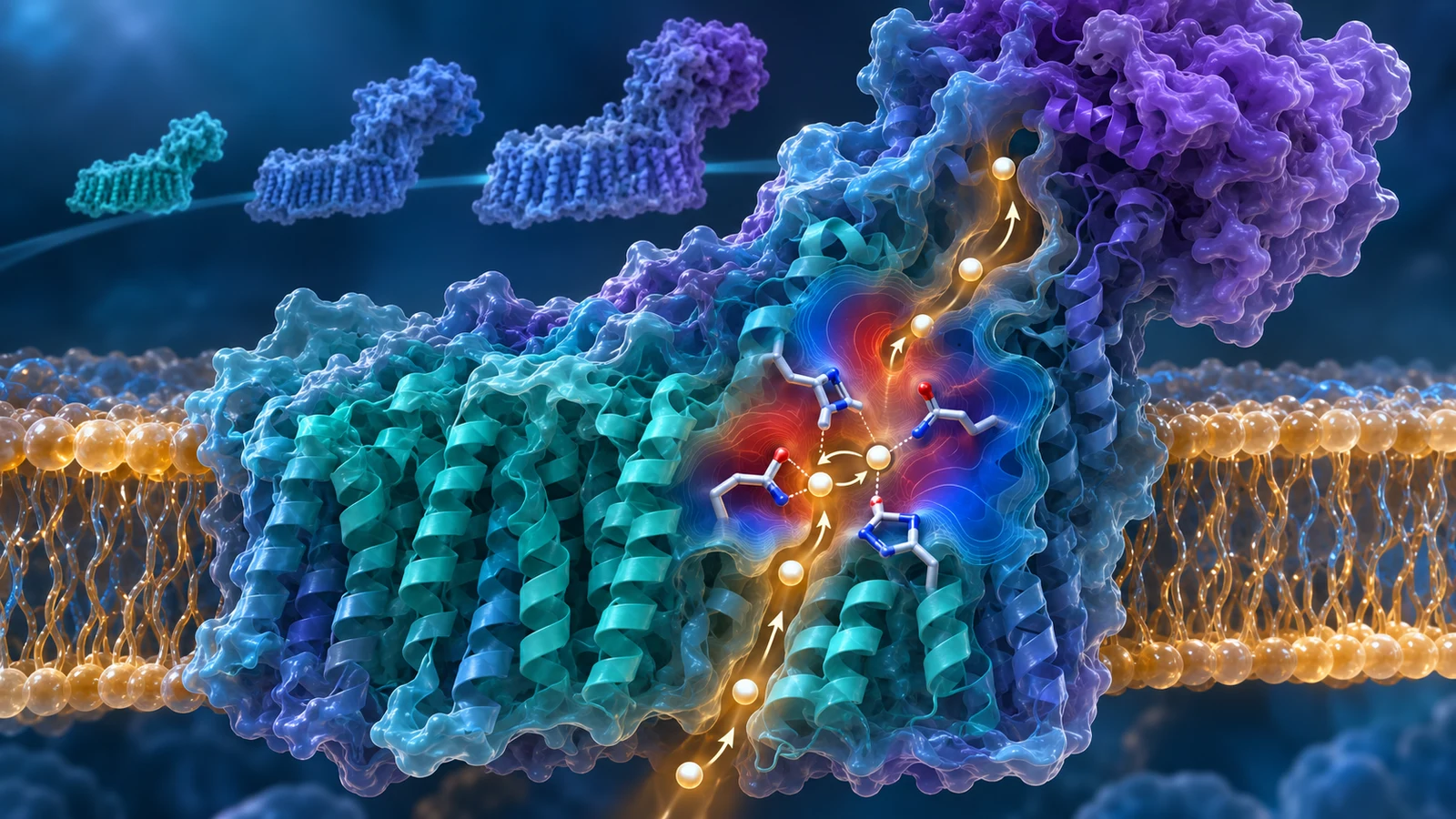
Bioenergetic proton pumps take protons from one side of a membrane, transiently binding them at a loading site within the protein matrix, and then release them to the other side against an electrochemical gradient. The E channel of Complex I, from bacteria to mammals, contains a conserved proton-loading region whose function is distributed among several interacting residues. Noting extensive sequence divergence across homologous Complex I structures, we asked how this function is conserved during evolution despite many amino acid changes. Multi-Conformation Continuum Electrostatics (MCCE) calculations were performed on the five E-channel subunits from 41 experimental structures from bacteria, cyanobacteria, insects, and mammals. A Monte Carlo sampling identified five to seven residues in each species that function as a proton-loading cluster. Structures with a closed E-channel have ~1 more proton in the cluster than those with open conformations. Proton binding represents ensemble averages across thousands of accessible microstates, each with an integer protonation state. A mean-field analysis showed that the proton affinity depends on both titrating residues and the surrounding protein electrostatic environment. Closely related proteins use nearly the same cluster of residues, whereas more divergent proteins substitute alternative proton-handling residues and modify electrostatically important fixed-charge groups to preserve cluster proton affinity. Thus, E-channel reversible proton-loading is preserved during sequence evolution by maintaining a local “electrostatic architecture,” often involving quite different evolutionary solutions. Thus, conservation of E-channel proton loading depends more strongly on the local electrostatic environment than on conservation of the individual residues that create it.