Bundibugyo virus glycoprotein seroreactivity following recombinant vesicular stomatitis virus-Zaire Ebola virus glycoprotein vaccination in outbreak-affected populations of the Democratic Republic of
There are currently no licensed vaccines for disease caused by Bundibugyo virus (BDBV). The recombinant vesicular stomatitis virus-Zaire Ebola virus glycoprotein (rVSVΔG-ZEBOV-GP) vaccine has been widely deployed during Ebola virus disease outbreaks caused by Ebola virus (EBOV). Human studies have shown cross-reactive BDBV antibody responses following licensed Ebola virus disease vaccine administration, but the durability and longitudinal kinetics of these responses in populations vaccinat
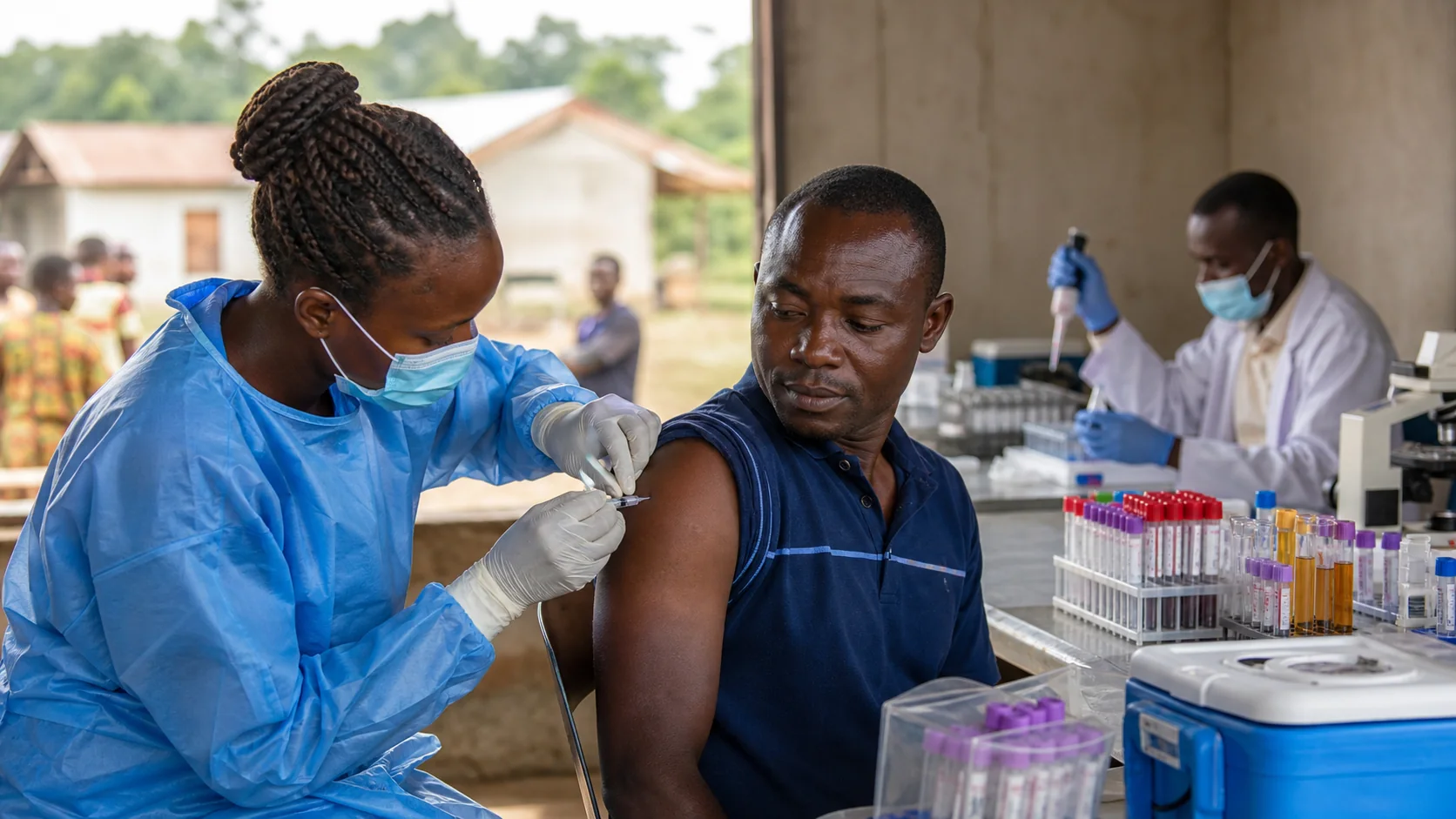
There are currently no licensed vaccines for disease caused by Bundibugyo virus (BDBV). The recombinant vesicular stomatitis virus-Zaire Ebola virus glycoprotein (rVSVΔG-ZEBOV-GP) vaccine has been widely deployed during Ebola virus disease outbreaks caused by Ebola virus (EBOV). Human studies have shown cross-reactive BDBV antibody responses following licensed Ebola virus disease vaccine administration, but the durability and longitudinal kinetics of these responses in populations vaccinated during outbreaks remain unknown. We aimed to evaluate BDBV glycoprotein seroreactivity following rVSVΔG-ZEBOV-GP vaccination in two longitudinal cohorts from regions of the Democratic Republic of the Congo affected by Ebola virus disease outbreaks. This longitudinal cohort study was done in Mbandaka, Equateur Province, and Beni, North Kivu Province. Individuals aged 1 year and older who received the rVSVΔG-ZEBOV-GP vaccine under the WHO ring-vaccination protocol were eligible for enrolment. These populations were defined as: people with confirmed Ebola virus disease, contacts of people with Ebola virus disease or contacts-of-contacts, and health-care or front-line workers in areas affected by Ebola virus disease. Participants were enrolled from June 2 to July 3, 2018, in Mbandaka and from Aug 15 to 29, 2018, in Beni. Serum samples were collected from vaccine recipients and antibody reactivity was assessed using a multiplex pan-filovirus immunoassay. Both cohorts were followed up over 5 years, with seven data collection periods in each province. We evaluated longitudinal trends in EBOV and BDBV glycoprotein seroreactivity using a pan-filovirus multiplex immunoassay across follow-up visits. We analysed 5849 serum samples from 1081 participants. 715 (66%) of 1081 participants were male and 366 (34%) were female. BDBV glycoprotein seroreactivity differed substantially between study sites. At baseline, 16 (3%) of 482 participants in Mbandaka and 62 (10%) of 599 in Beni were seroreactive to BDBV glycoprotein. In Mbandaka, BDBV glycoprotein antibody reactivity remained stable through to 6 months after initial vaccination before increasing from a mean median fluorescent intensity (MFI) of 1238 (SD 1599) at 2·5 years, with 16 (5%) of 355 seroreactive, to 4845 (5881) at 3·5 years and 116 (35%) of 329 seroreactive (p<0·0001), followed by waning at later visits. In Beni, BDBV glycoprotein antibody reactivity increased rapidly after the initial vaccination, with seroreactivity peaking at 21 days to a mean MFI of 6678 (SD 6997) with 283 (52%) of 541 participants seroreactive and at 6 months to an MFI of 6852 (6560) with 270 (54%) of 501 seroreactive. Although antibody levels decreased after 6 months, EBOV glycoprotein and BDBV glycoprotein antibody reactivity remained above baseline through to 5 years after vaccination. The differing patterns of BDBV glycoprotein seroreactivity observed between Beni and Mbandaka warrant further investigation into the epidemiological and immunological factors associated with this seroreactivity, including the epidemiological significance of baseline seroreactivity observed before vaccination. To our knowledge, these findings provide the first longitudinal human data describing BDBV glycoprotein seroreactivity following licensed Ebola virus disease vaccination in populations living in regions now affected by the current outbreak of disease caused by BDBV. They add to the growing body of human evidence describing cross-reactive antibody responses following licensed Ebola virus disease vaccination and support rigorous clinical evaluation of rVSVΔG-ZEBOV-GP during the ongoing outbreak while BDBV-specific vaccines continue to be developed. The US Food and Drug Administration, the Gates Foundation, and the US Defense Advanced Research Projects Agency.