Trimethylammonium-Substituted Amphiphilic Pillar[ n ]arene Channels for Selective Water Permeation.
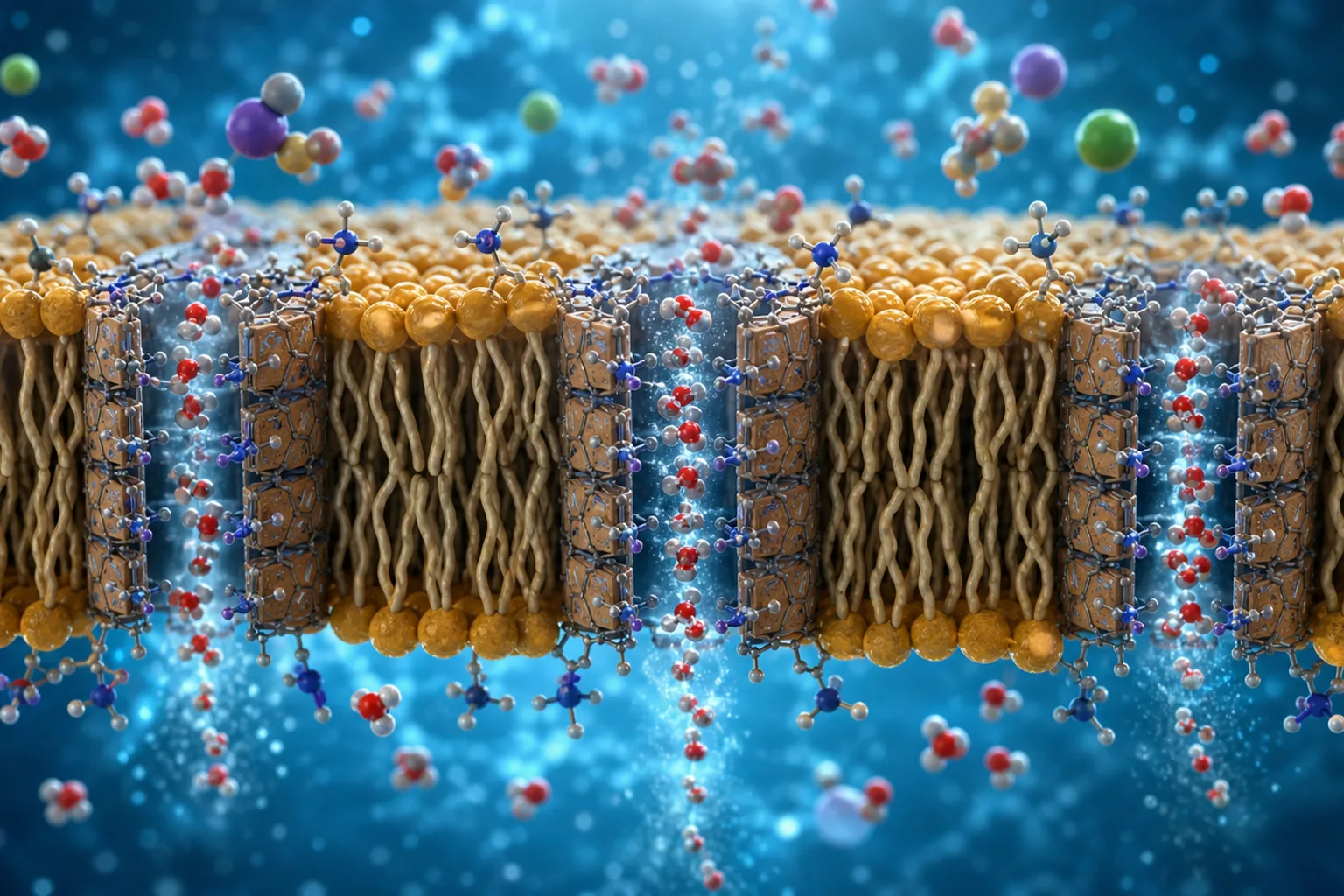
Artificial water channels (AWCs) are synthetic systems biomimicking natural aquaporins (AQPs) that selectively transport water while rejecting ions. Amphiphilic rim-differentiated pillar[5]arenes and pillar[6]arenes, featuring cationic methylammonium and alkyl substituents on opposite rims, spontaneously assemble into two-dimensional channels with tunable pore sizes and channel lengths. Herein, we considered the alkyl chains (butyl-C4 and decatyl-C10) of these channels in relation to membrane pa
Artificial water channels (AWCs) are synthetic systems biomimicking natural aquaporins (AQPs) that selectively transport water while rejecting ions. Amphiphilic rim-differentiated pillar[5]arenes and pillar[6]arenes, featuring cationic methylammonium and alkyl substituents on opposite rims, spontaneously assemble into two-dimensional channels with tunable pore sizes and channel lengths. Herein, we considered the alkyl chains (butyl-C4 and decatyl-C10) of these channels in relation to membrane partitioning and investigated the potential structure-activity relationships within the lipid bilayer. A synergistic effect of a large pore and favorable lipophilicity led to the highest water permeation (∼1 × 10 8 water molecules per channel per second) for AP-P6A-C10 , as well as ion rejection. The present channels may be regarded as a rare biomimetic example of artificial channels that preferentially transport water while presenting low proton or ion transport activity.