Physical/Tech

Tozorakimab to Prevent COPD Exacerbations.
| Source: The New England journal of medicine

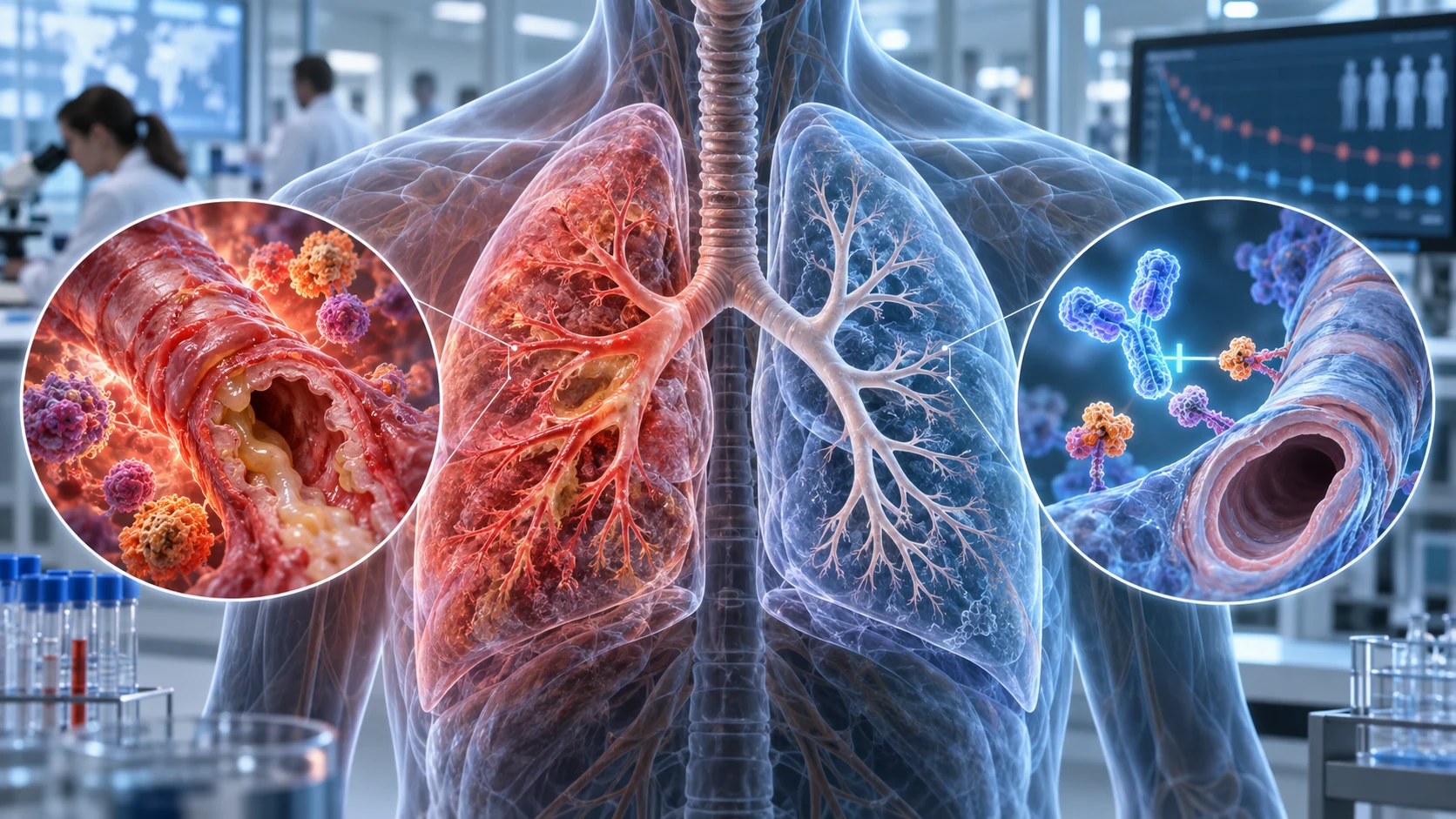
Many patients with chronic obstructive pulmonary disease (COPD) have exacerbations despite receiving standard-of-care inhaled maintenance therapy. Dysregulated interleukin-33 signaling is implicated in the pathogenesis of COPD. Tozorakimab is a monoclonal antibody that inhibits the activity of interleukin-33. In two replicate phase 3 trials (OBERON and TITANIA), we enrolled adults with COPD who were current or former smokers and had a history of exacerbations in the previous year despite receivi

Many patients with chronic obstructive pulmonary disease (COPD) have exacerbations despite receiving standard-of-care inhaled maintenance therapy. Dysregulated interleukin-33 signaling is implicated in the pathogenesis of COPD. Tozorakimab is a monoclonal antibody that inhibits the activity of interleukin-33. In two replicate phase 3 trials (OBERON and TITANIA), we enrolled adults with COPD who were current or former smokers and had a history of exacerbations in the previous year despite receiving stable standard-of-care inhaled maintenance therapy. There were no eligibility criteria related to blood eosinophil count. Patients were randomly assigned to receive add-on subcutaneous tozorakimab (300 mg) or placebo every 4 weeks for 52 weeks. The primary end point was the annualized rate of moderate or severe exacerbations that occurred over a 52-week period among former smokers, and the first key secondary end point was the annualized rate of moderate or severe exacerbations in the overall population. Safety was also assessed. The overall population in OBERON included 446 patients in the tozorakimab group and 431 in the placebo group, and in TITANIA included 438 in the tozorakimab group and 435 in the placebo group. The annualized rate of moderate or severe exacerbations among former smokers was 1.34 events in the tozorakimab group and 1.90 events in the placebo group (rate ratio, 0.71; 95% confidence interval [CI], 0.57 to 0.88; P = 0.002) in OBERON, and 1.37 events and 2.07 events, respectively (rate ratio, 0.66; 95% CI, 0.55 to 0.80; P<0.001), in TITANIA. In the overall population, the annualized rate of moderate or severe exacerbations was 1.41 events in the tozorakimab group and 2.00 events in the placebo group (rate ratio, 0.70; 95% CI, 0.58 to 0.85; P<0.001) in OBERON, and 1.44 events and 2.03 events, respectively (rate ratio, 0.71; 95% CI, 0.59 to 0.84; P<0.001), in TITANIA. Adverse events occurred in 70.4% of the patients in the tozorakimab group and in 77.2% of those in the placebo group in OBERON, and in 80.1% and 79.8%, respectively, in TITANIA. Among patients with COPD, treatment with tozorakimab resulted in a significantly lower rate of moderate or severe exacerbations than placebo in the cohort of former smokers and in the overall population of current and former smokers. (Funded by AstraZeneca; OBERON ClinicalTrials.gov number, NCT05166889; TITANIA ClinicalTrials.gov number, NCT05158387.).

Read the original source →

Related Stories

Physical/Tech

Reaction-based cryo-EM resolves the continuous conformational spectrum of CTP synthase catalysis.

Capturing enzymes under native turnover conditions remains a grand challenge in structural biology. Here, we develop a reaction-based cryo-electron microscopy (cryo-EM) strategy that directly samples Drosophila melanogaster cytidine triphosphate synthase (CTPS) from actively catalyzing mixtures containing only natural substrates and allosteric effectors. By integrating reaction-based sampling with three-dimensional variability analysis, we resolve a continuous conformational spectrum of CTPS dur

Continue reading
Physical/Tech

GTP orchestrates CTP synthase via an allosteric effector-cycling mechanism.

Cytidine triphosphate (CTP), a fundamental building block of RNA, plays vital roles in diverse biological processes. CTP synthase (CTPS) is the only known enzyme for de novo synthesis of CTP. Efficient CTPS catalysis requires guanosine triphosphate (GTP) in a dose-dependent, nonconsumptive manner; however, the precise mechanism by which GTP drives CTP formation remains unclear. Here, we integrate a series of cryo-EM structures of Drosophila melanogaster CTPS captured from actively catalyzing sam

Continue reading
Physical/Tech

Convergent innovation of (crypto)vivipary via asymmetric dismantling of seed desiccation and dormancy machinery.

Cryptovivipary and vivipary, referred to as (crypto)vivipary, occur across multiple angiosperm lineages and enable embryos to continue developing before dispersal. Yet, this trait raises a fundamental question: how are seed-specific abscisic acid (ABA) responses modulated to support continuous embryonic growth without compromising ABA-dependent vegetative stress tolerance? Here, integrating phylogenomic analyses of independently evolved (crypto)viviparous lineages with spatiotemporal transcripto

Continue reading
Physical/Tech

The Benjamini-Hochberg procedure can fail to control the FDR for correlated two-sided Gaussian tests.

The Benjamini-Hochberg (BH) procedure is the standard method for controlling the false discovery rate (FDR) in large-scale studies involving testing multiple hypotheses. Whether the BH procedure controls the FDR for every correlation structure among two-sided Gaussian tests has been a long-standing question, and a positive answer has been believed. Here, we settle the question negatively, by providing examples of Gaussian factor models for which the BH method fails to control the FDR at the nomi

Continue reading
Physical/Tech

NA-CDQuant: Quantitative spectral analysis of nucleic acid structure by circular dichroism spectroscopy.

Understanding the structural conformation and dynamics of nucleic acids in solution is critical for the development of nucleic acid therapeutics involving antisense or mRNA therapies, where controlling stability, efficacy, and manufacturability are important. Circular dichroism (CD) spectroscopy allows rapid and nondestructive solution analysis of the spatial arrangements of nucleic acids. While widely used to analyze protein structure, the potential of CD for DNA- and RNA-based pharmaceutical a

Continue reading