Health & Medicine

The role of small Heat Shock Proteins in Trypanosoma cruzi infection and intestinal homeostasis in a Chagas disease vector.
| Source: Proceedings of the National Academy of Sciences of the United States of America

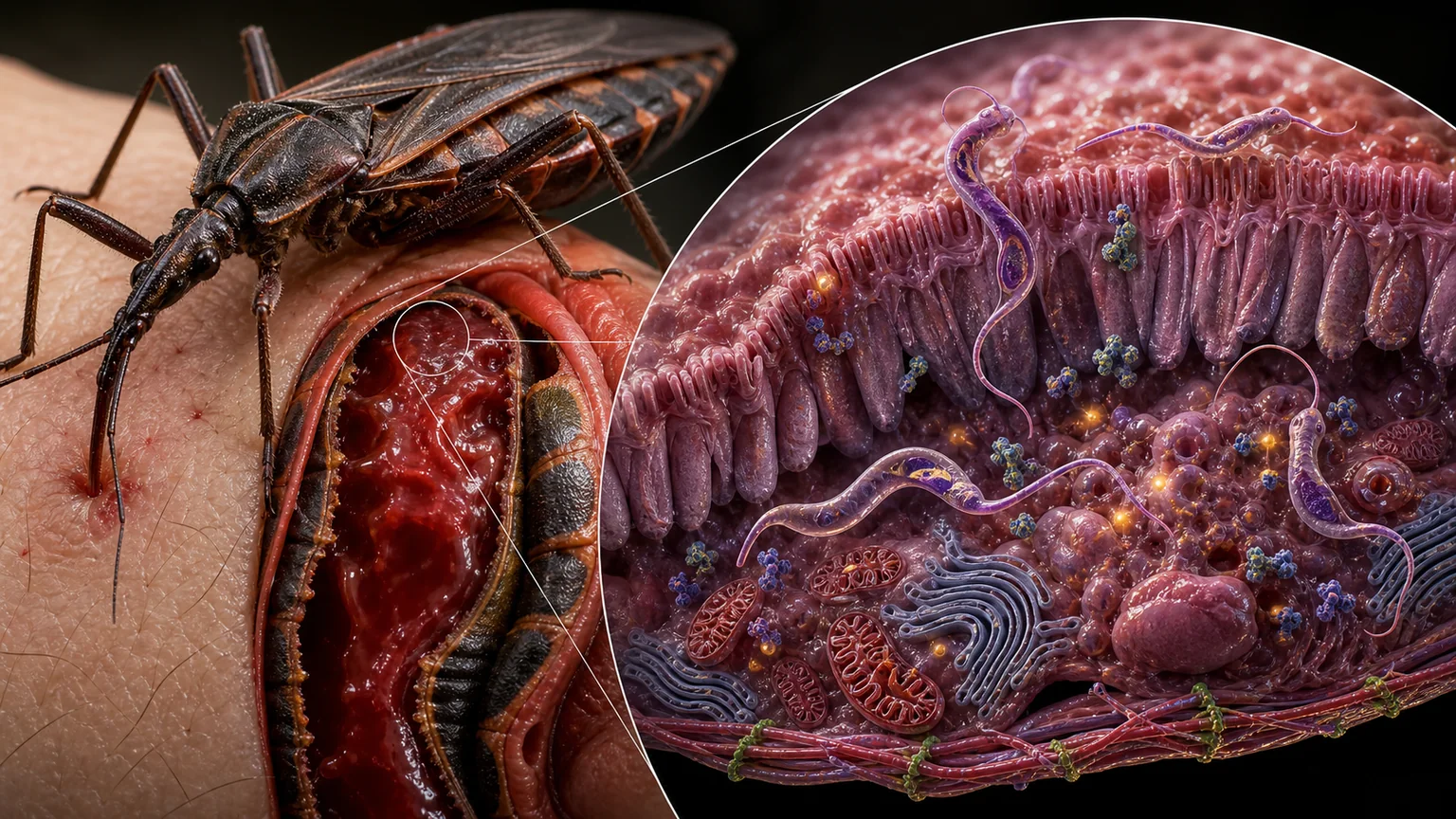
Rhodnius prolixus , an insect vector of Chagas disease, ingests blood meals several-fold its own body weight. This nutritional overload triggers specific adaptive responses that prevent or remediate damage from multiple stressors, including oxidative, osmotic, and microbial challenges. Transcriptomic analysis of first-instar nymph digestive apparatus revealed five members of the small Heat Shock Protein (sHSP) family that were highly expressed after blood meals but were downregulated upon Trypan

Rhodnius prolixus , an insect vector of Chagas disease, ingests blood meals several-fold its own body weight. This nutritional overload triggers specific adaptive responses that prevent or remediate damage from multiple stressors, including oxidative, osmotic, and microbial challenges. Transcriptomic analysis of first-instar nymph digestive apparatus revealed five members of the small Heat Shock Protein (sHSP) family that were highly expressed after blood meals but were downregulated upon Trypanosoma cruzi infection. sHSPs are proteins involved in cellular homeostasis and stress responses. Simultaneous knockdown of all five sHSPs profoundly disrupted insect physiology, causing decreased actin filament network formation, interrupted peristalsis, blocked endoplasmic reticulum (ER) expansion, and reduced ER-mitochondria association, while increasing reactive oxygen species generation and inducing premature epithelial cell mitosis. This apparent loss of digestive apparatus homeostasis was recapitulated by trypanosome infection and, conversely, sHSPs silencing in infected insects increased parasite numbers. Taken together, our data reveal a paramount role for sHSPs in midgut cell homeostasis following blood meals and support the hypothesis that sHSPs expression down regulation represents an adaptive manipulation of the insect host by the parasite.

Read the original source →

Related Stories

Health & Medicine

PLASTID ENVELOPE ION CHANNELS (PEC1/2) link Ca 2+ and jasmonic acid signaling in plant cells.

Plants constantly encounter adverse environmental interactions. One organelle is particularly specialized in stress signaling and phytohormone synthesis: the plastid. Calcium (Ca 2+ ), a key second messenger, is known to intersect with cellular phytohormone signaling networks. While cytosolic Ca 2+ dynamics have been studied extensively, the physiological relevance of stromal Ca 2+ transients and the identity of channels mediating rapid Ca 2+ flux into plastids remain largely unexplored. In this

Continue reading
Health & Medicine

Detection of "hidden" mitotic crossovers by long-read DNA sequencing.

Mitotic crossovers in diploid organisms are usually detected by looking for loss of heterozygosity (LOH) for a marker. Assuming the crossover occurs between two duplicated chromatids, a single reciprocal crossover will result in two recombinant chromatids and two nonrecombinant chromatids. LOH will only be observed when a recombinant chromatid cosegregates with a nonrecombinant chromatid. Cells containing both recombinant chromosomes will not result in LOH. Below, we use long-range DNA sequencin

Continue reading
Health & Medicine

Amino acid homeostasis by CORVET/HOPS: A metabolic and stress resilience checkpoint for T cells.

Amino acid sufficiency is critical for T cell metabolic reprogramming, yet how T cells maintain amino acid homeostasis remains poorly defined. Here, we identify the CORVET and HOPS (CORVET/HOPS) tethering complexes as essential upstream regulators. In activated T cells, they sustain intracellular amino acid levels by promoting macropinocytosis to acquire extracellular nutrients. This function enables dual signaling outcomes: suppression of the integrated stress response (ISR) and activation of m

Continue reading
Health & Medicine

Bright monomeric fluorescent protein elite-niRFP704 for two-channel near-infrared STED nanoscopy.

The near-infrared (NIR) spectral region is attractive for live-cell imaging, due to low autofluorescence and reduced phototoxicity. Some phytochrome-derived fluorescent proteins absorb and emit fluorescence in the NIR, but have short fluorescence lifetimes and relatively low quantum yields, requiring higher laser powers thus limiting their usefulness for live-cell superresolution microscopy. Using the bacterial phytochrome miRFP703 as a template, we screened for variants with longer fluorescence

Continue reading
Health & Medicine

Quantitative nanoscale imaging shows peptide-MHC I complexes are monomeric and spatially regulated in human dendritic cells.

Major histocompatibility complex class I (MHC I) molecules present antigenic peptides to cytotoxic T cells, a process central to immune surveillance. However, the nanoscale spatial organization of peptide-MHC I (pMHC I) on human dendritic cells (DCs), key initiators of cytotoxic T cell responses, remains largely unexplored. Here, we combine high-affinity soluble T cell receptors with DNA-based point accumulation for imaging in nanoscale topography (DNA-PAINT) to quantitatively map and count defi

Continue reading