TAVR in Patients with Moderate Aortic Stenosis with At-Risk Features.
For patients with moderate aortic stenosis, current guidelines recommend clinical surveillance with echocardiographic assessment every 1 or 2 years. Whether transcatheter aortic-valve replacement (TAVR) will improve outcomes in these patients remains unknown. We conducted an international, open-label, randomized trial to evaluate whether TAVR will result in better outcomes than clinical surveillance among patients with moderate aortic stenosis with at least one at-risk feature (i.e., a symptom o
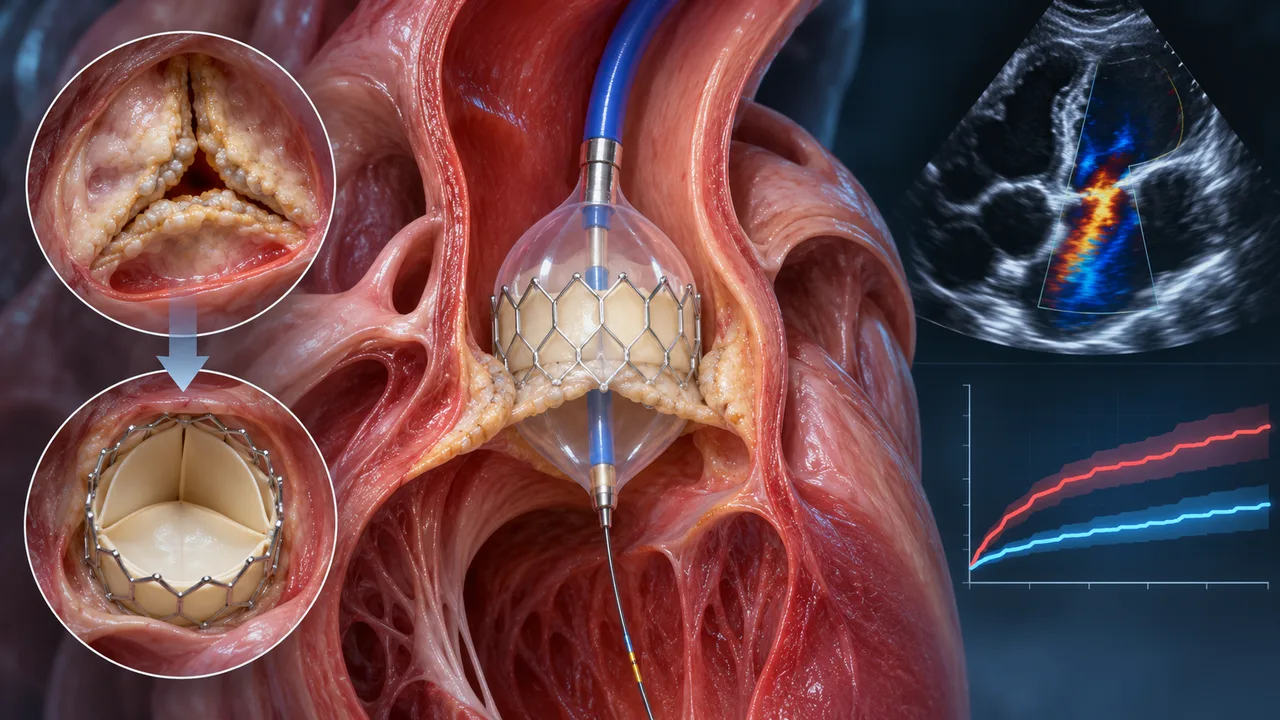
For patients with moderate aortic stenosis, current guidelines recommend clinical surveillance with echocardiographic assessment every 1 or 2 years. Whether transcatheter aortic-valve replacement (TAVR) will improve outcomes in these patients remains unknown. We conducted an international, open-label, randomized trial to evaluate whether TAVR will result in better outcomes than clinical surveillance among patients with moderate aortic stenosis with at least one at-risk feature (i.e., a symptom or structural or functional abnormality that has been shown to be associated with faster disease progression or adverse cardiovascular outcomes). The patients were assigned in a 1:1 ratio to undergo transfemoral TAVR with a balloon-expandable valve or clinical surveillance. The primary effectiveness end point was a composite of death from any cause or a heart-failure event with or without hospitalization at 2 years. Superiority testing was performed in the intention-to-treat population. A total of 744 patients underwent randomization: 373 patients were assigned to the TAVR group and 371 to the clinical-surveillance group. The mean age of patients was 78 years, 39.1% were women, and 45.6% were at low surgical risk. The mean aortic-valve area was 1.2 cm 2 , and the mean aortic-valve peak velocity was 3.3 m per second. At 2 years, the Kaplan-Meier estimate of the percentage of patients with a primary effectiveness end-point event was 16.7% in the TAVR group and 23.9% in the clinical-surveillance group (risk difference, -7.2 percentage points; 95% confidence interval, -13.1 to -1.3; P = 0.02 for superiority). The Kaplan-Meier estimate of the percentage of patients who died from any cause was 8.4% in the TAVR group and 7.3% in the clinical-surveillance group; the estimates for a heart-failure event were 10.8% and 19.0%, respectively. The incidence of procedure-related adverse events did not differ meaningfully between the patients in the TAVR group and those in the clinical-surveillance group who underwent aortic-valve replacement. Among patients with moderate aortic stenosis and at-risk features, a strategy of TAVR was superior to clinical surveillance in lowering the incidence of death or a heart-failure event at 2 years. (Funded by Edwards Lifesciences; PROGRESS ClinicalTrials.gov number, NCT04889872.).