One-Step Integration of Sulfonated Polymer Films with Separators for Shuttle Mitigation in Lithium-Sulfur Batteries.
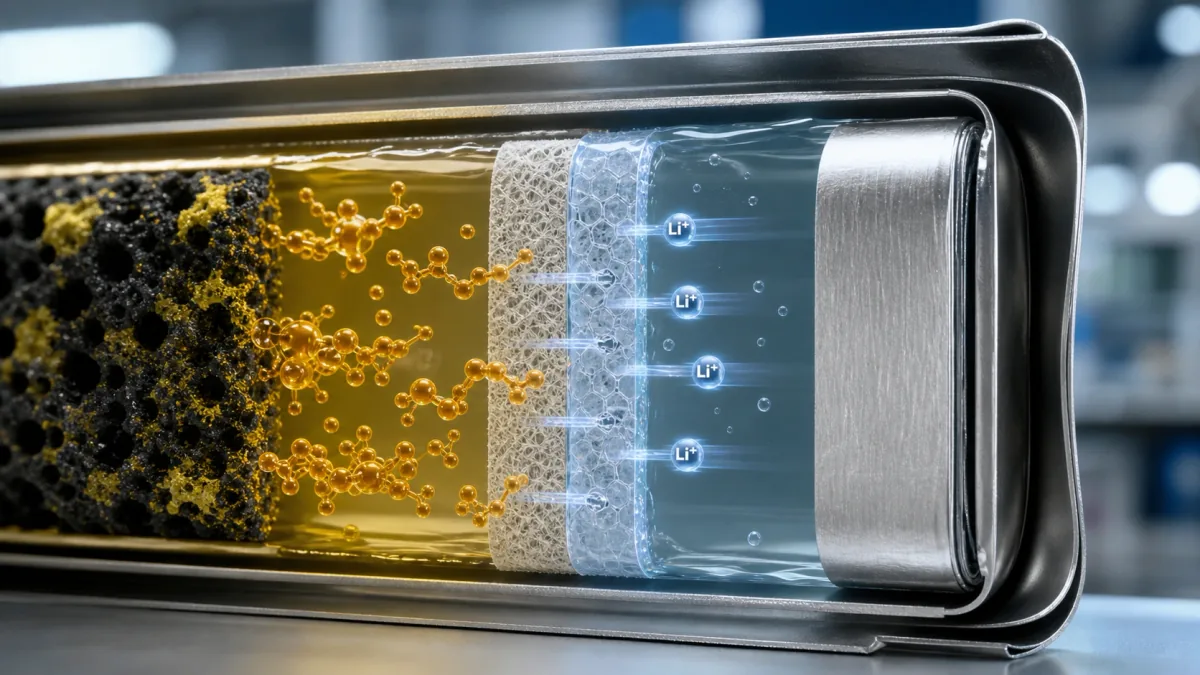
Interfacial polymerization (IP) offers a rapid and inexpensive method for fabricating thin polymer films. In this work, a one-step IP reaction between a triacyl chloride monomer and sulfonated diamine monomer is employed to add a dense, charge-selective sulfonated thin-film coating onto a commercial separator to improve selective transport in lithium-sulfur batteries. The coating effectively suppresses polysulfide shuttling, enhancing capacity retention, although at the expense of compromised ra
Interfacial polymerization (IP) offers a rapid and inexpensive method for fabricating thin polymer films. In this work, a one-step IP reaction between a triacyl chloride monomer and sulfonated diamine monomer is employed to add a dense, charge-selective sulfonated thin-film coating onto a commercial separator to improve selective transport in lithium-sulfur batteries. The coating effectively suppresses polysulfide shuttling, enhancing capacity retention, although at the expense of compromised rate performance due to hindered lithium conduction through the dense film. Fractional substitution of the trifunctionalized acyl chloride monomer for a difunctionalized analogue reduces the film cross-link density, which improves rate performance but decreases uniformity in film coverage. Uniform film coverage is achieved upon addition of a small fraction (0.25 wt %) of higher reactivity, nonsulfonated diamine in the IP reaction. This optimized thin film coating breaks the rate-capacity retention trade-off, enabling a capacity of 711.6 mAh g -1 after 200 cycles at 0.5C while still reaching over 800 mAh g -1 during rate testing at 2C.